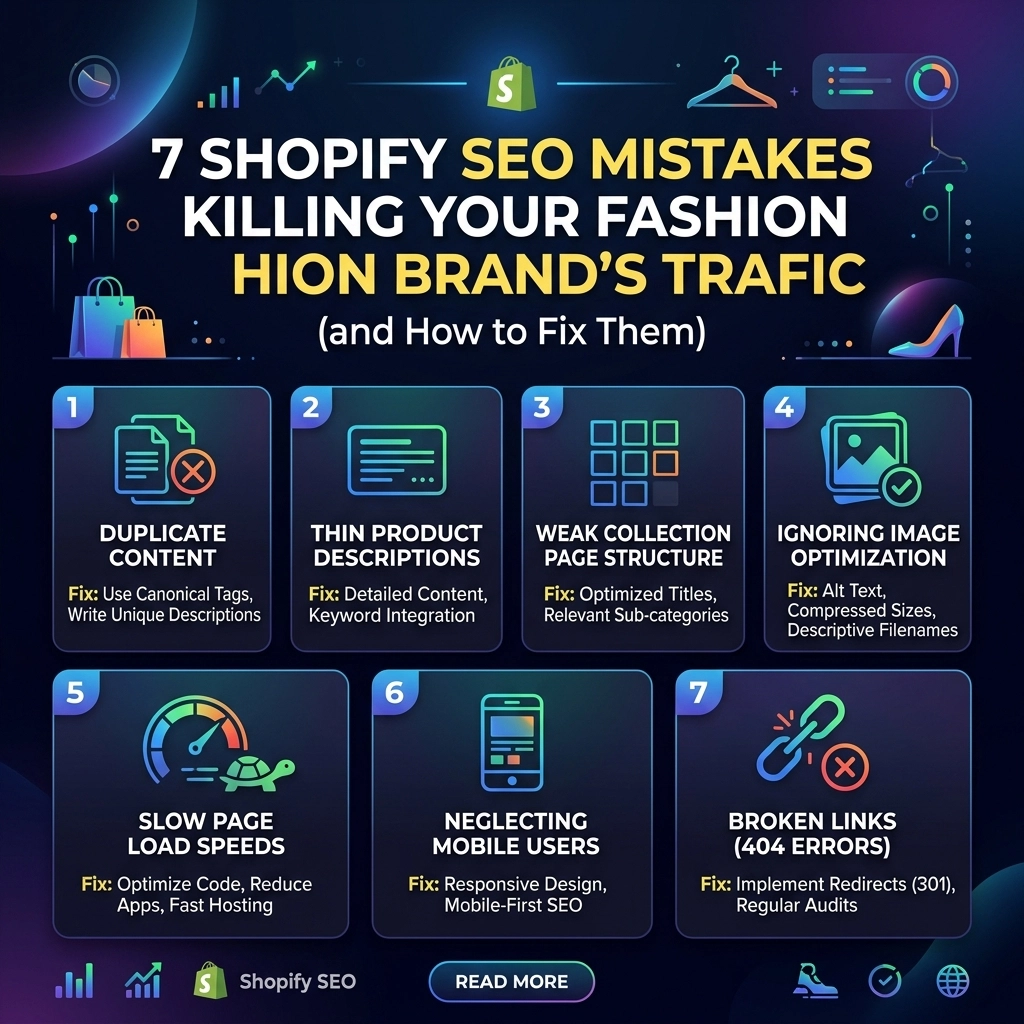
Scaling a D2C fashion brand in 2026 is no longer just about who has the biggest ad budget. With rising customer acquisition costs (CAC), organic traffic is the lifeblood of sustainable growth. You’ve built a stunning store, your designs are top-tier, and your Shopify website design is sleek: but if Google can’t find you, neither can your customers.
Many fashion founders treat SEO as an afterthought, a "nice-to-have" once they hit a certain revenue milestone. The truth? By the time you realize you need it, you’ve likely already lost thousands in potential sales to competitors who optimized from day one.
Let’s dive into the seven most common Shopify SEO mistakes currently killing your traffic and, more importantly, exactly how to fix them.
1. The "Ghost" Collection Pages
In the fashion world, shoppers rarely search for your specific SKU name. They search for categories: "oversized linen shirts," "sustainable gold hoops," or "minimalist streetwear hoodies."
The biggest mistake fashion brands make is focusing all their SEO energy on individual product pages while leaving their collection pages empty of content. On Shopify, collection pages are your highest-earning assets.
The Fix:
Treat your collection pages like landing pages. Add 200–300 words of high-quality, keyword-rich copy at the bottom of the page (or a short snippet at the top). Use this space to describe the fit, the fabric, and the vibe of the collection. This helps Google understand the context of the products within that category.

2. Copy-Pasting Manufacturer Descriptions
If you are a multi-brand boutique or using specific fabric technicalities from a supplier, do not copy and paste their descriptions. Google hates duplicate content. If ten different stores use the exact same description for a pair of denim jeans, Google will likely only rank the one with the highest domain authority: usually a giant retailer like Amazon or Nordstrom.
The Fix:
Write original, brand-aligned copy for every single product. Focus on the "why" and the "how it feels" rather than just the "what." Instead of "100% Cotton Tee," try "Our signature heavyweight cotton tee, designed to maintain its shape wash after wash." This doesn't just help SEO; it’s a core pillar of Conversion Rate Optimization (CRO).
3. High-Res Images Without Optimization
Fashion is a visual industry. You want your high-res editorial shots to look crisp. However, uploading 5MB JPEGs directly to Shopify is a recipe for a slow site. Page speed is a direct ranking factor in 2026. If your site takes more than 3 seconds to load on a mobile device, your bounce rate will skyrocket, and your rankings will tank.
The Fix:
- Compress everything: Use tools to shrink file sizes without losing quality.
- Rename your files: Change "IMG_5678.jpg" to "womens-charcoal-wool-overcoat.jpg" before uploading.
- Alt Text is non-negotiable: Describe the image for search engines and accessibility. "Model wearing a charcoal wool overcoat with a silk scarf" is a perfect example of descriptive alt text.
4. The Broad Keyword Trap
Many D2C brands try to rank for massive, high-volume keywords like "dresses" or "shoes." Unless you have a million-dollar SEO budget, you won't outrank the giants for those terms.
The Fix:
Go long-tail. Focus on specific, high-intent keywords that describe your niche. If you sell jewelry, don't just target "gold rings." Target "hand-crafted 14k gold stacking rings" or "waterproof gold jewelry for travel." These terms have lower search volume but much higher conversion rates because the user knows exactly what they want.
Pro Tip: Use Shopify SEO services to identify these "hidden gem" keywords that your competitors are overlooking. Start small, stay creative.

5. Broken Internal Linking (The "Silo" Effect)
Google crawls your site by following links. If your blog posts don't link to your products, or your products don't link back to relevant collections, you are creating "dead ends." This makes it harder for Google to index your pages and harder for customers to discover your catalog.
The Fix:
Create a spiderweb of internal links.
- Link to your "New Arrivals" collection from your homepage.
- In a blog post about "Summer Styling Tips," link directly to the products mentioned.
- Use "You May Also Like" sections on product pages to keep users (and crawlers) moving through your site.
6. Neglecting the Power of Blogging
Most fashion brands treat their blog like a graveyard for lookbook images. While visuals are great, search engines need text to understand your authority. If you aren't blogging, you are missing out on the "Discovery" phase of the customer journey.
The Fix:
Create content that answers customer questions.
- "How to style a blazer for a casual brunch."
- "The best eco-friendly fabrics for summer 2026."
- "5 ways to transition your wardrobe from day to night."
This type of content builds trust and captures users who are looking for inspiration, not just a specific product.

7. Ignoring the Mobile Shopping Experience
Over 70% of fashion e-commerce traffic comes from mobile devices. If your Shopify website design isn't mobile-first, you’re losing money. Google uses mobile-first indexing, meaning it looks at your mobile site version to determine your ranking.
The Fix:
Test your store on multiple devices. Ensure buttons are easy to click, text is legible without zooming, and pop-ups aren't blocking the entire screen. A seamless mobile experience is a major signal to Google that your brand is high-quality and user-focused.
Challenges of Shopify SEO for Fashion
Managing SEO for a fashion brand isn't without its hurdles. Unlike a static service site, fashion stores have high turnover. Products go out of stock, collections are seasonal, and trends shift overnight.
| Challenge | Impact | How to Navigate |
|---|---|---|
| Out-of-stock items | 404 errors and lost rankings | Redirect out-of-stock URLs to the parent collection page. |
| Seasonal turnover | Content becomes irrelevant quickly | Update old blog posts with new product links rather than deleting them. |
| Large Catalogs | Can cause "Crawl Budget" issues | Prioritize your best-sellers for deep optimization. |
Pros and Cons: DIY vs. Professional SEO
DIY SEO:
- Pros: Zero cost (other than time), you learn the "guts" of your business.
- Cons: Extremely time-consuming, steep learning curve, easy to make technical mistakes that hurt rankings.
Professional Shopify SEO Services:
- Pros: Expert strategy, faster results, technical issues solved instantly, allows you to focus on design and production.
- Cons: Requires an upfront investment.
Key Insight: For brands doing over $10k/month, the ROI on professional SEO usually pays for itself within 3–6 months through reduced ad spend and higher organic margins.

Your 2026 SEO Implementation Checklist
Never ever think of giving up on organic growth. It takes time, but the compounding effect is unmatched. Follow these steps to start fixing your store today:
- Audit your Collections: Add at least 150 words of unique text to your top 5 collections.
- Optimize Images: Download a Shopify app to bulk-compress images and automate alt text.
- Fix Your Headers: Ensure every page has one (and only one) H1 tag that includes your primary keyword.
- Create a Content Calendar: Commit to one "How-to" style blog post per week.
- Check Your Speed: Run a Google PageSpeed Insights report and remove any unused Shopify apps.
- Update Your Metadata: Ensure every product has a unique meta title and description: don't let Shopify default to your product name.
- Review Mobile UX: Place a test order on your phone and note any friction points.
Scaling Your Brand with Thriftizer
SEO is a marathon, not a sprint. If you’re ready to stop guessing and start growing, we’re here to act as your co-pilot. At Thriftizer, we specialize in high-growth strategies for D2C fashion and beauty brands.
Whether you need a complete overhaul of your Shopify website design or targeted SEO strategies that actually move the needle, our team of experts is ready to help. Check out our Shopify Expert profile to see how we’ve helped other fashion brands dominate the search results.
Next Step: Identify your three worst-performing product pages and rewrite their descriptions today. Start small, stay consistent, and watch your traffic transform.