Let’s be honest: the digital landscape in 2026 is louder than ever. If you’re running a D2C brand in the fashion, beauty, or jewelry space, you’ve probably felt the squeeze. Ad costs are climbing, social media algorithms are unpredictable, and the "quick win" hacks of five years ago just don't move the needle anymore.
You’ve likely asked yourself: Does Shopify SEO really matter in 2026?
The short answer is yes, but not in the way it used to. SEO isn't just about "ranking for keywords" anymore. It’s about building a repeatable growth system that captures high-intent customers while your competitors are busy burning their margins on expensive PPC campaigns.
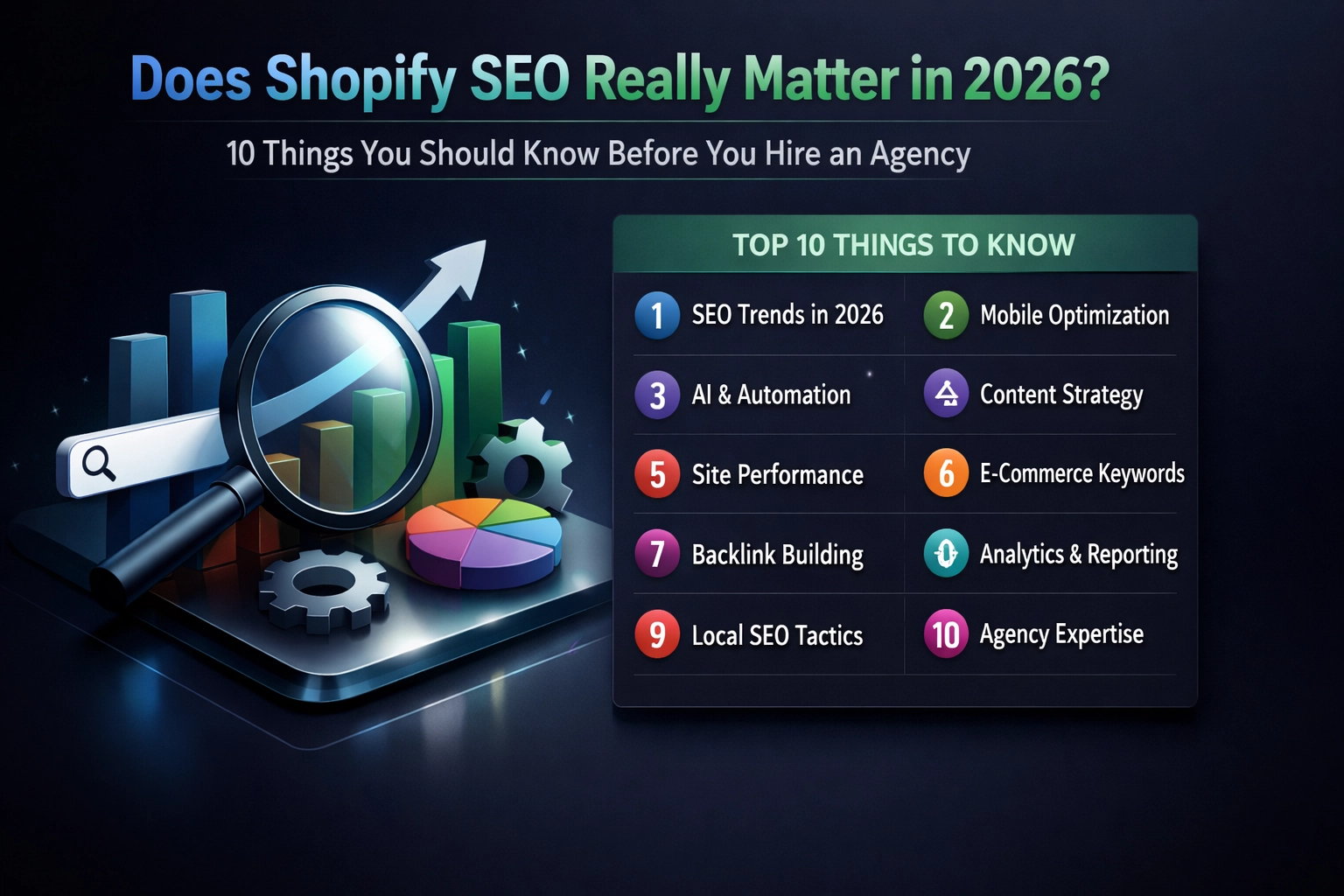
Before you sign a contract with a Shopify agency, you need to understand how the game has changed. Here are the 10 things you must know to ensure your investment leads to actual scaling, not just a fancy report of "vanity metrics."
Layer 1: Discovery (The Technical Engine)
In the Discovery phase, your goal is to ensure search engines can actually find, crawl, and understand your store. If your technical foundation is shaky, no amount of pretty product photos will save you.
1. Indexing and Structure Trump "Best Practices"
In 2026, simply having a sitemap isn't enough. Search engines are more selective about what they index to save on "crawl budget." A professional Shopify expert knows that your store’s architecture, how your collections link to products and how your navigation is nested, is the primary signal of relevance.
If your site structure is a mess of "tag" pages and duplicate content, you're essentially invisible. You need a clean, logical hierarchy that tells search engines exactly what you sell and why it matters.
2. Speed is a Revenue Metric, Not Just a Technical One
We’ve moved past the era where a 3-second load time was "okay." In 2026, site speed is a direct ranking factor and a massive conversion killer. For fashion and beauty brands with high-res imagery, this is a constant battle.
When conducting a Shopify audit, look for "Interaction to Next Paint" (INP) scores. It's not just about how fast the page loads; it's about how responsive it feels when a user clicks a "Buy Now" button. High-performance stores use optimized image formats and lean code to stay ahead.

3. Mobile-First is the Only Index
If your store isn't optimized for a flawless mobile experience, you are losing. Search engines now primarily evaluate the mobile version of your site. For streetwear and jewelry brands, where the majority of discovery happens on mobile devices during "scroll-time," this is non-negotiable. Your Shopify SEO services should focus on mobile usability, touch-target spacing, and mobile-specific speed optimizations.
Pro Tip: Don't just check your site on an iPhone. Test it on mid-range Android devices. That’s where you’ll find the real performance bottlenecks.
Layer 2: Trust (The Authority Builder)
Once you’re discoverable, you have to prove you’re a legitimate brand. In 2026, search engines prioritize stores that demonstrate Experience, Expertise, Authoritativeness, and Trustworthiness (E-E-A-T).
4. Quality Backlinks Over Quantity
The days of buying 500 directory links for $50 are long gone. In fact, doing that in 2026 will likely get your store penalized. Today, authority is built through genuine brand mentions.
Think digital PR, high-end fashion blog features, and partnerships with industry leaders. When a reputable jewelry magazine links to your collection, it sends a massive trust signal to search engines. A top-tier Shopify agency focuses on earning these "power links" rather than chasing volume.
5. Structured Data is Your Secret Weapon
Have you noticed how some search results show star ratings, prices, and stock levels directly on the results page? That’s Schema Markup (Structured Data). Shopify doesn't always handle this perfectly out of the box.
By injecting specific code into your product and review pages, you help search engines display "rich snippets." This significantly increases your click-through rate (CTR) because it builds immediate trust with the shopper before they even click your link.
6. The "Human" Factor in Content
Search engines are getting incredibly good at spotting AI-generated fluff. While AI is a great co-pilot for brainstorming, your brand's voice must be human. For a beauty brand, this means showing real results, featuring expert advice from aestheticians, and sharing authentic customer stories. Real expertise creates a moat around your brand that robots can't replicate.
Layer 3: Intent (The Conversion Engine)
SEO is useless if it brings the wrong people to your store. You need to capture shoppers at the moment they are ready to pull out their credit cards.
7. Collection Pages are Your Profit Centers
Most D2C brands spend all their energy on the homepage or individual product pages. But for SEO, Collection Pages are the real heavy hitters.
Think about it: someone searching for "oversized sustainable hoodies" doesn't want to land on a single product; they want to see your entire range. Your collection pages should be treated as "mini-homepages," complete with optimized headers, descriptive copy, and internal links that guide the user (and the search engine) through your catalog.

8. Target Buyer Intent, Not Just Keywords
Generic keywords like "shoes" are impossible to rank for and rarely convert. In 2026, successful brands target "long-tail" keywords that signal high intent.
- Low Intent: "Skincare"
- High Intent: "Organic vitamin C serum for sensitive skin"
By focusing your Shopify SEO services on these specific queries, you're attracting customers who have already decided what they want: they’re just looking for someone to buy it from.
9. Blogging with a Purpose (Topic Clusters)
Don't just blog for the sake of blogging. Use your blog to create "Topic Clusters." If you sell high-end watches, write about "How to care for automatic movements" or "The history of dive watches."
These articles support your main commercial pages by building topical authority. When you link from an informative blog post to a product page, you’re passing "link equity" and telling search engines, "We aren't just selling products; we are experts in this field."
Layer 4: Decision (Hiring Your Partner)
The final step is choosing who will help you execute this system. This is where most brands make their biggest mistake.
10. System-Based Growth vs. One-Off Tasks
Many agencies offer "SEO packages" that include a set number of blogs and links per month. This is a red flag. SEO in 2026 requires a dynamic, system-based approach.
You need a partner who understands the intersection of technical performance, content strategy, and user experience (UX). You aren't just looking for someone to "do SEO"; you’re looking for a Shopify expert who can integrate into your growth strategy and treat your store as a living, breathing ecosystem.
Key Insight: A great agency won't promise you "Rank #1 in 30 days." They will talk about sustainable traffic growth, conversion rate improvements, and long-term brand equity.
Challenges to Expect
While the rewards are massive, Shopify SEO in 2026 isn't without its hurdles:
- App Bloat: Every new app you add to your Shopify store can slow it down and create code conflicts.
- Algorithm Volatility: Search engines update their logic constantly. You need a strategy that is resilient to these shifts.
- Content Saturation: There is a lot of noise out there. Standing out requires genuine creativity and a unique brand perspective.
Start small, stay creative. You don't need to fix everything overnight. Focus on your technical foundation first, then move to your collection pages.
Your 2026 Shopify SEO Checklist
If you’re ready to stop guessing and start growing, follow these next steps to prepare your store for the future:
- Run a Professional Audit: Don't rely on free online tools. Get a comprehensive Shopify audit that looks at your code, speed, and architecture.
- Clean Up Your Redirects: Ensure you don't have broken links (404 errors) dragging down your site's health.
- Optimize Your Top 5 Collections: Add unique, helpful content to your best-selling categories.
- Audit Your App List: Remove any Shopify apps you aren't actively using to boost your site speed.
- Check Your Mobile UX: Spend 15 minutes trying to buy something from your own store using an old mobile phone. Fix the friction points.
- Partner with the Right Experts: Look for a team that understands the nuances of the Shopify platform.
At Thriftizer, we don’t believe in "one-size-fits-all" marketing. We build custom growth engines for D2C brands that want to scale without losing their soul. Whether you need a technical deep dive or a full-scale SEO strategy, our team of Shopify experts is here to help you navigate the complexities of 2026.
Ready to see what's actually holding your store back? Visit Thriftizer and let’s build something that lasts. Never ever think of giving up on organic growth: it’s the most valuable asset your brand can own.