You’ve built a brand. Your beauty palettes are pigmented to perfection, or your streetwear drops are selling out in minutes. You’re doing "okay," but "okay" isn't why you started this. You want to scale. You want to hit those mid-seven or eight-figure milestones, yet every time you pump more money into ads, your profit margins do a vanishing act.
It feels like you’re driving a Ferrari with the handbrake on.
In 2026, the D2C landscape is more crowded than a sample sale in Soho. If your store isn't scaling, it’s rarely a "marketing" problem; it’s usually a systemic one. Before you fire your media buyer or double your ad spend, you need to look under the hood.
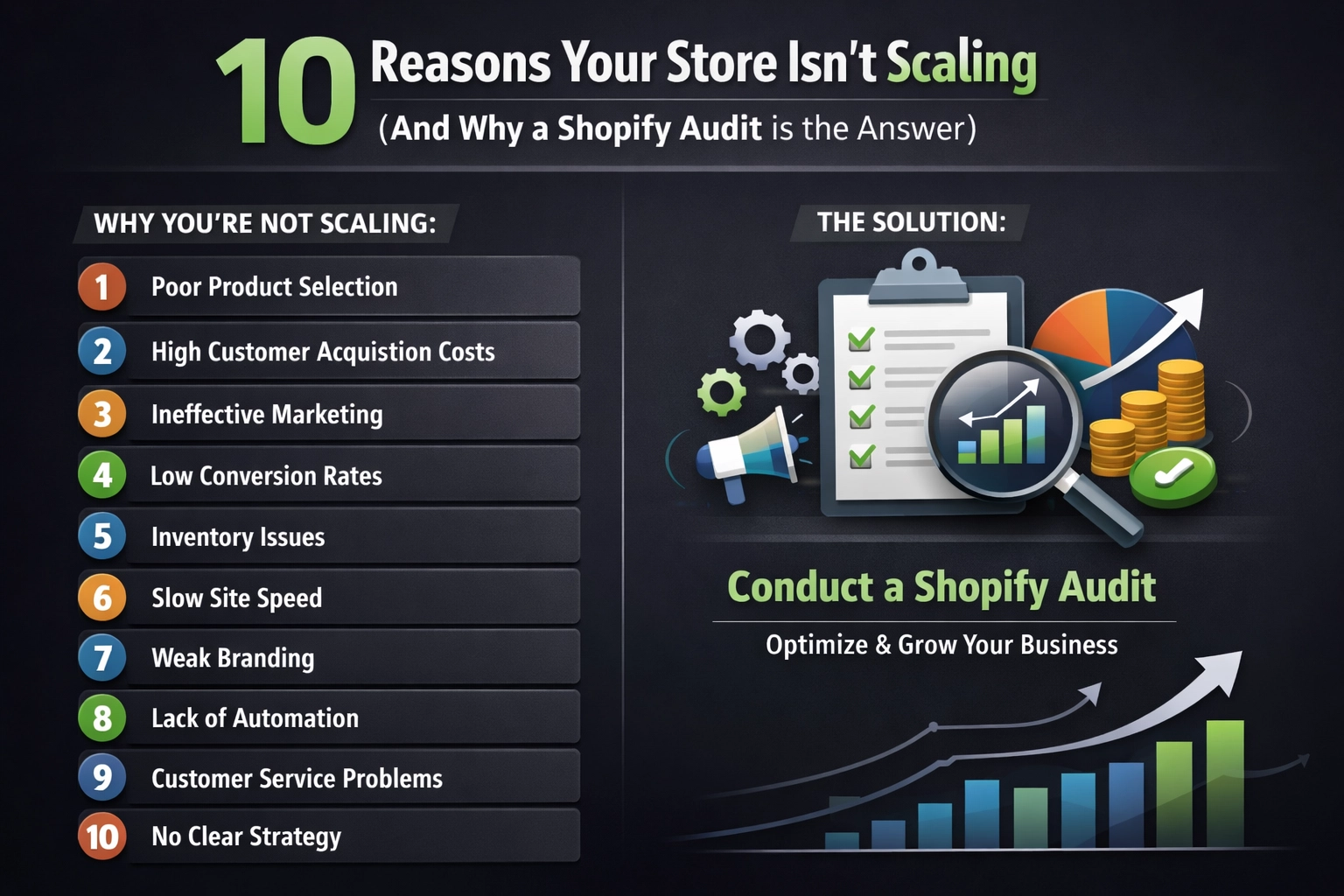
Here are the 10 reasons your Shopify store is stuck in neutral: and why a systemic Shopify audit is the only way to release the brake.
1. The "App Graveyard" is Killing Your Speed
We’ve all been there. You see a cool feature on a competitor’s site and think, "I need that!" Three minutes later, you’ve installed a new app. Fast forward a year, and your store is bloated with 30+ apps, half of which you don't even use.
Each app injects scripts into your theme. These scripts fight for attention like toddlers at a birthday party, causing your load times to plummet. In the world of fashion and beauty, where visual storytelling is everything, a slow site is a death sentence. Shopify speed optimization isn't just about passing a test; it’s about keeping a customer from bouncing back to Instagram before your hero image even loads.
Pro Tip: Every 100ms delay in load time can decrease conversions by 7%. Audit your apps monthly. If it doesn’t directly contribute to UX or Revenue, delete it.
2. Technical Debt and "Spaghetti Code"
If you’ve had multiple developers "tweak" your store over the years, your liquid files probably look like a bowl of spaghetti. This technical debt makes it impossible to launch new features quickly. When your code is messy, even a small change can break your entire checkout flow.
A professional Shopify audit identifies these hidden conflicts. It’s about moving from a "patched-together" store to a high-performance machine that can handle the traffic spikes of a viral TikTok moment.

3. High Customer Acquisition Cost (CAC) vs. Anemic LTV
Throwing money at social media ads is easy. Making that money back is the hard part. If you’re a makeup brand selling a $25 lipstick but spending $20 to acquire that customer, you’re not scaling; you’re subsidizing the ad platforms.
Scaling requires a system that prioritizes Lifetime Value (LTV). If your store doesn't have a systemic way to cross-sell, up-sell, or re-engage customers via automated workflows, you’re stuck on the "acquisition treadmill."
4. The Silent Killer: Checkout Friction
You’ve done the hard work. They found you, they liked the clothes, they added to the cart… and then they vanished.
Why? Maybe your shipping costs were a surprise. Maybe you asked for their phone number twice. Or maybe your mobile checkout UI feels like it was designed in 2012. Friction at the finish line is the most expensive mistake you can make. A systemic audit looks at the "Decision Pillar": ensuring that once a customer decides to buy, nothing gets in their way.
5. Mobile UX is an Afterthought
For apparel and jewelry brands, 80-90% of your traffic is likely mobile. Yet, many founders still manage their stores from a 27-inch desktop monitor. If your "Add to Cart" button is below the fold or your navigation menu is a labyrinth, your mobile shoppers will quit.
Key Insight: Scaling in 2026 requires a mobile-first philosophy. Your site shouldn't just be "responsive"; it should be designed for thumbs, not mouse clicks.

6. Overburdened Customer Support
As you scale from 50 orders a day to 500, your support tickets don't just grow: they explode. If your team is manually answering "Where is my order?" (WISMO) emails all day, they aren't helping you grow.
Scaling requires automated systems. From AI-driven helpdesks to self-service tracking portals, your operations must be built to handle volume without adding infinite headcount.
7. The Return Rate Trap
In the fashion world, returns are a silent profit eater. If your size guides are confusing or your product photos use filters that distort colors, your return rate will skyrocket as you scale.
A systemic audit looks at the "Trust Pillar." Are you providing enough information to ensure the customer gets it right the first time? Accurate descriptions, UGC (User-Generated Content), and video reviews are essential tools to lower return rates and protect your margins.
8. Inventory Ghosting and Out-of-Stock Loops
There is nothing more frustrating than running an ad for a product that is out of stock. Or worse, having "Ghost Inventory" where the site says it's available, but the warehouse is empty.
Without a tight integration between your Shopify store and your inventory management system, scaling will lead to overselling, unhappy customers, and potential bans from payment gateways.
9. Lack of "Trust Signals"
In beauty and skincare, trust is the primary currency. If your site looks "scammy" or lacks clear social proof, shoppers will hesitate.
- Do you have an "About Us" page that tells a story?
- Is your SSL certificate prominent?
- Are your reviews authentic?
If the answer is "I think so," you need an audit. Trust is a system, not a badge. You can learn more about building brand authority on our About Page.

10. Data Blindness: You’re Guessing, Not Growing
Many founders scale based on "vibes." They "feel" like the New Year's campaign worked. In 2026, vibes don't pay the bills. If you aren't tracking your conversion rate by device, your bounce rate by landing page, and your net profit after all fees, you’re flying blind.
A Shopify agency doesn't just look at the design; they look at the data. They find the leaks in your bucket so you can stop pouring water (and money) into a broken system.
Why a "Systemic Audit" is the Answer
Most audits are just a checklist of "fix this broken link" or "add a meta tag." A systemic audit is different. At Thriftizer, we look at your store as an interconnected ecosystem.
We break it down into four key layers:
- Discovery: How are people finding you, and is the landing experience seamless?
- Trust: Does your brand look like a leader in the beauty or fashion space?
- Intent: Is the product information clear enough to drive a "Yes"?
- Decision: Is the checkout fast, local, and frictionless?
By identifying the bottlenecks in these four areas, we don't just fix your store; we prepare it for the next level of growth. Whether it's Shopify speed optimization or a total UX overhaul, the goal is a profitable, scalable business.

The Challenges of Doing It Alone
- Objectivity: It’s hard to see the flaws in your own "baby."
- Technical Depth: You might know marketing, but do you know how to optimize a database call?
- Time: Every hour you spend trying to fix a CSS bug is an hour you aren't spent on product innovation or brand vision.
Never ever think of giving up just because things feel stagnant. Sometimes, the solution is simply a fresh set of expert eyes.
Next Steps: Transition from Consumption to Implementation
If you’re ready to stop guessing and start scaling, here is your action plan:
- Perform a "Speed Test": Use a tool to see your real-world mobile load times. If it's over 3 seconds, you have work to do.
- Audit Your Apps: Delete anything you haven't used in the last 30 days.
- Ghost Your Own Checkout: Try to buy a product on your phone using a weak data signal. Note every point of frustration.
- Check Your Unit Economics: Calculate your true profit after COGS, Shipping, Marketing, and Shopify fees.
- Hire a Professional: If you're serious about reaching the next tier, it’s time to work with a dedicated Shopify agency.
Scaling is a science, not a secret. By fixing the foundational bottlenecks in your store, you create a platform that doesn't just survive traffic: it thrives on it.
Ready to see what's actually holding you back? Check out our Shopify Expert profile and let's build something systemic. Start small, stay creative, and let the data lead the way.
Your brand deserves to grow. Don't let a hidden bottleneck stand in the way.