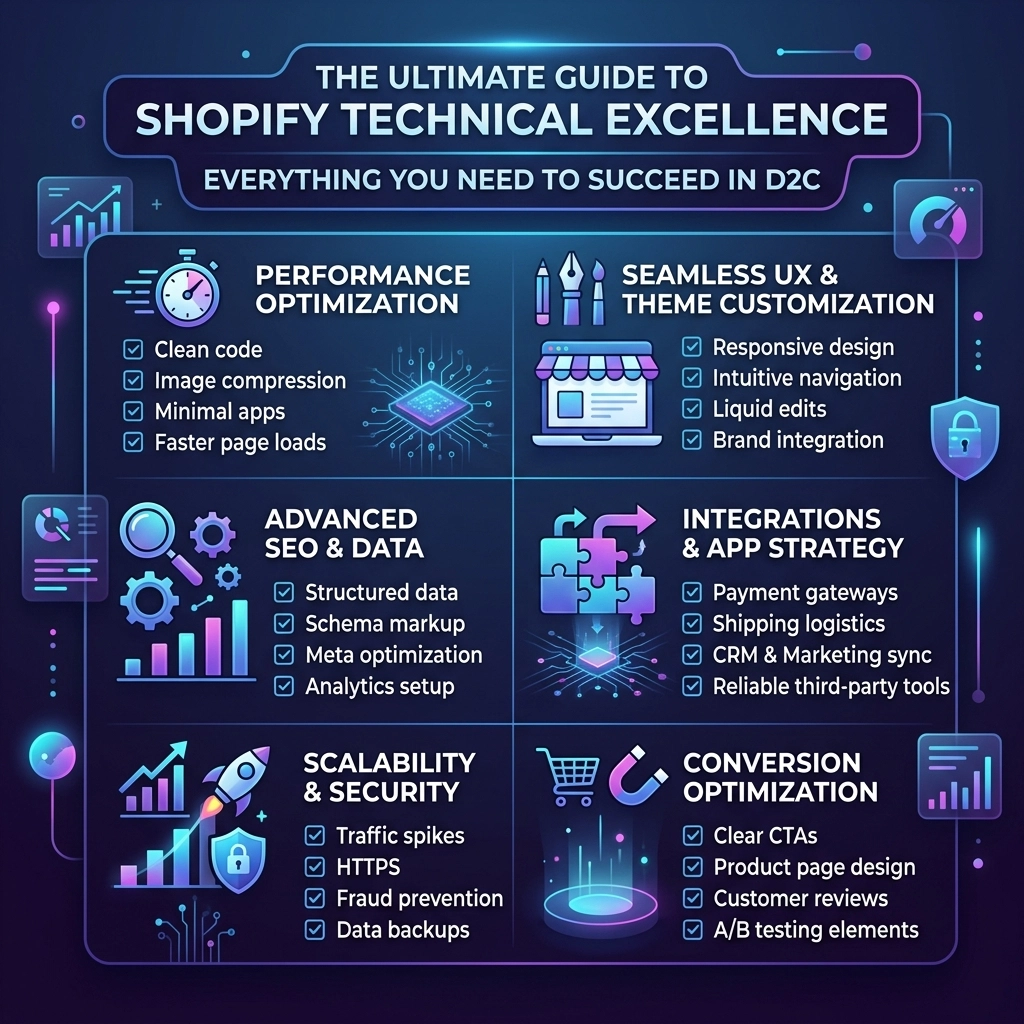
Scaling a Direct-to-Consumer (D2C) brand in 2026 isn't just about having a great product or a massive ad budget. It’s about technical resilience. In a world where a 100-millisecond delay in page load can cost you thousands in lost revenue, your Shopify store needs to be more than just "functional": it needs to be a high-performance machine.
Whether you are running a high-growth streetwear label or a luxury jewelry boutique, the gap between "good" and "excellent" is found in the backend. This guide breaks down the pillars of Shopify technical excellence to help you save time, increase conversion rates, and build a brand that scales effortlessly.
1. The Infrastructure: Choosing Your Shopify Engine
The first step toward technical excellence is ensuring your foundation can support your weight. For high-growth fashion and beauty brands, the choice usually boils down to Shopify Plus vs. Advanced Shopify.
Why Shopify Plus is the D2C Gold Standard
If your brand is doing significant volume, the native automation and customization capabilities of Shopify Plus are non-negotiable.
- Customizable Checkout: Plus allows you to modify the
checkout.extensibility(formerly checkout.liquid), which can reduce cart abandonment by 20–35% through personalized upsells and trust signals. - Unlimited API Access: Essential for connecting your ERP, WMS, and custom marketing tools without hitting rate limits.
- Shopify Flow: This is your secret weapon for operational efficiency, potentially saving your team 15–30 hours of manual work every single week.
Pro Tip: If you are planning a major product drop: common in the streetwear niche: Shopify Plus’s Launchpad allows you to schedule theme changes, price adjustments, and automation triggers in advance. This ensures your site doesn't break under the pressure of a 10:00 AM hype launch.
2. Shopify Speed Optimization: The Silent Conversion Killer
You can have the most beautiful jewelry photography in the world, but if the page takes five seconds to load, your customers are gone. Speed is the most critical component of Shopify development today.
The Technical Audit Checklist
To achieve a sub-3-second load time, you must address these three areas:
- Image Compression & WebP Conversion: Large hero images are the primary culprits in fashion D2C. Use modern formats like WebP and implement "lazy loading" for images below the fold.
- App Audit: Every app you install adds a "script tag" that slows down your site. If an app isn't driving direct ROI, delete it. Even after deletion, check your
theme.liquidfile for "ghost code" left behind. - Minify Liquid and JavaScript: Clean code is fast code. A professional Shopify agency will often rewrite clunky app-provided features into native Liquid code to reduce dependency on external scripts.

Key Insight: Speed isn't just for users; it's for Google. Faster sites rank higher. If you're wondering why your site isn't showing up, it might be a technical crawl issue. Read more about how fast Google indexes your site to understand the connection between performance and visibility.
3. Custom Development: Moving Beyond Templates
Standard themes are great for starting out, but high-growth brands eventually hit a "template wall." To stand out in the crowded beauty and fashion space, you need custom Shopify development.
Liquid vs. Hydrogen (Headless)
Most brands thrive on Liquid, Shopify’s native templating language. It is robust, SEO-friendly, and easy to maintain. However, if you want a truly unique, app-like experience with complex transitions, you might consider Hydrogen, Shopify’s React-based framework for headless commerce.
The Pros and Cons of Going Headless:
- Pros: Total creative freedom, lightning-fast transitions, and a decoupled frontend.
- Cons: Higher development costs, loss of some "plug-and-play" app functionality, and increased complexity.
Start small, stay creative. You don't always need to go full headless. Customizing your existing Liquid theme with unique product page modules or an interactive "Find Your Fit" quiz can offer the same premium feel at a fraction of the cost.
4. Automation: Your Operational Co-Pilot
Efficiency is the name of the game. If your team is still manually tagging orders or emailing customers about out-of-stock items, you are wasting human potential.
Essential Shopify Flow Workflows
- Inventory Alerts: Automatically unpublish a product when stock hits zero and send a Slack notification to your production team.
- High-Value Customer Tagging: When a customer spends over a certain threshold, tag them as "VIP" to trigger exclusive email flows in Klaviyo.
- Fraud Prevention: Set rules to hold orders that show high-risk signals, saving you from costly chargebacks.

By treating automation as a "co-pilot," you free up your creative team to focus on brand storytelling and product design rather than spreadsheets. For those looking to take automation even further, exploring AI-driven workflows can provide a significant edge in customer service and content creation.
5. Technical SEO for D2C Growth
SEO for Shopify isn't just about keywords; it's about site architecture. For fashion brands with thousands of SKUs and variants, managing "crawl budget" is essential.
The Pillars of Shopify SEO Excellence
- Structured Data (Schema): Ensure your product schema is perfect. This allows Google to show your price, availability, and star ratings directly in the search results (Rich Snippets).
- Sitemap Management: Regularly check your sitemap.xml to ensure no "dead" pages or "noindex" tags are hurting your visibility.
- Collection Page Logic: Avoid duplicate content issues caused by Shopify's default URL structure (e.g.,
/products/blue-shirtvs/collections/mens/products/blue-shirt). Use canonical tags to tell Google which version is the "master" copy.
6. Data Intelligence & Personalization
In 2026, the brands that win are the ones that use their data. Shopify’s unified data model allows you to see exactly how your customers behave across different channels.
Leveraging AI and LLMs
Custom chatbots and recommendation engines are no longer "futuristic": they are expected. Implementing LLM-based chatbots can help customers find the right size or style instantly, significantly boosting conversion rates for jewelry and apparel brands where "fit" is a major concern.
Pro Tip: Use a recommendation engine like Rebuy or Nosto to create "Frequently Bought Together" sections. This simple technical addition can increase your Average Order Value (AOV) by 15-20% almost overnight.

Challenges to Anticipate
Technical excellence isn't a one-time project; it’s a continuous process. You will face challenges:
- App Fatigue: The temptation to solve every problem with a $10/month app. Resist this. Every app is a technical debt.
- The Mobile Gap: Most developers work on desktops, but 80% of your fashion customers shop on mobile. Always test your custom features on a phone first.
- Scaling Pains: What works for 100 orders a day might break at 10,000. Regularly stress-test your integrations and third-party logistics (3PL) syncs.
Your Implementation Checklist: Next Steps
Ready to transition from consumption to implementation? Follow these steps:
- Run a Speed Audit: Use Google PageSpeed Insights and identify the top three scripts slowing you down.
- App Purge: Delete any app you haven't used in the last 30 days. Clean up the residual code.
- Optimize Images: Ensure every image on your homepage is under 200kb and served in WebP format.
- Set Up One Flow: Create a Shopify Flow that automates a task you currently do manually (like tagging high-value orders).
- Review SEO: Check your sitemap for errors and ensure your product titles follow a consistent, keyword-rich format.
- Partner with Experts: If the technical side feels overwhelming, don't go it alone. Reach out to a specialized Shopify agency that understands the nuances of D2C growth.

Conclusion: Never Ever Think of Giving Up
Building a technically excellent Shopify store is a marathon, not a sprint. The technical landscape changes fast, but the fundamentals: speed, automation, and user experience: remain the same.
At Thriftizer, we specialize in turning complex technical challenges into streamlined growth engines. Whether you need a full store build or intensive Shopify speed optimization, our team is here to help you scale.
Ready to take your store to the next level? View our Shopify Expert profile or contact us at Thriftizer today to start your journey toward technical excellence. Start small, stay creative, and watch your D2C brand thrive.