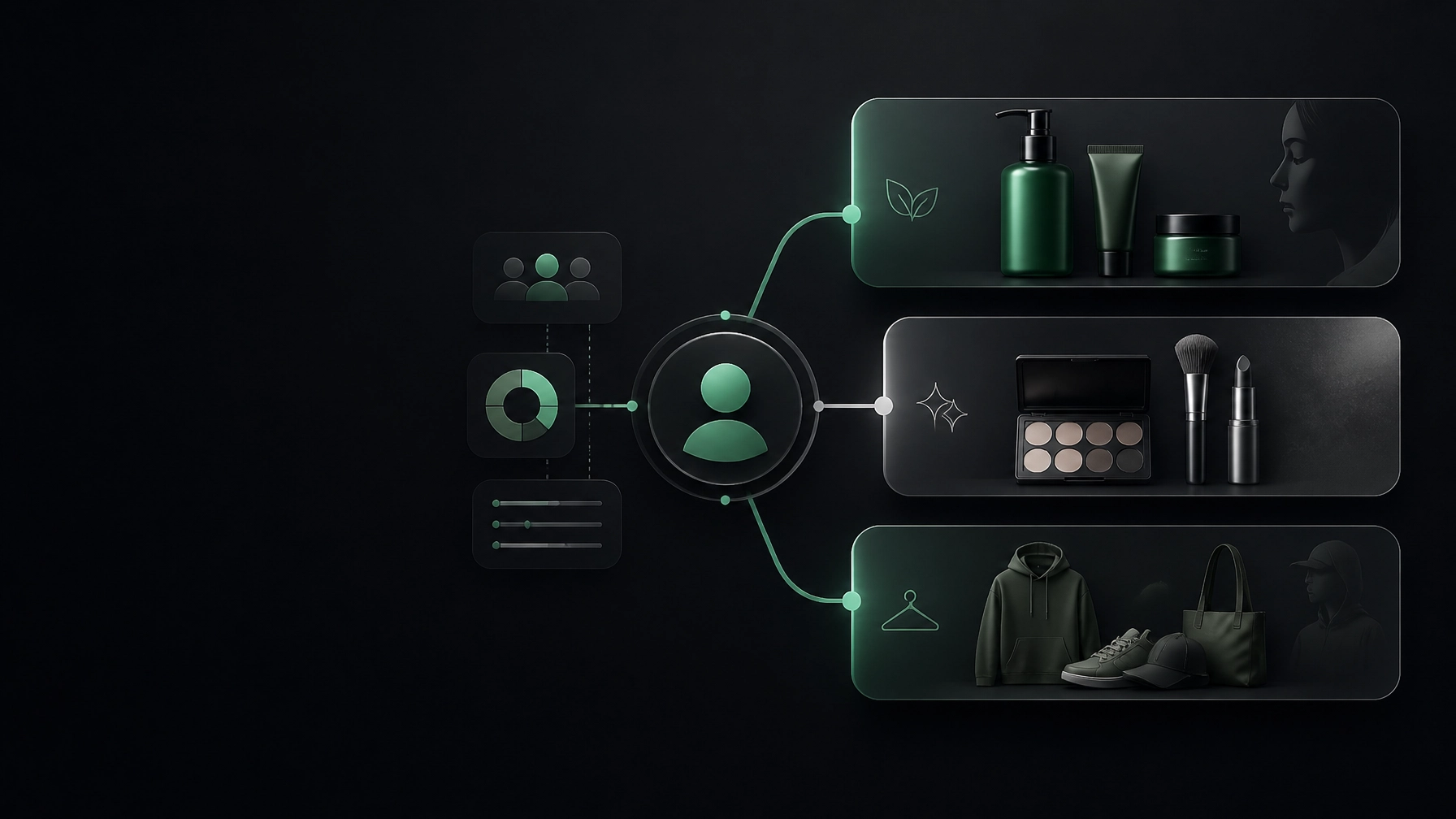
Personalization can help your Shopify store sell more from the traffic you already have: without immediately increasing your ad budget. By matching product discovery, offers, and content to customer intent, you can create larger baskets, stronger repeat purchases, and a faster path to conversion.
For beauty, fashion, jewelry, and streetwear brands, the opportunity is especially clear. Customers do not want to browse an endless catalog. They want a routine, a look, a fit, or a product that feels selected for them.
This is your 2026 playbook: segment customers intelligently, personalize the experience quickly, and measure AOV by audience: not only across the store.
Why segmentation is the foundation of Shopify personalization
Personalization fails when every visitor receives the same product grid, banner, and promotion.
A skincare shopper looking for a barrier-repair routine should not see the same recommendations as someone browsing makeup shades. A streetwear customer interested in oversized hoodies may not respond to messaging designed for occasionwear shoppers.
Segmentation gives you a practical way to organize these differences.
Shopify customer segments can be created using details such as:
- Purchase history
- Product categories browsed or purchased
- Order frequency
- Average order value
- Last purchase date
- Location
- Engagement and campaign activity
- Lifecycle stage
- Customer metafields and preferences
Shopify’s customer segmentation documentation explains how dynamic segments can update automatically when customers meet: or stop meeting: specific conditions.
That matters because speed is a feature. You should not need to rebuild an audience manually every time a shopper changes behavior.

The five-layer segmentation framework for beauty and fashion brands
Do not start with dozens of complicated audiences. Start with a small system that your team can maintain.
Use these five layers as your segmentation framework.
1. Category affinity
Identify what customers consistently browse, purchase, or engage with.
For beauty brands, useful segments may include:
- Skincare shoppers
- Makeup and color cosmetics shoppers
- Fragrance buyers
- Clean beauty or ingredient-focused customers
- Discovery-set and sample buyers
- Routine or bundle purchasers
For fashion and streetwear brands, consider:
- Dresses and occasionwear shoppers
- Everyday essentials buyers
- Sneaker and accessory enthusiasts
- Oversized or relaxed-fit shoppers
- Premium or limited-drop customers
- Jewelry and gifting customers
Shopify has introduced category-based segmentation capabilities for customers who have browsed or bought from specific product categories. You can read more about the update in Shopify’s product category segmentation announcement.
Action: Create one segment for each major category that contributes meaningful revenue. Do not segment simply because a category exists.
2. Lifecycle stage
The same customer needs different messaging at different points in the relationship.
Build segments for:
- New subscribers who have not purchased.
- First-time customers who have completed one order.
- Active repeat customers with recent purchases.
- High-potential customers whose AOV or engagement is rising.
- At-risk customers whose purchase cycle is slowing.
- Lapsed customers who have not returned within your normal buying window.
A first-time skincare customer may need education and routine guidance. A repeat customer may need replenishment reminders. A lapsed fashion buyer may respond better to a fresh edit than a generic discount.
Key Insight: Lifecycle segmentation helps you avoid sending the right offer to the wrong person at the wrong time.
3. Behavioral intent
Behavior tells you what the customer may want now.
Useful behavior segments include:
- Viewed a product several times but did not add it to cart.
- Added a product to cart but did not purchase.
- Purchased a core product without its complementary item.
- Engaged with a product drop or waitlist.
- Used a skin quiz, shade finder, or style quiz.
- Clicked a specific category in email or SMS.
- Repeatedly searched for a particular product type.
This is where personalization becomes more useful than demographic targeting. Age and location can provide context, but intent signals are usually closer to the buying decision.
For example:
- A customer who views a serum three times may need stronger proof, reviews, or ingredient details.
- A customer who buys a crop top may be ready for a complete-the-look recommendation.
- A customer who purchases a fragrance discovery set may be ready for a full-size product follow-up.
4. Value and AOV
Your highest-value customers should not be treated like occasional bargain hunters.
Create value-based segments such as:
- VIP customers
- Top 10% by total spend
- Customers with AOV above your store average
- Frequent purchasers
- Bundle buyers
- Customers with high predicted lifetime value
- Customers who respond to premium products
Shopify’s high-volume ecommerce segmentation guidance recommends using purchase behavior, lifecycle, engagement, category affinity, and VIP status to prioritize high-impact audiences.
Use these segments to test:
- Early access to new collections.
- Premium bundles.
- Exclusive product drops.
- Complimentary samples or gifts.
- Personal styling content.
- Loyalty benefits.
- Higher free-shipping thresholds paired with stronger value.
Do not automatically give your best customers the deepest discount. You may reduce margin without increasing loyalty. Test access, convenience, exclusivity, and relevance first.
5. Preference and first-party data
Beauty and fashion brands can collect valuable preference data: but only when there is a clear value exchange.
For beauty, ask about:
- Skin type.
- Primary skin concerns.
- Shade preferences.
- Ingredient sensitivities.
- Routine goals.
- Fragrance preferences.
For fashion, ask about:
- Size and fit.
- Preferred silhouettes.
- Style aesthetic.
- Favorite colors.
- Occasion.
- Sustainability preferences.
- Preferred price range.
Then show customers what they receive in return:
- More relevant recommendations.
- Better-fit product suggestions.
- Personalized routines.
- Early access to matching products.
- Restock alerts.
- Curated outfit edits.
A quiz should not become a data-collection exercise with no visible benefit. Collect only what you can use.

How to turn segments into AOV growth
Segmentation alone does not increase revenue. The experience attached to the segment does.
Build personalized product paths
Give each major segment a clear next step.
For beauty brands
- Show a complete skincare routine instead of one product.
- Recommend a cleanser, treatment, moisturizer, and SPF based on the customer’s goal.
- Follow up with full-size products after a discovery-set purchase.
- Recommend compatible shades or complementary makeup products.
- Offer a routine bundle with a transparent value explanation.
For fashion and streetwear brands
- Add complete-the-look recommendations to product pages.
- Pair dresses with accessories, outerwear, or footwear.
- Recommend complementary pieces based on fit and color preferences.
- Create edits for specific use cases such as travel, festivals, work, or gifting.
- Use drop engagement to offer early access to related releases.
Keep recommendations useful. Three relevant products are better than twelve random suggestions.
Personalize the cart and threshold offers
The cart is one of the fastest places to influence AOV because intent is already high.
Test:
- “Add ₹X more to unlock free shipping.”
- A relevant accessory recommendation.
- A routine-completion suggestion.
- A bundle upgrade.
- A gift-with-purchase threshold.
- A premium version of an item already in the cart.
Make the threshold achievable. If the customer’s current cart is ₹1,500 and free shipping begins at ₹3,500, the incentive may feel unrealistic. Use historical AOV and segment-level behavior to set practical thresholds.
Connect onsite personalization with email and SMS
Your website, email, and SMS should not operate as separate systems.
A simple flow might look like this:
- A shopper completes a skin quiz.
- Shopify records the preference through customer data or metafields.
- The shopper sees a tailored collection or product recommendation.
- Email follows up with education about the relevant routine.
- A replenishment or cross-sell message arrives based on the expected usage cycle.
Your marketing tools are co-pilots, not replacements for strategy. Automation can deliver the message quickly, but your team must decide whether the recommendation is genuinely helpful.
A practical Shopify implementation plan
Start small. Stay creative.
Step 1: Audit your current data
List what you already know:
- Product categories purchased.
- AOV and total spend.
- Order frequency.
- Last purchase date.
- Email and SMS engagement.
- Quiz or preference data.
- Cart and browse behavior.
Then identify gaps. Do not build a personalization strategy around data you cannot reliably collect.
Step 2: Launch three high-impact segments
Start with:
- Category affinity: skincare, streetwear, jewelry, or another core category.
- Lifecycle: new, active repeat, or at-risk.
- Value: high-AOV or VIP customers.
Shopify recommends choosing segments based on business goal, audience size, data reliability, expected lift, and maintainability.
Step 3: Attach one experience to each segment
For example:
- Skincare shoppers receive a routine builder.
- At-risk customers receive a curated win-back edit.
- VIP customers receive early access to a premium drop.
Do not launch ten campaigns at once. Build one useful workflow, measure it, and expand.
Step 4: Measure AOV by segment
Track:
- AOV
- Conversion rate
- Revenue per visitor
- Items per order
- Repeat purchase rate
- Gross margin
- Return rate
- Unsubscribe rate
Compare personalized and non-personalized experiences. A higher AOV is not a win if returns, discount costs, or customer complaints rise sharply.

Pros, cons, and challenges
Pros
- Higher relevance: Customers find products faster.
- Better merchandising: You can promote the right product to the right audience.
- More efficient marketing: Campaigns become less dependent on broad discounts.
- Stronger retention: Personalized replenishment and recommendations support repeat orders.
- Faster optimization: Dynamic segments update as behavior changes.
Cons and challenges
- Poor data quality creates poor recommendations.
- Over-segmentation can make campaigns difficult to manage.
- Personalization can feel invasive without clear consent and transparency.
- Too many apps can slow your Shopify store.
- AOV gains can hide margin erosion if discounts are too generous.
- Small stores may not have enough traffic for complex testing.
Thriftizer’s CRO approach is deliberately practical: fix observable friction first, then test what is genuinely uncertain. If your store has limited conversion volume, prioritize speed, product-page clarity, shipping transparency, mobile usability, and checkout friction before building an advanced experimentation program.
The Thriftizer advantage: speed without shortcuts
Personalization does not need to become a six-month agency project.
Thriftizer is building toward the Amazon of Shopify Services model: a faster, more efficient, and agile alternative to slow-moving traditional agencies. Our 4-Hour Onboarding concept is designed to reduce the gap between identifying a problem and starting useful work.
That means you can move from:
- Data audit to segment plan.
- Segment plan to campaign mapping.
- Campaign mapping to implementation.
- Implementation to measurement.
The goal is not to remove human creativity. It is to give your strategists, designers, and developers better signals: and help them execute faster.
Explore Thriftizer’s Shopify growth services, or review our Shopify Expert profile when you are ready to improve personalization, CRO, SEO, or store performance.
Next steps: your 2026 personalization checklist
- Calculate your current AOV by product category and customer lifecycle stage.
- Identify your three most valuable customer groups.
- Create dynamic Shopify segments for category, lifecycle, and value.
- Map one relevant product experience to each segment.
- Add useful first-party data collection, such as a skin quiz, fit preference, or style profile.
- Test cart recommendations and realistic free-shipping thresholds.
- Connect onsite behavior with email and SMS flows.
- Measure AOV, margin, conversion, repeat purchase rate, and returns together.
- Remove irrelevant recommendations and slow apps.
- Review performance every month and expand only what proves useful.
Never ever think of giving up. Start with one segment, one experience, and one measurable goal. Then improve quickly.