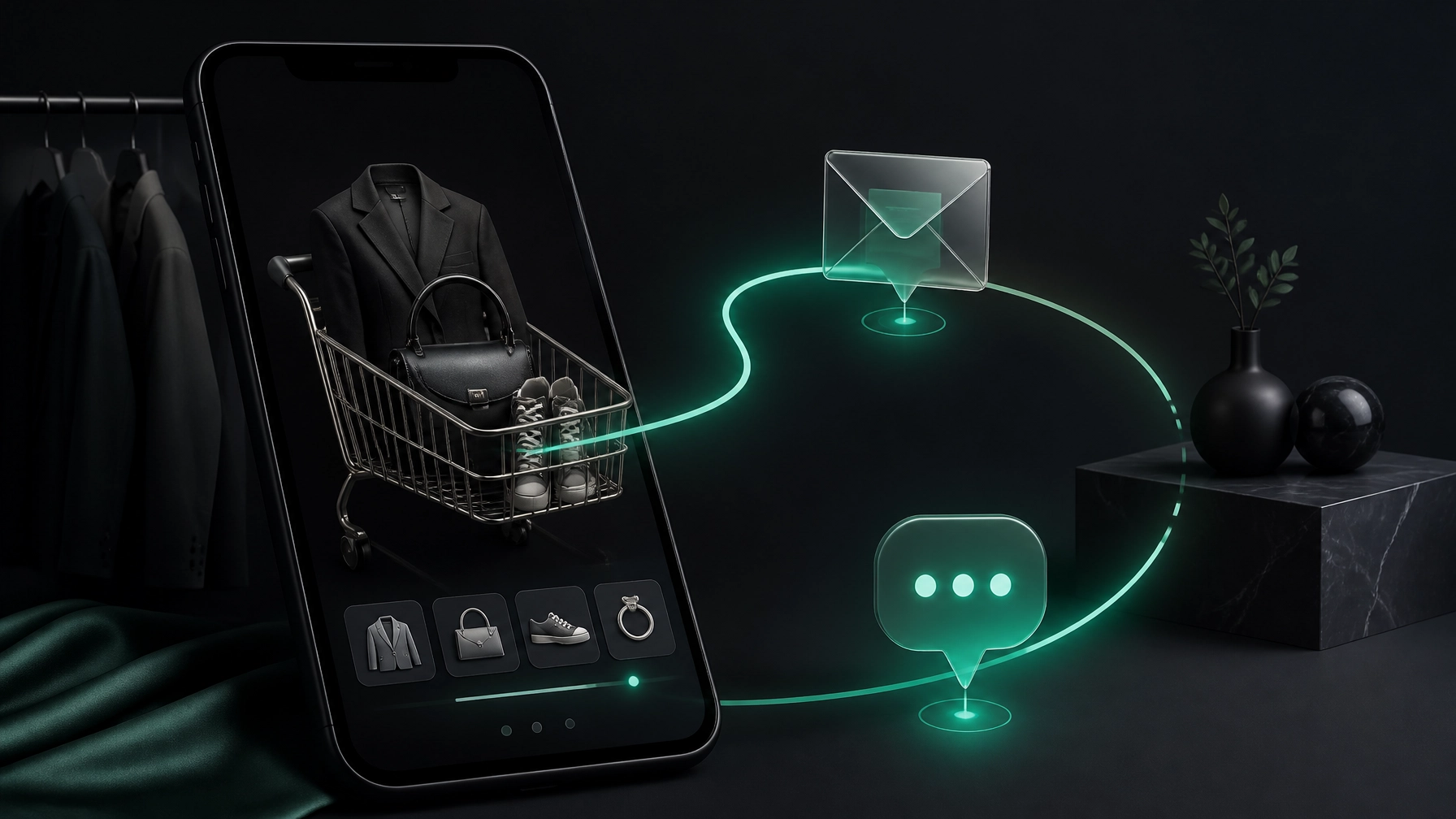
Fashion shoppers rarely abandon a cart because they have no interest. They pause because they are unsure about fit, delivery dates, shipping costs, payment options, or whether the product will look as good in real life.
A fast, well-timed abandoned cart recovery system can turn that hesitation into revenue: without relying on constant discounts. For Shopify fashion brands, the opportunity is significant. Industry benchmarks commonly place ecommerce cart abandonment between 70% and 80%, while strong email and SMS programs can recover approximately 10% to 20% of abandoned carts, depending on traffic quality, offer strategy, and customer consent.
The goal is not to chase every shopper. It is to remove friction for shoppers who already showed buying intent.
This guide breaks down six automated email and SMS flows for fashion, beauty, jewelry, makeup, and streetwear brands on Shopify.
Why Fashion Carts Need More Than a Reminder
Fashion and beauty purchases are visual and emotional, but they also involve risk.
Your customer may be asking:
- Will this size fit me?
- Is the color accurate?
- How quickly will it arrive?
- Can I exchange it?
- Is the material or formula right for me?
- Will this piece work with what I already own?
- Is the shipping cost worth it?
A generic “You left something behind” message does not answer those questions.
Effective recovery flows combine three layers:
- Intent : Remind the shopper what they selected.
- Trust : Resolve concerns about fit, quality, delivery, and returns.
- Action : Make it effortless to return to checkout.

Key Insight: Technology should act as your co-pilot, not your creative replacement. Automation delivers the message quickly, but your brand voice, styling perspective, and customer understanding make it persuasive.
Flow 1: The Immediate SMS Nudge
Timing: 5–15 minutes after abandonment
Channel: SMS, only for customers who have provided valid marketing consent
Primary goal: Capture high purchase intent
This is a short, helpful reminder: not a discount announcement.
What to include
- The product or product group left in the cart
- A direct link back to checkout
- The selected size, color, or variant where possible
- A simple opt-out instruction
- No incentive unless your strategy specifically requires one
Example
Still thinking about your selected pieces? Your cart is saved here: [secure checkout link]. Reply STOP to opt out.
For a beauty brand, mention the selected shade or routine. For a jewelry brand, show the item name and material. For streetwear, reinforce the drop or collection without making unsupported scarcity claims.
Do not send SMS without appropriate consent. Requirements vary by country and region, so confirm your collection, disclosure, opt-out, and sending practices before launching.
Flow 2: The Visual Cart Reminder Email
Timing: Approximately 1 hour after abandonment
Channel: Email
Primary goal: Reconnect the customer with the product desire
Your first email should be visual, fast, and focused. Show the product immediately. Do not bury the cart below a long brand story.
Build the email around
- Large product imagery
- Product name and variant
- Price and availability
- A clear Return to Your Cart button
- Delivery expectations
- A link to the size guide or product details
For fashion, include a useful fit message such as “Check the size guide before completing your order.” For makeup, link to shade information. For jewelry, clarify dimensions, material, and care instructions.
Avoid introducing a discount at this stage unless your margin model supports it. Many shoppers only need a reminder or reassurance.
Speed is a feature here. The message should arrive while the customer still remembers the product and the reason they wanted it.
Flow 3: The Fit, Quality, and Policy Reassurance Email
Timing: 12–24 hours after abandonment
Channel: Email
Primary goal: Remove purchase anxiety
The second email should address the objections that prevent fashion customers from completing checkout.
Add relevant reassurance
- Fit: Size guide, model measurements, garment stretch, or fit notes
- Quality: Materials, construction, finish, or product testing
- Returns: Exchange window and return process
- Delivery: Estimated dispatch and arrival information
- Support: A simple way to ask a pre-purchase question
For a beauty or makeup store, explain skin type, finish, shade range, or usage. For a fine jewelry store, add clarity around measurements, packaging, care, and authenticity documentation.
Keep the tone useful, not defensive. Your customer should feel guided: not pressured.
Pro Tip: Add the answer to your most common support question directly into the flow. If customers repeatedly ask whether a dress runs small, do not make them search for that answer.
Flow 4: The Social Proof SMS
Timing: 18–30 hours after abandonment
Channel: SMS
Primary goal: Reinforce confidence with concise proof
SMS is effective when it is brief and relevant. Use this touchpoint to share one trust signal rather than another generic reminder.
Potential content
- A verified customer review
- A useful styling suggestion
- A link to customer-generated content
- A product rating
- A note about best-selling status, only when accurate
Example
Still considering the jacket you viewed? See how customers style it and return to your saved cart: [link]. Reply STOP to opt out.
Do not overload the message with multiple links, large claims, or unnecessary urgency. If the product is low in stock, use a real inventory trigger rather than manufactured pressure.
For luxury fashion and high-value jewelry, consider replacing the SMS with a personal support option. A customer may need help with sizing, styling, or customization before purchasing.
Flow 5: The Incentive or Value-Exchange Email
Timing: 36–48 hours after abandonment
Channel: Email
Primary goal: Convert remaining hesitation without training customers to wait for discounts
If your data shows that price is a meaningful barrier, introduce a carefully controlled incentive. Do not automatically give every customer the largest discount.
Test alternatives such as
- Free shipping above a threshold
- Free size exchange
- A modest first-order incentive
- A complimentary sample for beauty products
- Gift wrapping for jewelry
- A styling guide or outfit recommendation
- Flexible payment messaging
Segment your offer by:
- New versus returning customer
- Cart value
- Full-price versus sale items
- Product category
- Geographic market
- Previous discount usage
A 10% offer may be appropriate for one segment and wasteful for another. Measure profit from recovered carts, not just the number of orders.

Flow 6: The Final Reminder and Win-Back Path
Timing: 60–72 hours after abandonment
Channel: Email, with optional SMS for highly engaged subscribers
Primary goal: Create a clear final action
The final message should be direct but respectful. Remind the customer that their cart may not remain saved indefinitely, or that inventory can change: only if this is technically true.
Include
- The original cart
- A single primary CTA
- A clear deadline for any offer
- A link to customer support
- Optional related products
- A preference or unsubscribe link
If the customer does not purchase, stop the abandoned cart sequence. Move them into a relevant browse-abandonment, product education, or win-back flow instead.
This prevents over-messaging and gives you a better chance of earning the next purchase.
How to Build the Shopify Automation
You can use Shopify’s native tools or an email platform such as Klaviyo or Omnisend, depending on your catalog, segmentation needs, and SMS requirements. Shopify also provides a useful overview of abandoned cart email fundamentals.
Set up the system in this order:
- Track cart creation and checkout events.
- Capture email and SMS consent correctly.
- Add a purchase-based suppression rule.
- Personalize product, variant, price, and cart links dynamically.
- Create separate segments for new, returning, and high-value customers.
- Check that every message renders correctly on mobile.
- Test the checkout link, discount logic, and unsubscribe function.
- Review performance weekly for the first month.
Use automation as a co-pilot. Keep human creativity in the subject lines, product storytelling, styling recommendations, and customer support experience.
Pros, Cons, and Common Challenges
Pros
- Recovers revenue from existing traffic
- Runs 24/7 without manual follow-up
- Supports personalization at scale
- Reduces dependence on paid acquisition
- Gives you measurable customer-behavior data
Cons
- Poor timing can feel intrusive
- Discounts can reduce margin
- Weak product data limits personalization
- SMS requires careful consent management
- High sends can damage deliverability if segmentation is ignored
The biggest challenge is usually not writing the emails. It is fixing the customer experience behind them.
If shipping costs appear too late, your flow cannot solve the problem alone. If your size guide is confusing, link placement will not fix it. If checkout is slow on mobile, a beautiful reminder may only send more shoppers into the same friction.
Use Shopify CRO principles to identify and fix the underlying leaks.
What to Measure in 2026
Track each flow by segment and channel. Focus on business outcomes rather than vanity metrics.
Monitor
- Cart abandonment rate
- Recovery rate
- Recovered revenue
- Revenue per recipient
- Click-to-purchase rate
- Unsubscribe and opt-out rate
- Discount cost
- Mobile versus desktop performance
- New versus returning customer performance
As a directional target, an email-only program may recover around 5% to 15% of abandoned carts, while a well-coordinated email and SMS system may perform closer to 10% to 20%. Treat these as planning ranges, not guarantees. Your own baseline is more valuable than a universal benchmark.

Next Steps: Launch Your Recovery System
- Audit your current abandoned cart flow. Check timing, copy, mobile rendering, and suppression rules.
- List your top five customer objections. Use reviews, support tickets, and session recordings.
- Build the first three messages. Start with the SMS nudge, visual reminder email, and reassurance email.
- Add segmentation. Separate high-value carts, returning shoppers, and product categories.
- Test one incentive. Compare free shipping, exchange reassurance, and a modest discount.
- Review results after 30 days. Keep winners, remove friction, and improve weak messages.
- Scale the system quickly. With Thriftizer’s 4-Hour Onboarding, you can move from a scattered setup to a clear implementation plan without waiting weeks for a traditional agency process.
Thriftizer works as the Amazon of Shopify Services for ambitious D2C brands: focused, agile, and built for speed. If you need help with email, SMS, CRO, SEO, or Shopify execution, explore Thriftizer’s growth services or review our work on the Shopify Expert profile.
Start small. Stay creative. Never ever think of giving up. Your next recovered order may already be sitting in a cart( you just need to make returning easy.)