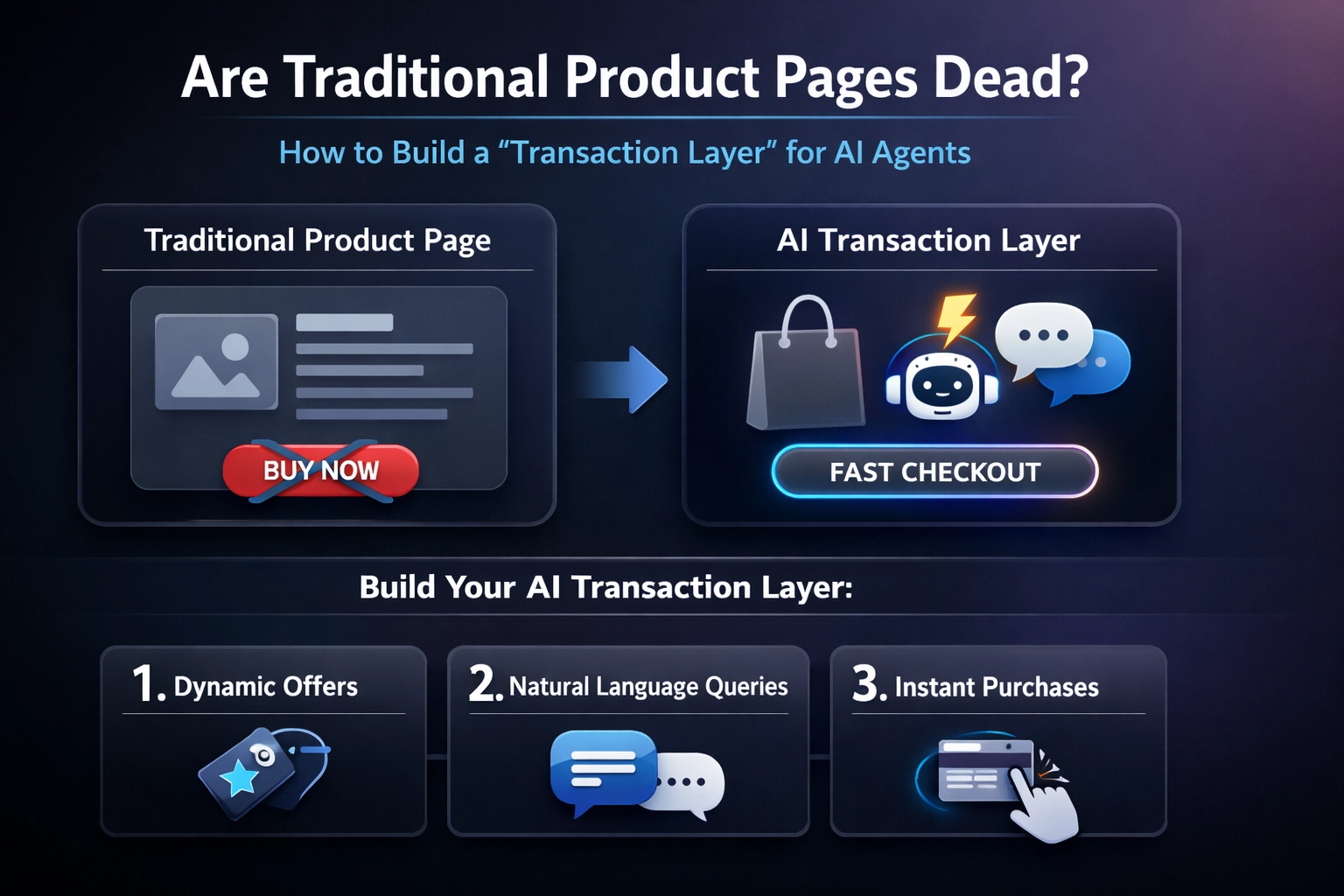
The year is 2026, and the way your customers "shop" has fundamentally shifted. For a decade, the goal of a Shopify store was simple: capture a human’s attention with a beautiful hero image, social proof, and a shiny "Add to Cart" button.
But today, the person clicking that button might not be a person at all.
With the rise of autonomous AI shopping agents: think OpenAI’s Operator, Google’s Shopping AI, and specialized fashion "co-pilots": the traditional Product Detail Page (PDP) is facing a crisis of identity. To a human, your page looks like a lifestyle dream. To an AI agent, it often looks like a chaotic mess of unreadable scripts and hidden data.
If your D2C brand wants to survive the "Agentic Era," you need to stop thinking about your website as just a visual storefront and start building a Transaction Layer.
The Great Decoupling: How AI Agents "See" Your Store
When a human lands on a beauty brand’s Shopify page, they look for aesthetic cues. They want to see the texture of the cream, the "before and after" photos, and the vibe of the brand.
An AI agent has a different mission. It is looking for parameters.
If a user tells their AI assistant, "Find me a vegan, paraben-free night cream under $60 with overnight shipping to New York," the agent doesn't care about your brand's "Our Story" video. It cares about:
- Attributes: Is it tagged as "vegan" and "paraben-free"?
- Logic: Is it in stock for a specific ZIP code?
- Fulfillment: Can it be delivered by tomorrow?
Traditional product pages are often "heavy." They are built for human eyes, which means essential data is often buried inside JavaScript or non-standard HTML. If the agent can't find the data in milliseconds, it moves to your competitor who has a cleaner "Transaction Layer."

What Exactly is a "Transaction Layer"?
The Transaction Layer is the invisible architecture of your store. It is the structured, machine-readable version of your commerce experience that exists alongside your visual UI.
Think of it as the "API-first" version of your product page. While the human interacts with the pixels, the AI agent interacts with the data schema.
The Three Pillars of the Transaction Layer
- Robust JSON-LD & Schema Markup: This isn't just about basic SEO anymore. In 2026, your Schema needs to be hyper-granular. We’re talking about mapping every variant, every ingredient, and every shipping nuance into a format Google and OpenAI can digest instantly.
- Clean Structured Data: AI agents struggle with "creative" pricing (e.g., "Starting at $10" when the actual product is $50). A true Transaction Layer provides clear, unambiguous data points for price, currency, and availability.
- Real-Time API Access: If an agent is making a purchase on behalf of a user, it needs to know that the "Limited Edition Streetwear Hoodie" is actually in stock before it tries to checkout.
Why Fashion and Beauty Brands are at High Risk
In the D2C space, particularly in fashion and beauty, product complexity is high. A single lipstick might have 40 shades. A pair of jeans might have 12 sizes and 3 washes.
If your Shopify theme isn't optimized for the Agentic Era, these variants often become a "black box" to AI.
The Problem: Most themes only load variant data when a human clicks a dropdown.
The Consequence: The AI agent only "sees" the default variant. It misses the other 39 shades, meaning you lose the sale because the agent reported the product as "unavailable" in the user’s preferred color.
At Thriftizer, we focus on ensuring that your Shopify Plus architecture exposes this data correctly from the jump. We build stores that don't just look good but "speak" fluently to the agents that are increasingly controlling the wallet.

How to Build Your Transaction Layer: A Technical Blueprint
You don't need to delete your beautiful website. You just need to reinforce it. Here is how you bridge the gap between human-centric design and agent-centric data.
1. Optimize for Entity Authority
AI agents don't just look for keywords; they look for "entities." If you sell sustainable jewelry, your Transaction Layer should link your products to recognized entities in the Knowledge Graph (e.g., "Recycled Gold," "Conflict-Free Diamonds"). This builds trust with the AI, making it more likely to recommend your brand as a "verified" source.
2. Implement "Deep" Variant Schema
Don't settle for standard Shopify Schema. Work with a Shopify Expert to implement customized JSON-LD that describes every single SKU in detail. This includes specific attributes like fabric weight for streetwear or skin-type compatibility for beauty products.
3. Streamline the Checkout Handshake
The "Transaction Layer" isn't just about discovery; it's about the transaction. AI agents are moving toward "headless" checkout experiences. Ensure your Shopify store’s Cart API is robust and that your checkout flow doesn't have "bot-blockers" that accidentally prevent legitimate shopping agents from completing a purchase.
4. Semantic Search and Metadata
Standard search looks for exact matches. Semantic search looks for intent. Your backend metadata should be written to answer questions. Instead of just "Blue Summer Dress," your metadata should include "breathable cotton dress for outdoor weddings." This is exactly how AI agents "think" when they are searching for a solution for their user.

Pros and Cons of the Agentic Shift
| Pros | Cons |
|---|---|
| Higher Conversion: Agents only visit when intent is 100% confirmed. | Technical Complexity: Requires deeper Shopify Plus customization. |
| Reduced Return Rates: Precise data mapping ensures users get exactly what they expected. | Loss of "Impulse" Branding: Harder to "wow" an agent with lifestyle imagery. |
| Global Reach: AI agents can navigate your store in any language or currency via data. | Evolving Standards: The "rules" for AI agents are changing monthly. |
Key Insight: While you might lose the ability to "distract" a customer with fancy pop-ups, you gain a massive advantage by being the most "efficient" option for an AI agent to buy from.
Positioning Your Brand for the Future
The brands that will win in 2026 and 2027 are those that treat their website as a dual-purpose asset.
- The UI (User Interface) is your brand's soul. It’s where the storytelling happens.
- The TL (Transaction Layer) is your brand's brain. It’s where the commerce happens.
If you neglect the brain, the soul won't have anyone to talk to. Fashion and beauty brands, in particular, need to audit their Shopify Plus stores now. Are you still relying on a theme from 2022 that hasn't updated its Schema logic? Are your product descriptions just blocks of text, or are they structured data nodes?

Start Small, Stay Creative
Moving toward an agentic commerce model doesn't happen overnight. You don't need to rebuild your entire store from scratch. Start by auditing your most popular SKUs. Ensure their data is impeccable.
Remember, AI is a co-pilot, not a replacement for your brand's voice. Your job is to make it as easy as possible for that co-pilot to choose your products over a thousand others.
Your "Agent-Ready" Checklist
Ready to move beyond the traditional product page? Follow these steps to start building your Transaction Layer today:
- Audit Your Schema: Use Google’s Rich Results Test to see what an AI actually "sees" when it crawls your product page.
- Fix Your Variants: Ensure every SKU has a unique, crawlable URL or a clearly defined data object in your JSON-LD.
- Optimize Page Load Logic: Move critical product data (Price, SKU, Availability) to the top of the HTML so agents don't have to wait for heavy images to load first.
- Enhance Metadata: Add "Attribute-Rich" descriptions that focus on specs, materials, and use-cases.
- Talk to an Expert: Consult with a Shopify Plus agency like Thriftizer to discuss an API-first strategy for your storefront.
The "traditional" product page isn't dead: it's just evolving. It's time to stop building for the screen and start building for the system.
Never ever think of giving up on the technical side of your brand. The digital landscape is shifting, but with the right structure, your Shopify store can become an unstoppable force in the era of AI-driven commerce. 🚀