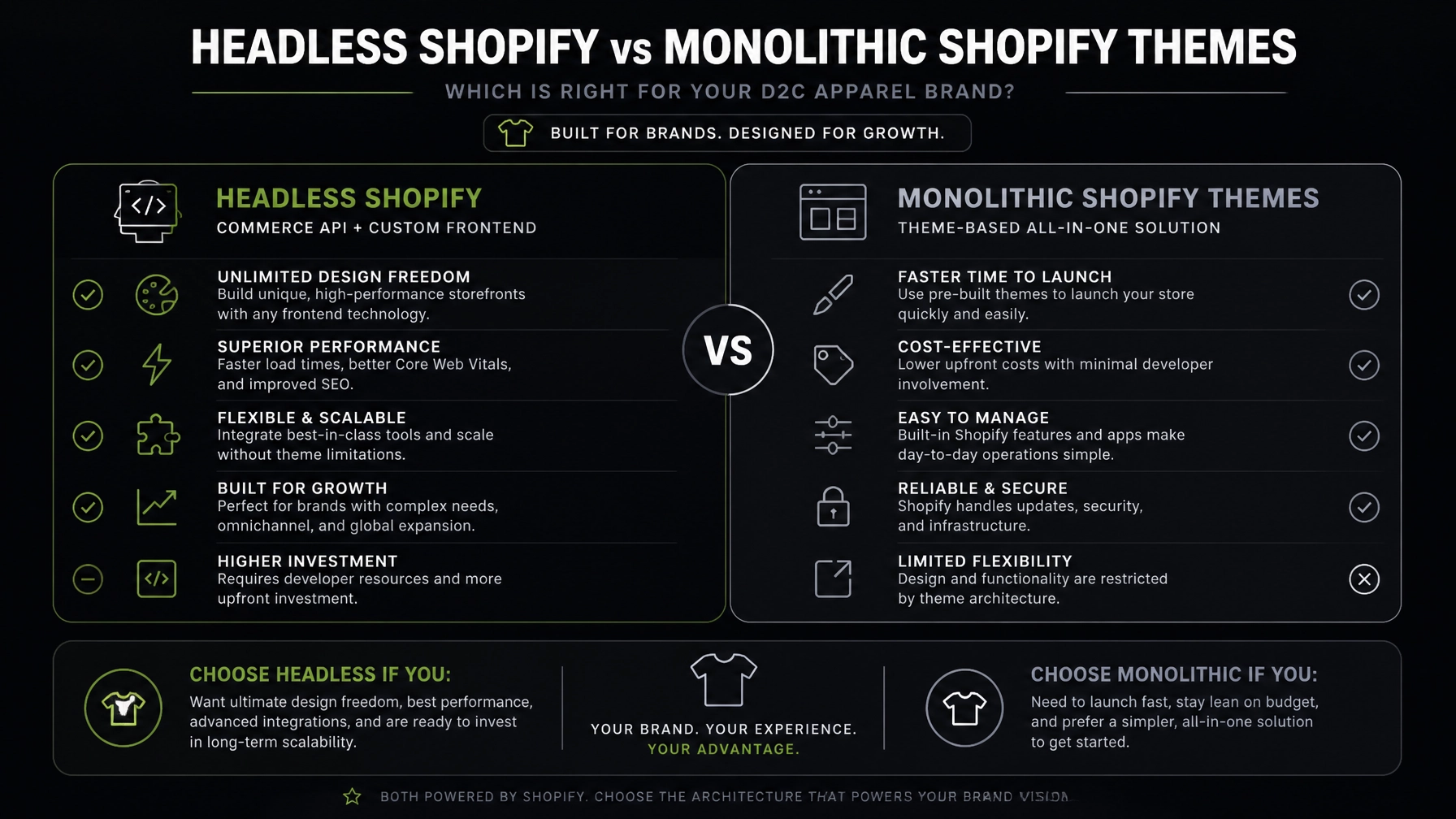
If you are running a growing D2C fashion or apparel brand doing between $1M and $10M in annual revenue, you have likely sat through a pitch where an agency breathlessly recommends Headless Shopify. They will tell you that traditional themes are holding you back, that your site speed is costing you millions, and that you need a custom React or Hydrogen front-end decoupled from your backend.
Before you sign a six-figure contract and commit your engineering team to a nine-month replatforming marathon, take a deep breath.
For 90% of mid-market apparel brands, headless architecture is expensive overkill. It introduces staggering maintenance overhead, bloated development budgets, and timeline delays without delivering a proportional return on investment.
At Thriftizer, we champion a "Speed as a Feature" philosophy: not just in how fast your pages load, but in how quickly you can launch campaigns, test new collections, and scale your storefront. In this guide, we break down why headless is often a hype trap for mid-market brands, what it actually costs, and the high-performance middle-ground strategy that gets you 90% of the benefits at a fraction of the price.
The Headless Hype: Why Mid-Market Brands Fall for the Trap
Headless commerce undeniably has its place in the enterprise stratosphere. If you are operating across twelve global regions with multilingual storefronts, custom ERP integrations in every warehouse, and a massive internal engineering squad, decoupling your front-end from Shopify makes absolute sense.
However, agencies often pitch headless as a silver bullet to mid-market apparel brands struggling with basic conversion rate optimization (CRO) or slow page loads that are actually caused by bloated third-party tracking apps: not Shopify’s theme engine.
The Hidden Costs of Headless for $1M–$10M Brands
When evaluating headless architecture, most founders focus solely on the initial build estimate while ignoring the ongoing operational tax.

Consider the real-world benchmarks between a traditional custom Shopify build and a mid-market headless deployment:
- Initial Build Costs: A professional, high-converting monolithic custom Shopify theme typically ranges from $30k to $120k and launches in 2 to 8 weeks. In contrast, a mid-market headless implementation (Hydrogen or Next.js + headless CMS) routinely costs $100k to $350k+ and takes 4 to 8 months minimum to reach production.
- Ongoing Engineering & Maintenance: With a traditional theme, your marketing team can swap banners, adjust sections, and launch flash sales using native visual builders. With headless, every minor layout change or landing page update requires an engineering ticket, translating to ongoing developer retainers of $8k to $40k per month.
- Total Cost of Ownership (3-Year TCO): Independent benchmarks show that headless implementations result in a 3-year TCO of $690k to $1.44M+, whereas a robust monolithic setup averages $375k to $865k.
Key Insight: Headless commerce rarely saves you money; it shifts your budget from customer acquisition and growth into infrastructure maintenance and developer salaries.
The Modern Monolith: How to Get 90% of Headless Benefits Without the Headache
You do not need a headless stack to achieve lightning-fast load times, flawless mobile UX, and sophisticated merchandising. Modern Shopify (especially on Shopify Plus) has evolved past rigid monolithic templates.
By leveraging native platform features smartly, you can build a blazing-fast apparel storefront that satisfies both your shoppers and your CFO.
1. Leverage Section-Based Architecture & Custom Liquid
Today’s Online Store 2.0 theme architecture allows developers to build modular, reusable sections. Instead of hardcoding static templates, use Custom Liquid blocks to embed custom calculators, sizing widgets, or interactive lookbooks directly into the native theme customizer. This gives your marketing team drag-and-drop flexibility without sacrificing site speed.
2. Harness Shopify Metafields & Metaobjects
Apparel brands live and die by rich product data: fit guides, fabric care instructions, model sizing, and material origin. Instead of relying on heavy third-party apps that slow down your DOM, use native Shopify Metafields and Metaobjects to structure complex product attributes natively.
3. Deploy Shopify Functions for Custom Checkout Logic
Historically, brands went headless to customize the checkout or shipping logic. Today, Shopify Functions allow developers to execute custom backend logic directly on Shopify's lightning-fast infrastructure. Whether you are offering dynamic bundling discounts, custom loyalty tiers, or localized shipping rules, Shopify Functions execute securely at the edge without a custom server.
Decision Framework: When is Headless Actually Worth It?
To help you evaluate whether your apparel brand is ready for headless, use this quick scorecard.
Headless is likely NOT for you if:
- Your annual revenue is currently between $1M and $10M.
- Your marketing team needs to launch landing pages and flash sales within hours, not weeks.
- You do not have a dedicated, full-time React/Next.js developer on your payroll.
- Your current performance bottlenecks are caused by unoptimized imagery and excessive tracking pixels rather than Shopify's Liquid rendering engine.
Headless MIGHT make sense if:
- You operate multiple distinct storefronts across international regions with complex localized currencies and multi-warehouse ERP logic.
- You have a multi-person internal engineering squad ready to maintain custom frontend codebases.
- Your brand identity requires deeply experimental, non-standard 3D WebGL animations or highly custom interactive shopping experiences that push browser limits.
The Thriftizer Advantage: Agility Over Complexity
At Thriftizer, we believe that speed is the ultimate competitive advantage for D2C brands. While traditional agencies drag out projects for months with bloated discovery phases and expensive architectural overhauls, we operate as the "Amazon of Shopify Services": delivering elite design, robust engineering, and rapid execution.

We know that time kills momentum. That is why we pioneered our signature 4-Hour Onboarding process. From the moment you partner with our strategists and designers, we audit your technical stack, map out your conversion funnels, and initiate execution within hours: not weeks.
As an officially recognized partner, you can also explore our verified credentials directly through our Shopify Expert profile to see how we help apparel and beauty brands scale efficiently.
Pros and Cons of Sticking with a Monolithic Shopify Setup
To maintain complete transparency, let’s weigh the trade-offs of choosing a high-performance native Shopify theme over a headless stack:
Pros
- Faster Time-to-Market: Launch your new store in weeks instead of quarters.
- Lower Upfront Capital: Preserve cash flow for paid acquisition, inventory, and brand marketing.
- Empowered Marketing Teams: Visual theme editors allow non-technical staff to update pages instantly.
- Reliable Ecosystem: Seamless compatibility with thousands of vetted Shopify apps and payment gateways.
Cons / Challenges
- Platform Constraints: Deeply unorthodox user experience flows may require creative workaround development.
- Theme Lock-In: Migrating between complex themes requires careful data and style mapping.
Next Steps to Scale Your Apparel Brand Today
Stop letting tech hype drain your marketing budget. If you want to maximize your conversion rate and scale revenue without the engineering nightmares of headless, follow this actionable checklist:
- Audit Your Current Tech Stack: Review every installed app and remove any redundant scripts or legacy tracking pixels dragging down your site speed.
- Optimize Native Assets: Compress your high-res apparel lookbooks, implement lazy loading, and leverage modern WebP image formats.
- Upgrade Your Theme Architecture: Transition to an Online Store 2.0 OS-compliant custom theme utilizing native Metafields and section blocks.
- Partner with Experts: Skip the slow agency bloat. Contact Thriftizer today to experience our rapid 4-Hour Onboarding and turn your store into a high-converting growth engine.
Start small, stay creative, and never ever think of giving up on your brand's vision.