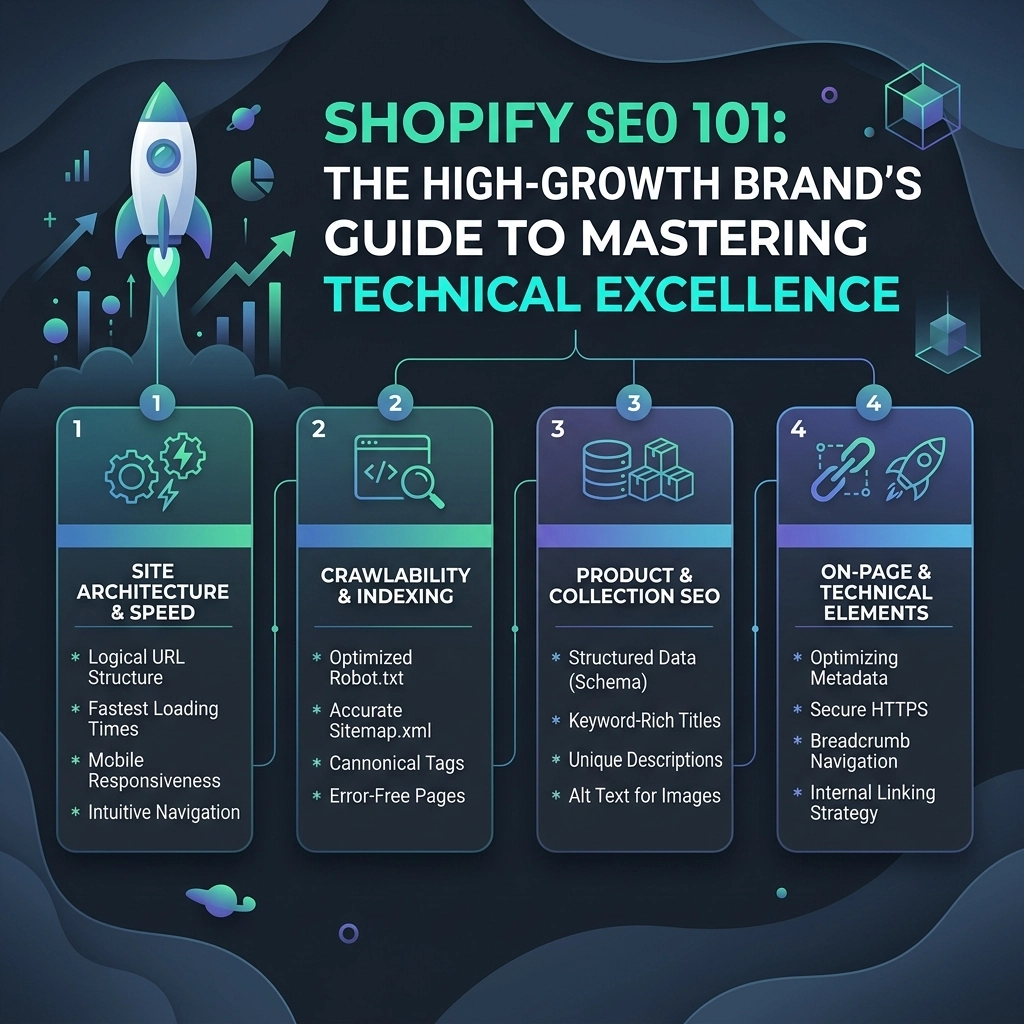
For a high-growth fashion or streetwear brand, your Shopify store is more than just a digital storefront: it is your most valuable asset. But as you scale from five-figure months to seven-figure drops, the cracks in your technical foundation can become chasms. You can have the most stunning lookbook in the world, but if Google can’t crawl your collections or your site takes five seconds to load on a 5G connection, you are leaving money on the table.
Technical SEO is the "silent engine" of your e-commerce growth. It’s not about stuffing keywords into image alt text anymore. It’s about site speed, infrastructure, and creating a frictionless path for both search engines and customers. If you want to dominate the 2026 search landscape, you need to move beyond the basics.
In this guide, we’re breaking down the technical pillars that every high-growth brand must master to achieve peak performance.
The Velocity Pillar: Shopify Speed Optimization
In the world of high-fashion and fast-moving D2C brands, speed is a ranking factor, but more importantly, it’s a conversion factor. A one-second delay in mobile load times can slash conversions by up to 20%. When we talk about Shopify speed optimization, we aren't just talking about "feeling fast": we are talking about passing Core Web Vitals (CWV).
1. App Audit and Script Management
The most common "speed killer" for Shopify stores is app bloat. Every time you install a new upsell tool, a loyalty program, or a chatbot, you add external JavaScript that drags down your performance.
- The Solution: Regularly audit your apps. If an app isn't driving direct ROI, delete it. For the ones you keep, consider using a Shopify agency to implement "lazy loading" for non-critical scripts. This ensures your main product images load before your reviews widget.
2. Image Optimization for High-Resolution Brands
Fashion brands rely on high-quality imagery. However, oversized files are the enemy of SEO.
- Use WebP formats: Shopify now automatically serves WebP images, but you should still ensure your source files are compressed.
- Implement Aspect Ratio Boxes: This prevents "Layout Shift" (CLS), a key metric in Google’s Core Web Vitals.

The Infrastructure Pillar: Mastering Shopify Development
High-growth brands eventually outgrow standard "out-of-the-box" themes. To truly scale, you need a custom approach to Shopify development that prioritizes clean code over "feature-heavy" templates.
Liquid Code Optimization
Shopify’s templating language, Liquid, is powerful, but inefficient code can slow down your server response time (TTFB).
- Avoid Excessive Loops: Iterating through every product in a huge collection to find one tag is a performance nightmare.
- Pro Tip: Use Shopify’s "Render" tag instead of "Include" for snippets. It’s a small change that offers better performance by localizing variables.
Custom Sections vs. App Blocks
Instead of using third-party page builders that inject massive amounts of CSS, invest in custom-coded sections. This keeps your codebase lean and ensures your brand identity remains consistent without the technical debt of a drag-and-drop builder.
The Discovery Pillar: Advanced Site Architecture
Search engines need a map to understand your store. For fashion brands with deep catalogs, complex color/size variants, and seasonal collections, this "map" often gets messy.
1. Fixing the Collection/Product URL Trap
By default, Shopify often creates multiple URLs for the same product (e.g., /collections/mens/products/blue-tee and /products/blue-tee). This creates duplicate content issues.
- The Fix: Edit your
product-grid-item.liquidor equivalent snippet to ensure your internal links always point to the canonical/products/URL. This consolidates link equity and helps Google index your store faster.
2. Strategic Breadcrumbs
Breadcrumbs aren't just for navigation; they are structural signals for Google. They create a clear hierarchy (Home > Men’s > Outerwear > Jackets) that helps search engines understand the relationship between pages.
3. Robots.txt and Sitemap Control
High-growth brands often have "hidden" pages: landing pages for influencers, VIP-only collections, or draft products.
- Action Step: Use the
robots.txt.liquidfile to exclude low-value pages from being crawled. This preserves your "crawl budget," ensuring Google focuses on your high-margin product pages.

The Shopify Plus Advantage for Enterprise Growth
If you are pushing high volume, Shopify Plus offers technical tools that standard plans simply don't have. Mastering these can give you a significant edge in SEO and UX.
- Shopify Scripts: These allow you to run custom logic on the server side (like complex discounts or shipping rules) without needing heavy front-end apps.
- Multipass and Custom Checkouts: While primarily for conversion, a custom checkout flow on Plus reduces bounce rates during the most critical stage of the funnel.
- International SEO (Hreflang): For global fashion brands, Shopify Plus makes managing subfolders (e.g.,
/en-gb/vs/en-us/) much easier. Ensuring your hreflang tags are correctly implemented prevents your UK site from competing with your US site in search results.
Challenges & Trade-offs: The Reality of Technical SEO
While technical excellence is the goal, there are always trade-offs to consider.
| Feature | Pros | Cons |
|---|---|---|
| Heavy Video Content | High engagement, showcases product movement. | Can drastically slow down mobile page load if not hosted correctly. |
| Third-Party Review Apps | Builds trust and provides "Social Proof" SEO. | Often adds the most third-party "weight" to your site's code. |
| Deep Collection Filtering | Helps users find specific items (size, color). | Can create thousands of "junk" URLs that confuse search crawlers. |
Key Insight: Never prioritize a design trend over a functional necessity. If a high-resolution video background kills your mobile speed, your SEO will suffer, and your "cool" factor won't matter because nobody will see the site.

The Human Side: Why Technical SEO Supports Your Brand Story
We often treat SEO like a math problem, but at its core, it’s about user experience. Google rewards sites that users love. When you invest in Shopify speed optimization, you aren't just checking a box for a bot; you are respecting your customer's time.
High-growth brands in the jewelry or beauty space need to evoke a sense of luxury. A lagging, buggy website is the digital equivalent of a dusty, disorganized physical boutique. Technical excellence is the "white-glove service" of the internet.
Your Technical SEO Checklist: Next Steps
Transitioning from a basic store to a high-performance engine doesn't happen overnight. Start with these actionable steps:
- Run a Baseline Test: Use PageSpeed Insights and GTmetrix to see where you stand today.
- Audit Your App List: Delete any app you haven't looked at in the last 30 days.
- Optimize Your Images: Ensure every image on your homepage is under 200kb.
- Fix Duplicate URLs: Ensure your internal links point to canonical product pages.
- Review Your "No-Index" Tags: Make sure your search result pages and filtered collection pages aren't being indexed.
- Consult an Expert: If your theme code looks like a bowl of spaghetti, it might be time for a professional Shopify development audit.
Scale Your Brand with Technical Precision
Mastering Shopify SEO isn't about one-time hacks; it's about building a culture of performance. As your brand grows, your technical requirements will evolve. Stay creative, but keep your foundation solid.
If you're ready to take your store to the next level of technical excellence, working with an experienced Shopify agency can save you months of trial and error. At Thriftizer, we specialize in helping high-growth D2C brands navigate the complexities of Shopify speed optimization and custom development.
Ready to optimize your growth? Check out our Shopify Expert profile to see how we’ve helped brands like yours scale to new heights.
The future of your brand is fast, accessible, and technically flawless. Start building it today.