Author: Nivi

  • Are Traditional Product Pages Dead? How to Build a “Transaction Layer” for AI Agents

    Are Traditional Product Pages Dead? How to Build a “Transaction Layer” for AI Agents

    The year is 2026, and the way your customers "shop" has fundamentally shifted. For a decade, the goal of a Shopify store was simple: capture a human’s attention with a beautiful hero image, social proof, and a shiny "Add to Cart" button.

    But today, the person clicking that button might not be a person at all.

    With the rise of autonomous AI shopping agents: think OpenAI’s Operator, Google’s Shopping AI, and specialized fashion "co-pilots": the traditional Product Detail Page (PDP) is facing a crisis of identity. To a human, your page looks like a lifestyle dream. To an AI agent, it often looks like a chaotic mess of unreadable scripts and hidden data.

    If your D2C brand wants to survive the "Agentic Era," you need to stop thinking about your website as just a visual storefront and start building a Transaction Layer.

    The Great Decoupling: How AI Agents "See" Your Store

    When a human lands on a beauty brand’s Shopify page, they look for aesthetic cues. They want to see the texture of the cream, the "before and after" photos, and the vibe of the brand.

    An AI agent has a different mission. It is looking for parameters.

    If a user tells their AI assistant, "Find me a vegan, paraben-free night cream under $60 with overnight shipping to New York," the agent doesn't care about your brand's "Our Story" video. It cares about:

    • Attributes: Is it tagged as "vegan" and "paraben-free"?
    • Logic: Is it in stock for a specific ZIP code?
    • Fulfillment: Can it be delivered by tomorrow?

    Traditional product pages are often "heavy." They are built for human eyes, which means essential data is often buried inside JavaScript or non-standard HTML. If the agent can't find the data in milliseconds, it moves to your competitor who has a cleaner "Transaction Layer."

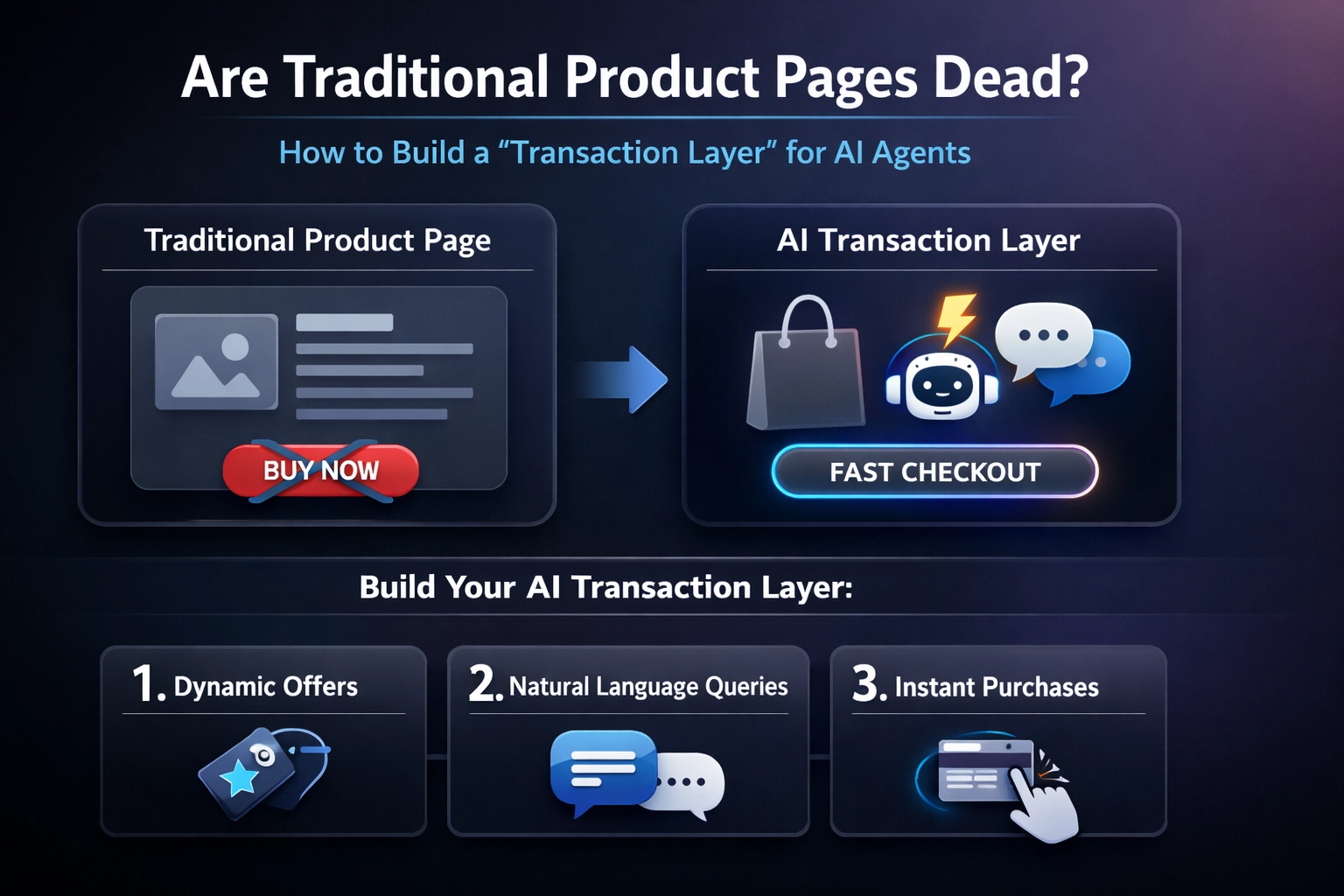
    Comparison of a visual beauty product page and a machine-readable data layer for AI shopping agents.

    What Exactly is a "Transaction Layer"?

    The Transaction Layer is the invisible architecture of your store. It is the structured, machine-readable version of your commerce experience that exists alongside your visual UI.

    Think of it as the "API-first" version of your product page. While the human interacts with the pixels, the AI agent interacts with the data schema.

    The Three Pillars of the Transaction Layer

    1. Robust JSON-LD & Schema Markup: This isn't just about basic SEO anymore. In 2026, your Schema needs to be hyper-granular. We’re talking about mapping every variant, every ingredient, and every shipping nuance into a format Google and OpenAI can digest instantly.
    2. Clean Structured Data: AI agents struggle with "creative" pricing (e.g., "Starting at $10" when the actual product is $50). A true Transaction Layer provides clear, unambiguous data points for price, currency, and availability.
    3. Real-Time API Access: If an agent is making a purchase on behalf of a user, it needs to know that the "Limited Edition Streetwear Hoodie" is actually in stock before it tries to checkout.

    Why Fashion and Beauty Brands are at High Risk

    In the D2C space, particularly in fashion and beauty, product complexity is high. A single lipstick might have 40 shades. A pair of jeans might have 12 sizes and 3 washes.

    If your Shopify theme isn't optimized for the Agentic Era, these variants often become a "black box" to AI.

    The Problem: Most themes only load variant data when a human clicks a dropdown.
    The Consequence: The AI agent only "sees" the default variant. It misses the other 39 shades, meaning you lose the sale because the agent reported the product as "unavailable" in the user’s preferred color.

    At Thriftizer, we focus on ensuring that your Shopify Plus architecture exposes this data correctly from the jump. We build stores that don't just look good but "speak" fluently to the agents that are increasingly controlling the wallet.

    Infographic showing Shopify Plus product variants organized as structured data for AI-driven commerce.

    How to Build Your Transaction Layer: A Technical Blueprint

    You don't need to delete your beautiful website. You just need to reinforce it. Here is how you bridge the gap between human-centric design and agent-centric data.

    1. Optimize for Entity Authority

    AI agents don't just look for keywords; they look for "entities." If you sell sustainable jewelry, your Transaction Layer should link your products to recognized entities in the Knowledge Graph (e.g., "Recycled Gold," "Conflict-Free Diamonds"). This builds trust with the AI, making it more likely to recommend your brand as a "verified" source.

    2. Implement "Deep" Variant Schema

    Don't settle for standard Shopify Schema. Work with a Shopify Expert to implement customized JSON-LD that describes every single SKU in detail. This includes specific attributes like fabric weight for streetwear or skin-type compatibility for beauty products.

    3. Streamline the Checkout Handshake

    The "Transaction Layer" isn't just about discovery; it's about the transaction. AI agents are moving toward "headless" checkout experiences. Ensure your Shopify store’s Cart API is robust and that your checkout flow doesn't have "bot-blockers" that accidentally prevent legitimate shopping agents from completing a purchase.

    4. Semantic Search and Metadata

    Standard search looks for exact matches. Semantic search looks for intent. Your backend metadata should be written to answer questions. Instead of just "Blue Summer Dress," your metadata should include "breathable cotton dress for outdoor weddings." This is exactly how AI agents "think" when they are searching for a solution for their user.

    Digital handshake symbolizing a seamless API-first transaction between a Shopify store and an AI agent.

    Pros and Cons of the Agentic Shift

    Pros Cons
    Higher Conversion: Agents only visit when intent is 100% confirmed. Technical Complexity: Requires deeper Shopify Plus customization.
    Reduced Return Rates: Precise data mapping ensures users get exactly what they expected. Loss of "Impulse" Branding: Harder to "wow" an agent with lifestyle imagery.
    Global Reach: AI agents can navigate your store in any language or currency via data. Evolving Standards: The "rules" for AI agents are changing monthly.

    Key Insight: While you might lose the ability to "distract" a customer with fancy pop-ups, you gain a massive advantage by being the most "efficient" option for an AI agent to buy from.

    Positioning Your Brand for the Future

    The brands that will win in 2026 and 2027 are those that treat their website as a dual-purpose asset.

    • The UI (User Interface) is your brand's soul. It’s where the storytelling happens.
    • The TL (Transaction Layer) is your brand's brain. It’s where the commerce happens.

    If you neglect the brain, the soul won't have anyone to talk to. Fashion and beauty brands, in particular, need to audit their Shopify Plus stores now. Are you still relying on a theme from 2022 that hasn't updated its Schema logic? Are your product descriptions just blocks of text, or are they structured data nodes?

    Diagram illustrating the balance between visual brand storytelling and technical AI-ready structured data.

    Start Small, Stay Creative

    Moving toward an agentic commerce model doesn't happen overnight. You don't need to rebuild your entire store from scratch. Start by auditing your most popular SKUs. Ensure their data is impeccable.

    Remember, AI is a co-pilot, not a replacement for your brand's voice. Your job is to make it as easy as possible for that co-pilot to choose your products over a thousand others.

    Your "Agent-Ready" Checklist

    Ready to move beyond the traditional product page? Follow these steps to start building your Transaction Layer today:

    1. Audit Your Schema: Use Google’s Rich Results Test to see what an AI actually "sees" when it crawls your product page.
    2. Fix Your Variants: Ensure every SKU has a unique, crawlable URL or a clearly defined data object in your JSON-LD.
    3. Optimize Page Load Logic: Move critical product data (Price, SKU, Availability) to the top of the HTML so agents don't have to wait for heavy images to load first.
    4. Enhance Metadata: Add "Attribute-Rich" descriptions that focus on specs, materials, and use-cases.
    5. Talk to an Expert: Consult with a Shopify Plus agency like Thriftizer to discuss an API-first strategy for your storefront.

    The "traditional" product page isn't dead: it's just evolving. It's time to stop building for the screen and start building for the system.

    Never ever think of giving up on the technical side of your brand. The digital landscape is shifting, but with the right structure, your Shopify store can become an unstoppable force in the era of AI-driven commerce. 🚀
  • Why Mobile-First CRO Will Change the Way You Sell Beauty Products on Shopify

    Why Mobile-First CRO Will Change the Way You Sell Beauty Products on Shopify

    In the high-stakes world of D2C beauty, your storefront isn't a brick-and-mortar boutique or even a sprawling desktop website. For over 60% of your customers, your storefront is a six-inch glass screen held in the palm of their hand.

    If you are still designing your Shopify store on a 27-inch iMac and simply "checking" how it looks on an iPhone, you are leaving significant revenue on the table. Traditional Conversion Rate Optimization (CRO) often treats mobile as a secondary thought: a condensed version of the "real" site. In 2026, this approach is a recipe for stagnation. To scale a beauty brand effectively, you must flip the script and adopt a mobile-first CRO strategy that respects the unique physiological and psychological behaviors of the mobile shopper.

    The Reality of the Mobile Beauty Shopper

    Beauty is an inherently visual and emotional category. Customers aren't just buying a liquid foundation or a vitamin C serum; they are buying a feeling, a look, and a solution to a personal concern. On mobile, the window to capture that emotion is incredibly narrow.

    Research shows that over 5.22 billion people are mobile users, and the beauty industry sees some of the highest mobile engagement rates in e-commerce. However, mobile conversion rates historically lag behind desktop. Why? Because the friction is higher. Small buttons, slow-loading high-res images, and clunky checkout forms turn a moment of "I need this" into a moment of "this is too much work."

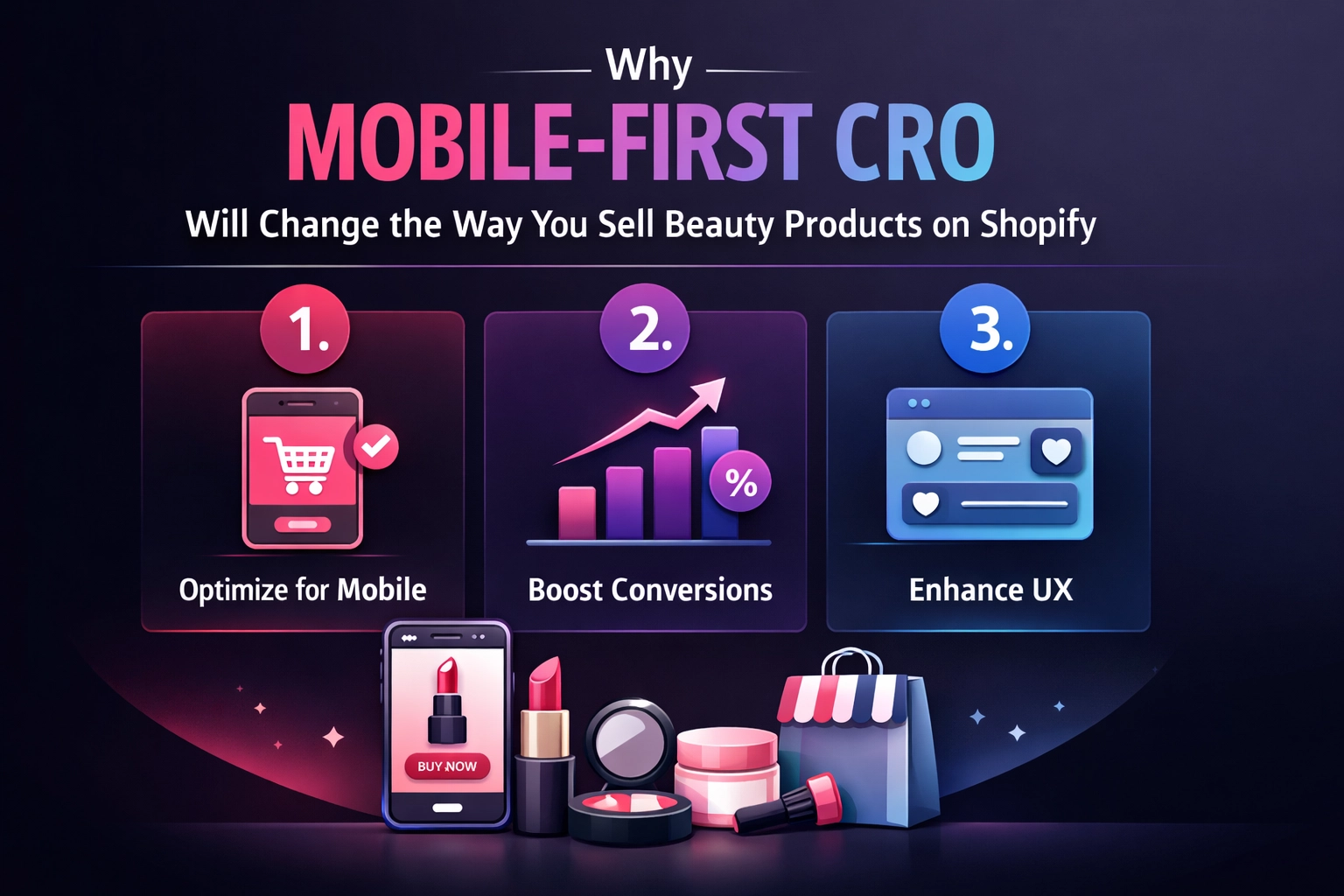
    Mobile beauty shopping on a smartphone illustrating thumb-friendly navigation and Shopify conversion icons.

    Why Traditional Desktop-First CRO is Failing Your Brand

    Most beauty brands suffer from "Legacy Design Syndrome." They build complex mega-menus, large hover-effect galleries, and detailed ingredient sidebars that look stunning on a laptop but become a navigation nightmare on a smartphone.

    The "Ghost" Click Problem: On desktop, precision is easy with a mouse. On mobile, the "fat finger" syndrome is real. If your "Add to Cart" button is too close to a "Size Guide" or "Shade Chart" link, you create frustration.

    The Information Overload: Beauty products require education: ingredients, usage instructions, and skin-type compatibility. On desktop, you have space. On mobile, long walls of text lead to "scroll fatigue." If a user has to scroll five times just to see the price, they’ve already checked their Instagram notifications and forgotten about your brand.

    Pillar 1: Thumb-Friendly Navigation and UI

    Mobile-first CRO starts with the ergonomics of the human hand. Most users navigate their phones with a single thumb. This means the most important interactive elements of your Shopify store should live within the "Natural Thumb Zone": the bottom and middle-third of the screen.

    Key Tactics for Beauty UI:

    1. Sticky Bottom CTAs: Your "Add to Cart" or "Buy Now" button should be pinned to the bottom of the screen. As the user scrolls through your beautiful product imagery, the ability to purchase is always one thumb-tap away.
    2. The Power of the Drawer: Instead of sending users to new pages for ingredient lists or "How to Use" guides, use slide-out drawers or accordions. This keeps the user on the Product Detail Page (PDP) and maintains their context.
    3. Visual Search and Filters: For beauty brands with large catalogs (e.g., 40 shades of foundation), standard dropdown menus are a conversion killer. Use visual swatches and horizontal scrolling filters that allow users to swipe through options quickly.

    Key Insight: Never make your customer reach for the top-left corner to find the menu or the search bar. Use a bottom-tab navigation bar, similar to how Instagram or TikTok functions, to keep the experience intuitive.

    Pillar 2: High-Speed Performance for Complex Variants

    One of the biggest challenges for Shopify beauty brands is the sheer weight of the site. To sell skincare or makeup, you need high-definition photography and often 4K video. Combine that with a dozen apps for loyalty, reviews, and shade-matching, and your site speed plummets.

    Data indicates that 53% of mobile users abandon a site if it takes longer than three seconds to load. For beauty brands, every second of delay can result in a 20% drop in conversions.

    Optimizing the "Variant Lag"

    When a customer taps on a different lipstick shade, they expect the image to change instantly. If there is a "ghosting" effect or a loading spinner, the magic is lost.

    • Next-Gen Formats: Use WebP or AVIF image formats to maintain crisp detail at a fraction of the file size.
    • Lazy Loading: Ensure that only the images in the viewport load first.
    • Minify the App Bloat: Many Shopify apps inject heavy scripts. Audit your store and remove anything that isn't directly contributing to the bottom line.

    If you’re struggling with these technical hurdles, working with a certified Shopify Expert can help you clean up your code and implement advanced liquid optimizations that standard themes simply don't offer.

    Infographic representing Shopify speed optimization and fast loading performance for mobile beauty brands.

    Pillar 3: Mobile-Optimized Social Proof

    In beauty, trust is the primary currency. A customer needs to know how that highlighter looks on someone with their specific skin tone. On desktop, you can have a grid of 12 reviews. On mobile, that grid becomes an endless vertical scroll.

    Transitioning to Video Reviews

    Mobile users are programmed for vertical video. Integrating TikTok-style "shoppable" video reviews directly onto your product pages is a game-changer.

    • Short-Form Content: Use 15-second clips of real customers applying the product.
    • Muted Autoplay: Ensure videos play silently as the user scrolls, with clear captions.
    • UGC Integration: Place user-generated photos directly under the variant selector so the social proof is contextual to the shade they are looking at.

    Pro Tip: Use "Verified Buyer" badges and filterable reviews (e.g., "Filter by Skin Type: Oily") to help mobile users find relevant social proof without digging through hundreds of comments.

    Pillar 4: Eliminating Friction at Checkout

    The checkout is where the most beauty sales are lost. Typing in a 16-digit credit card number and a shipping address on a tiny keyboard is the ultimate friction point.

    The Solution: One-Tap Payments.
    Integrate Shop Pay, Apple Pay, and Google Pay prominently. These tools bypass the entire data-entry phase. For a returning Shopify customer, Shop Pay can turn a 2-minute checkout process into a 5-second tap.

    Mobile Checkout Checklist:

    • Express Buttons at the Top: Put Shop Pay/Apple Pay at the very top of the checkout page.
    • Minimize Form Fields: Use address auto-complete.
    • Progress Indicators: If you must have multiple steps, show a clear progress bar so the user knows they are almost done.

    A streamlined one-tap mobile checkout process showing frictionless payment for Shopify beauty store customers.

    Challenges: The Beauty Complexity Factor

    While mobile-first is the goal, beauty brands face unique challenges that desktop handles more gracefully.

    • Shade Matching: It is difficult to accurately represent a shade on a mobile screen with varying brightness and "True Tone" settings.
      • Solution: Use descriptive text (e.g., "Cool undertones") alongside the swatch and offer a "Find My Shade" quiz that is optimized for mobile tapping, not typing.
    • Comparison Shopping: It’s harder to compare two products side-by-side on a small screen.
      • Solution: Implement a "Recently Viewed" sticky bar or a "Compare" feature that uses a mobile-optimized overlay.

    Pros and Cons of Mobile-First CRO

    Pros Cons
    Higher Engagement: Aligns with how 60%+ of customers actually browse. Design Complexity: Requires a complete shift in how you conceptualize layouts.
    Lower Bounce Rates: Faster speeds and better UI keep users on the site. Testing Hurdles: Requires testing across dozens of different screen sizes and OS versions.
    Better Ad ROI: Most social traffic (FB/IG/TikTok) is mobile; a mobile-optimized landing page increases ROAS. Initial Cost: Heavy optimization of variants and speed can require expert development.

    Next Steps for Your Shopify Beauty Store

    Don't try to overhaul your entire site in one day. Start small, stay creative, and focus on the high-impact areas first.

    1. Audit Your Speed: Run your site through PageSpeed Insights, specifically looking at the "Mobile" tab. Identify the largest contentful paint (LCP) issues.
    2. The "Thumb Test": Open your store on your own phone. Try to navigate and buy a product using only your thumb. If you have to adjust your grip or use two hands, your UI needs work.
    3. Implement Sticky CTAs: Work with a developer or use a high-quality app to add a sticky "Add to Cart" button to your PDPs.
    4. Optimize Your Media: Convert your hero images to WebP and ensure your video reviews are formatted vertically (9:16).
    5. Simplify Checkout: Enable all "Accelerated Checkout" options in your Shopify admin settings.

    At Thriftizer, we specialize in helping D2C brands navigate these technical shifts. Whether you are migrating to Shopify Plus or looking to squeeze more revenue out of your current traffic, a mobile-first approach is no longer optional: it is the foundation of growth.

    The beauty industry is evolving, and the brands that win will be those that provide the most frictionless, beautiful, and fast experience in the palm of the customer's hand. Never ever think of giving up on your optimization journey; the difference between a 2% and a 4% conversion rate is often found in these small, mobile-focused details.

    Ready to transform your mobile experience? Explore our custom packages or check out our work with brands like Crossbeats to see how we scale Shopify stores for the modern era.

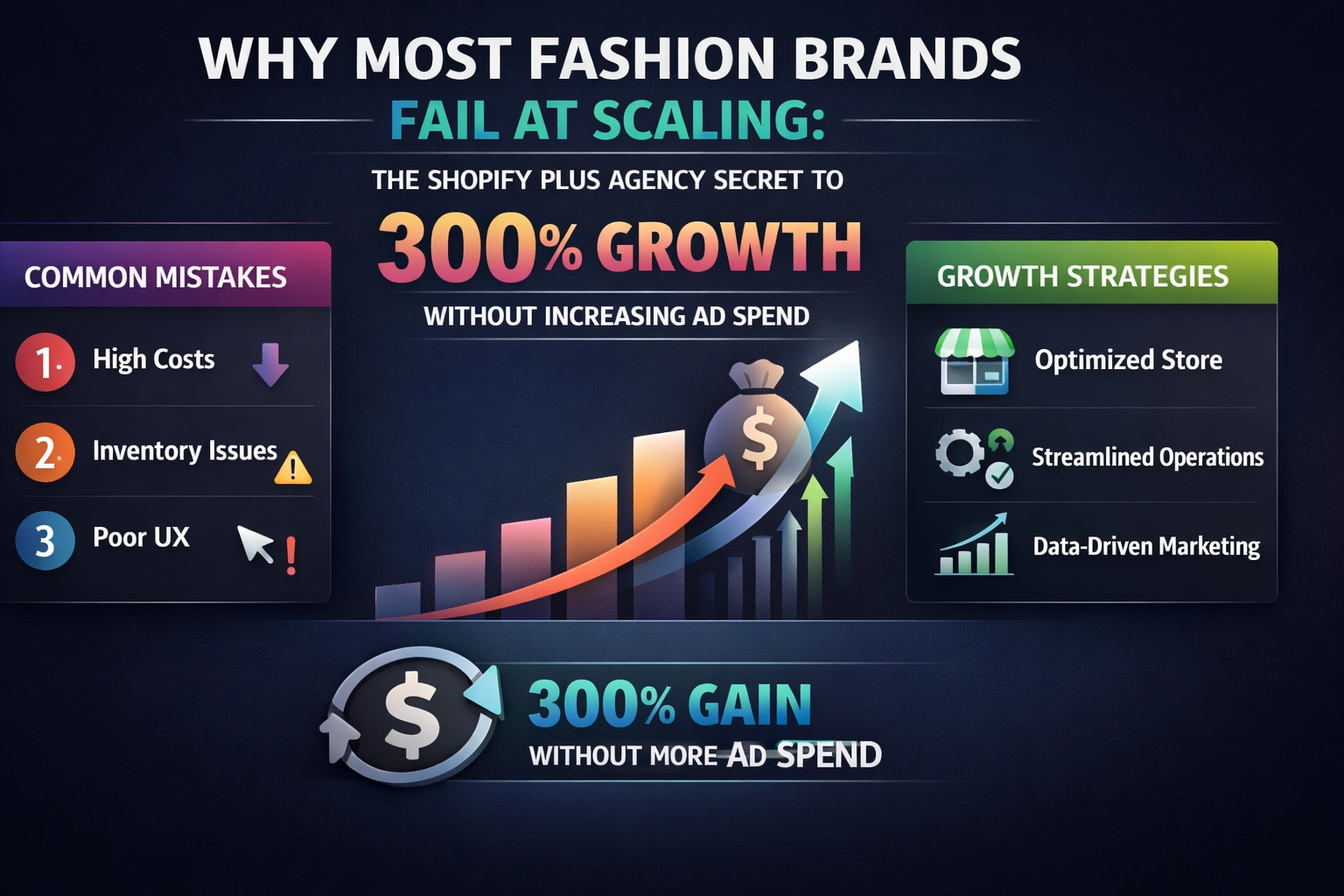
  • Why Most Fashion Brands Fail at Scaling: The Shopify Plus Agency Secret to 300% Growth Without Increasing Ad Spend

    Why Most Fashion Brands Fail at Scaling: The Shopify Plus Agency Secret to 300% Growth Without Increasing Ad Spend

    Most D2C fashion and beauty founders share a common nightmare: you’ve built a brand people love, your products are high-quality, and your social media is buzzing: but the moment you try to scale, your profit margins vanish.

    The traditional "scaling" playbook tells you to simply pump more money into Meta and Google Ads. But in 2026, that’s a one-way ticket to a "leaky bucket" business model. When your customer acquisition cost (CAC) rises alongside your budget, you aren't scaling; you’re just subsidizing Big Tech.

    The secret that top-tier Shopify Plus agencies gatekeep isn't a "hidden" ad setting. It is a fundamental shift from aggressive acquisition to systemic optimization. You can achieve 300% growth by fixing the engine, not just by adding more fuel. At Thriftizer, we call this the "Multi-Pillar Efficiency Model."

    The Scaling Paradox: Why More Traffic Isn't the Answer

    The fashion and jewelry niches are notoriously crowded. If your conversion rate is 1.5% and your repeat purchase rate is low, doubling your traffic will only double your losses if your CAC is high.

    Most brands fail at scaling because they treat their Shopify store as a static catalog rather than a dynamic conversion machine. They ignore the "Invisible Audit": the technical and psychological friction points that prevent a visitor from becoming a lifelong advocate.

    The Problem with Ad-Heavy Scaling:

    • Diminishing Returns: The more you spend, the less efficient each dollar becomes.
    • Platform Dependency: One algorithm update can wipe out your monthly revenue.
    • Margin Erosion: High ad spend leaves no room for product R&D or team expansion.

    Central glowing gear representing a Shopify store engine vs cracked gears for wasted ad spend.

    Pillar 1: Infrastructure and the "Speed to Sale" Ratio

    In the world of luxury streetwear and high-end beauty, your site's performance is your brand's digital "first impression." High-level agencies focus heavily on technical infrastructure because a 100ms delay in load time can result in a 7% drop in conversions.

    Shopify Plus Checkout Extensibility is one of the most underutilized tools for scaling. Instead of a generic checkout, top brands use this to offer hyper-relevant upsells, loyalty program prompts, and social proof at the exact moment of purchase.

    Key Infrastructure Upgrades:

    • Headless-Lite Architecture: You don't always need a full headless build. Optimizing your Liquid code and reducing "app bloat" can achieve similar speed gains.
    • Mobile-First UX: 85% of fashion traffic is mobile. If your "Add to Cart" button isn't easily reachable by a thumb, you are losing money.
    • Predictive Search: Implementing AI-driven search helps users find that specific "emerald pendant" or "oversized hoodie" in seconds.

    Pro Tip: Stop obsessing over your desktop view. Your customers are shopping on their phones while waiting for coffee. If your mobile experience is a "shrunken version" of your desktop site, you’re failing.

    Pillar 2: The Retention Revolution (Mining Your Own Gold)

    The "Agency Secret" to 300% growth without more ads is simple: Sell more to the people who already know you.

    It is 5x to 25x more expensive to acquire a new customer than to keep an existing one. For a beauty or fashion brand, the second purchase is the most important milestone in the customer journey. This is where you move from a "transaction" to a "relationship."

    The Automation Trinity:

    1. Post-Purchase Education: Send a video on how to style that new blazer or how to apply that skincare serum. This reduces returns and builds trust.
    2. Tiered Loyalty Programs: Don't just give points; give access. Early access to new drops is a powerful motivator for streetwear and fashion enthusiasts.
    3. Predictive Restock SMS: If you sell beauty products that last 60 days, send an SMS on day 50.

    Key Insight: A 5% increase in customer retention can increase profits by more than 25%. This is the math that allows brands to scale sustainably.

    Teal infinity loop showing the customer retention cycle for fashion brands to scale sustainably.

    Pillar 3: Tactical CRO – Turning Browsers into Buyers

    Conversion Rate Optimization (CRO) is often misunderstood as "changing button colors." For high-growth fashion brands, CRO is about reducing cognitive load.

    When a customer lands on your product page, they are asking: Will this fit? Is the quality good? Can I return it if I hate it? If you don't answer these questions immediately, they leave.

    High-Level CRO Strategies:

    • Dynamic Bundling: Instead of selling a shirt, sell the "Full Look." Use AI to suggest matching jewelry or accessories, increasing your Average Order Value (AOV) without increasing your CAC.
    • Visual Social Proof: Integrate UGC (User Generated Content) directly onto product pages. Seeing a "real person" wearing your clothes is more convincing than any studio photoshoot.
    • Zero-Party Data Quizzes: "Find your perfect fit" or "Which scent matches your vibe?" quizzes collect data that allows for hyper-personalized email marketing later.

    By focusing on AOV and Conversion Rate, you can triple your revenue on the exact same amount of traffic you have right now.

    Pillar 4: Preparing for the AI-Agent Era

    As we move through 2026, the way people shop is changing. We are entering the era of Agentic Commerce, where AI shopping agents will "browse" the web for users.

    To scale without ads, your Shopify store must be readable by these agents. This means your SEO needs to move beyond keywords and into structured data and semantic search.

    • Schema Markup: Ensure your product data (price, availability, material) is perfectly structured for AI scrapers.
    • Long-Tail Authority: Create content that answers specific "How-to" and "Comparison" questions. If someone asks an AI, "What are the best sustainable streetwear brands in 2026?" you want to be the answer.

    Abstract digital network representing AI shopping agents and structured product data for commerce.

    The Challenges of Scaling Without Ad Spend

    While the "300% growth without ads" strategy is powerful, it isn't easy. It requires a shift in mindset and a willingness to invest in "unsexy" backend work.

    Common Obstacles:

    • Patience: SEO and retention strategies take longer to show results than a "Turn On" Facebook ad.
    • Technical Complexity: Implementing advanced Shopify Plus features often requires a specialized Shopify Expert to ensure nothing breaks.
    • Data Overload: You need to know which metrics actually matter (CLTV, AOV, Contribution Margin) versus vanity metrics (Likes, Total Traffic).

    Next Steps: Your 300% Growth Checklist

    Ready to stop burning money on ads and start building a fortress? Follow this implementation roadmap:

    1. Audit Your Speed: Use tools to identify which third-party apps are slowing down your mobile checkout.
    2. Calculate Your LTV: Identify your top 10% of customers. Reach out to them personally or create a VIP-only offer.
    3. Fix Your Product Pages: Add a "Complete the Look" section to every product to boost AOV instantly.
    4. Automate One Flow: If you don't have a "Win-back" email flow for customers who haven't bought in 90 days, build it today.
    5. Review Your Data: Look at your "Product Affinity" reports in Shopify. What products are people frequently buying together? Create a bundle for them.

    Scaling a fashion brand in 2026 is about being smarter, not just louder. By optimizing your infrastructure, focusing on the customers you already have, and leveraging the full power of the Shopify ecosystem, you can build a brand that thrives on profit, not just hype.

    If you are looking for a partner to help navigate these technical waters and unlock your store's true potential, the team at Thriftizer is here to help. We specialize in taking high-potential fashion and beauty brands and turning them into market leaders through data-driven digital marketing and Shopify expertise.

    Start small, stay creative, and remember: your profit is in the process.

  • Stop Wasting Time on “Speed Apps”: Try These 5 Shopify Speed Optimization Hacks Instead

    Stop Wasting Time on “Speed Apps”: Try These 5 Shopify Speed Optimization Hacks Instead

    You’ve seen the ads. "Boost your Shopify speed in one click!" "Instant 90+ PageSpeed score!" It sounds like a dream for any frustrated store owner watching their bounce rate climb as their site crawls. You install the app, pay the $10 or $20 monthly fee, and… nothing really changes. Or worse, your site feels "glitchy," and your developer tells you your theme’s code looks like a bowl of spaghetti.

    Here’s the hard truth: Most "speed apps" are just fancy band-aids. They often work by "lazy loading" elements in a way that tricks speed testing tools but doesn't actually improve the real-world user experience. In many cases, these apps add more JavaScript to your site to "manage" your other scripts, effectively adding weight to a person who’s already struggling to run a marathon.

    If you want a truly fast store, the kind that converts high-intent traffic for your beauty, fashion, or streetwear brand, you need to stop looking for a "magic button" and start looking at the code. As a Shopify development agency, we’ve cleaned up hundreds of stores bogged down by app bloat.

    Let’s dive into the five developer-level hacks for Shopify speed optimization that actually move the needle in 2026.

    1. The "Clean Slate" Strategy: Migrate to Shopify OS 2.0

    If your store is still running on a legacy theme from three or four years ago, no amount of optimization will make it "fast" by modern standards. Older themes weren't built with the efficiency of Online Store 2.0.

    Switching to a modern, speed-optimized theme like Dawn or a high-performance premium theme is the single most impactful move you can make. These themes are built using "Liquid" in a way that minimizes server response times and prioritizes the "First Contentful Paint" (how fast a user sees the first piece of content).

    Why this works better than an app:

    Apps can’t fix a fundamentally broken foundation. An OS 2.0 theme allows for native sections and blocks, reducing the need for "layout-building" apps that inject massive amounts of CSS and JS into your store.

    Pro Tip: Before committing to a new theme, run the developer’s demo store through Google PageSpeed Insights. If their own demo doesn't hit a 80+ on mobile, keep looking.

    Comparison of cluttered legacy code versus clean, optimized Shopify OS 2.0 code for faster page loading.

    2. Image Optimization: The "Save for Web" Lost Art

    Images are almost always the biggest resource hogs on a Shopify site, especially for visual-heavy niches like jewelry or streetwear. Most store owners think "optimization" just means "compression." It’s much more than that.

    While apps like TinyIMG are great, they don't solve the problem of improper scaling. If you upload a 4000px wide image into a container that only displays at 400px, you’re forcing the user’s browser to download a massive file and then do the work of resizing it.

    The Developer Method:

    1. Use WebP Format: It’s 30% smaller than JPEG without losing quality. Shopify now handles this natively, but you need to ensure your Liquid code is calling the optimized versions.
    2. Explicit Dimensions: Ensure your code specifies width and height attributes. This prevents "layout shift," which is a major factor in your Google Core Web Vitals score.
    3. Strategic Lazy Loading: Modern Shopify themes have lazy loading built-in. However, you should never lazy load your hero image (the "above the fold" content). This should load instantly to give the user a sense of speed.

    Key Insight: One perfectly scaled and compressed hero image is worth more for your conversion rate than a dozen blurry, poorly compressed ones.

    3. The "App Audit" (Killing the Ghost in the Machine)

    Every time you install an app to "add a star rating" or "create a countdown timer," a snippet of code is injected into your theme.liquid or added as a script tag. When you uninstall that app, the code often stays behind.

    These "ghost scripts" continue to try and pull data from servers that no longer exist, causing your site to hang while it waits for a response.

    How to perform a manual audit:

    • Check your theme.liquid file: Look for tags that mention apps you deleted months ago.
    • Use the Inspector: Right-click on your store, hit "Inspect," go to the "Network" tab, and refresh. Look for red lines or files that take forever to load.
    • Consolidate: Do you really need three different apps for "Product Reviews," "Insta-feed," and "Upsells"? A Shopify expert can often code these features directly into your theme, removing the need for external scripts entirely.

    Digital dashboard visual showing a Shopify expert removing app bloat and optimizing site scripts.

    4. Eliminate Excessive HTTP Requests (The "Font" Trap)

    Every single font file, icon set, and tracking pixel is a separate "request" your browser has to make to a server. If your store is making 150+ requests, it’s going to be slow, regardless of how "optimized" your images are.

    The biggest silent killer? Custom Fonts. If you’re loading five different weights of a custom Google Font, you’re adding hundreds of kilobytes to every page load.

    The Speed Hack:

    • Stick to System Fonts: It might sound boring, but using system fonts (like Arial, Helvetica, or San Francisco) is the fastest way to load text. They require zero HTTP requests because they’re already on the user’s device.
    • Limit to Two Weights: If you must use a custom brand font for your beauty line, use one for headings and one for body text. Skip the "Light," "Semi-bold," and "Extra-bold" variations.
    • App Script Management: Use a "Script Manager" approach to ensure tracking pixels (Meta, TikTok, Google) only fire when necessary, rather than loading everything on the initial page paint.

    5. Preconnect and Preload Critical Assets

    This is where we get into the "developer magic" that no $10 app can do effectively. "Preloading" tells the browser, "Hey, I know you’re busy, but this specific file is really important for the user to see, so download it first."

    By adding a simple line of code to your theme’s <head>, you can preconnect to your font files or your primary CSS.

    Why this beats a "Speed App":

    Most apps try to delay everything to make the "load time" look better on paper. But for a real human user, a "jumpy" site where text appears 3 seconds after the background is frustrating. Professional Shopify speed optimization ensures the elements the user interacts with first are prioritized properly.

    Next Steps Checklist:

    1. Run a Baseline Test: Use PageSpeed Insights and note your mobile score.
    2. Delete 3 Unused Apps: We promise you don't need that "falling snow" effect or the third-party chat widget that no one uses.
    3. Optimize Your Hero Image: Manually resize it and re-upload it.
    4. Audit Your Fonts: Reduce your font count to two.
    5. Consult a Pro: If your score is still in the red, it’s time to stop DIYing.

    Infographic illustrating the balance between high Shopify speed and essential store features for D2C brands.

    Challenges: Why "Perfect" Speed is Hard

    It’s important to be realistic. If you’re running a high-growth D2C brand, you probably need a few apps for things like subscriptions, loyalty programs, and advanced analytics. These will slow down your site slightly.

    The goal isn't necessarily a 100/100 score: it's a fast, frictionless experience for your customers. A 70 score on mobile with a smooth, high-converting checkout is better than a 100 score on a site that has no features.

    Why a Professional Service Beats a Monthly App

    While apps offer a recurring cost for a temporary fix, a Shopify development agency provides a permanent structural improvement. We don't just hide the mess; we clean the kitchen.

    When you work with a Shopify expert, you get:

    • Custom Liquid coding that replaces bulky apps.
    • Script sequencing so your marketing pixels don't stop your customers from seeing your products.
    • Database clean-up to remove years of accumulated junk.

    At Thriftizer, we specialize in making Shopify stores lean, mean, conversion machines. Whether you're a luxury beauty brand or a fast-paced streetwear label, speed is your competitive advantage.

    Ready to stop wasting money on apps that don't work? Check out our Shopify Expert profile to see how we’ve helped brands like yours scale. Or, if you’re ready to get under the hood of your own store, head over to Thriftizer and let’s talk about a real performance audit.

    Start small, stay creative, and remember: Speed is a feature, not an afterthought.

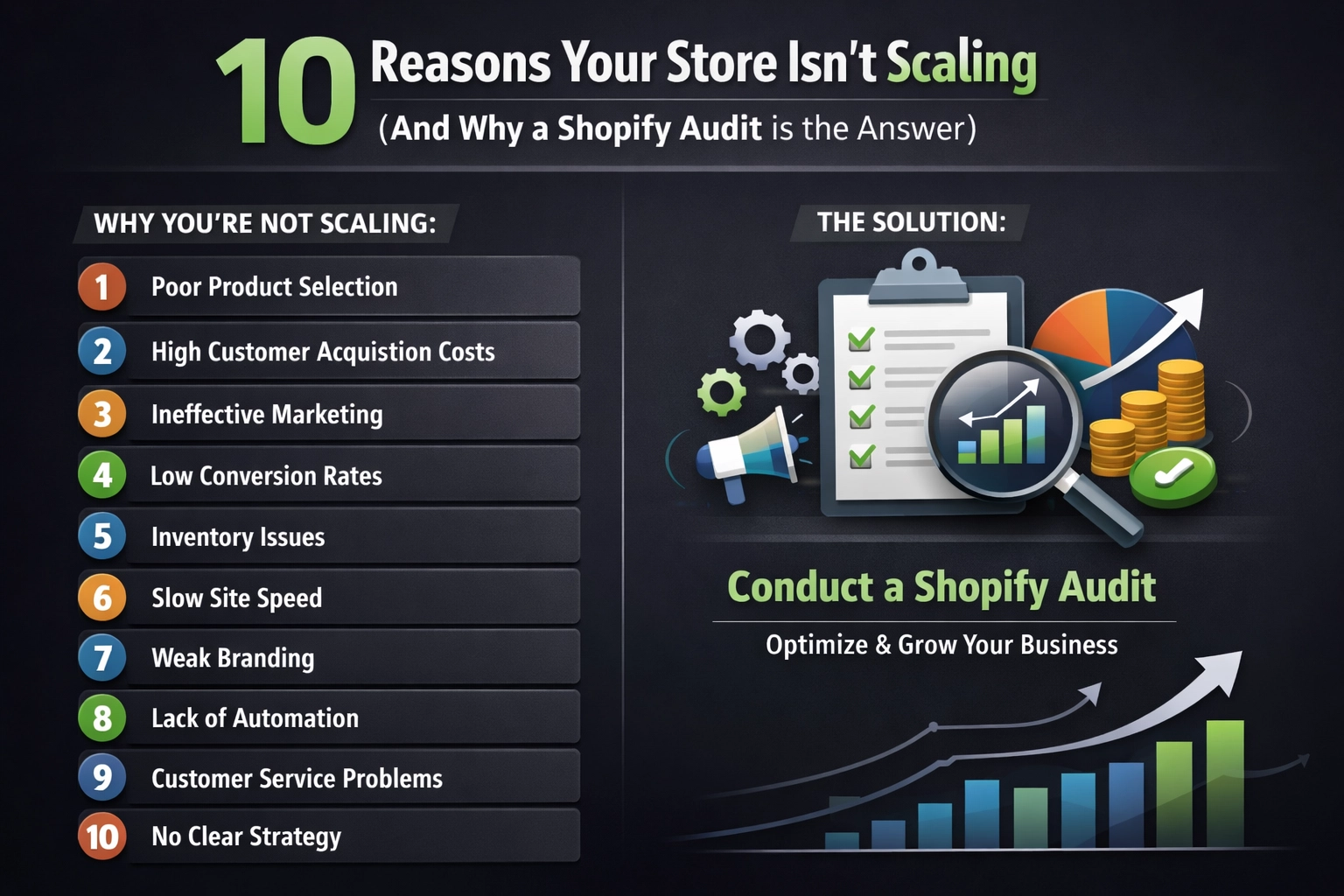
  • 10 Reasons Your Store Isn’t Scaling (And Why a Shopify Audit is the Answer)

    10 Reasons Your Store Isn’t Scaling (And Why a Shopify Audit is the Answer)

    You’ve built a brand. Your beauty palettes are pigmented to perfection, or your streetwear drops are selling out in minutes. You’re doing "okay," but "okay" isn't why you started this. You want to scale. You want to hit those mid-seven or eight-figure milestones, yet every time you pump more money into ads, your profit margins do a vanishing act.

    It feels like you’re driving a Ferrari with the handbrake on.

    In 2026, the D2C landscape is more crowded than a sample sale in Soho. If your store isn't scaling, it’s rarely a "marketing" problem; it’s usually a systemic one. Before you fire your media buyer or double your ad spend, you need to look under the hood.

    Here are the 10 reasons your Shopify store is stuck in neutral: and why a systemic Shopify audit is the only way to release the brake.


    1. The "App Graveyard" is Killing Your Speed

    We’ve all been there. You see a cool feature on a competitor’s site and think, "I need that!" Three minutes later, you’ve installed a new app. Fast forward a year, and your store is bloated with 30+ apps, half of which you don't even use.

    Each app injects scripts into your theme. These scripts fight for attention like toddlers at a birthday party, causing your load times to plummet. In the world of fashion and beauty, where visual storytelling is everything, a slow site is a death sentence. Shopify speed optimization isn't just about passing a test; it’s about keeping a customer from bouncing back to Instagram before your hero image even loads.

    Pro Tip: Every 100ms delay in load time can decrease conversions by 7%. Audit your apps monthly. If it doesn’t directly contribute to UX or Revenue, delete it.

    2. Technical Debt and "Spaghetti Code"

    If you’ve had multiple developers "tweak" your store over the years, your liquid files probably look like a bowl of spaghetti. This technical debt makes it impossible to launch new features quickly. When your code is messy, even a small change can break your entire checkout flow.

    A professional Shopify audit identifies these hidden conflicts. It’s about moving from a "patched-together" store to a high-performance machine that can handle the traffic spikes of a viral TikTok moment.

    A Shopify audit visual showing the transition from messy code to a high-performance, organized store system.

    3. High Customer Acquisition Cost (CAC) vs. Anemic LTV

    Throwing money at social media ads is easy. Making that money back is the hard part. If you’re a makeup brand selling a $25 lipstick but spending $20 to acquire that customer, you’re not scaling; you’re subsidizing the ad platforms.

    Scaling requires a system that prioritizes Lifetime Value (LTV). If your store doesn't have a systemic way to cross-sell, up-sell, or re-engage customers via automated workflows, you’re stuck on the "acquisition treadmill."

    4. The Silent Killer: Checkout Friction

    You’ve done the hard work. They found you, they liked the clothes, they added to the cart… and then they vanished.

    Why? Maybe your shipping costs were a surprise. Maybe you asked for their phone number twice. Or maybe your mobile checkout UI feels like it was designed in 2012. Friction at the finish line is the most expensive mistake you can make. A systemic audit looks at the "Decision Pillar": ensuring that once a customer decides to buy, nothing gets in their way.

    5. Mobile UX is an Afterthought

    For apparel and jewelry brands, 80-90% of your traffic is likely mobile. Yet, many founders still manage their stores from a 27-inch desktop monitor. If your "Add to Cart" button is below the fold or your navigation menu is a labyrinth, your mobile shoppers will quit.

    Key Insight: Scaling in 2026 requires a mobile-first philosophy. Your site shouldn't just be "responsive"; it should be designed for thumbs, not mouse clicks.

    Premium mobile UX interface for an apparel store highlighting a seamless, mobile-first shopping experience.

    6. Overburdened Customer Support

    As you scale from 50 orders a day to 500, your support tickets don't just grow: they explode. If your team is manually answering "Where is my order?" (WISMO) emails all day, they aren't helping you grow.

    Scaling requires automated systems. From AI-driven helpdesks to self-service tracking portals, your operations must be built to handle volume without adding infinite headcount.

    7. The Return Rate Trap

    In the fashion world, returns are a silent profit eater. If your size guides are confusing or your product photos use filters that distort colors, your return rate will skyrocket as you scale.

    A systemic audit looks at the "Trust Pillar." Are you providing enough information to ensure the customer gets it right the first time? Accurate descriptions, UGC (User-Generated Content), and video reviews are essential tools to lower return rates and protect your margins.

    8. Inventory Ghosting and Out-of-Stock Loops

    There is nothing more frustrating than running an ad for a product that is out of stock. Or worse, having "Ghost Inventory" where the site says it's available, but the warehouse is empty.

    Without a tight integration between your Shopify store and your inventory management system, scaling will lead to overselling, unhappy customers, and potential bans from payment gateways.

    9. Lack of "Trust Signals"

    In beauty and skincare, trust is the primary currency. If your site looks "scammy" or lacks clear social proof, shoppers will hesitate.

    • Do you have an "About Us" page that tells a story?
    • Is your SSL certificate prominent?
    • Are your reviews authentic?

    If the answer is "I think so," you need an audit. Trust is a system, not a badge. You can learn more about building brand authority on our About Page.

    Luxury beauty brand products featuring trust icons to build customer authority and store credibility.

    10. Data Blindness: You’re Guessing, Not Growing

    Many founders scale based on "vibes." They "feel" like the New Year's campaign worked. In 2026, vibes don't pay the bills. If you aren't tracking your conversion rate by device, your bounce rate by landing page, and your net profit after all fees, you’re flying blind.

    A Shopify agency doesn't just look at the design; they look at the data. They find the leaks in your bucket so you can stop pouring water (and money) into a broken system.


    Why a "Systemic Audit" is the Answer

    Most audits are just a checklist of "fix this broken link" or "add a meta tag." A systemic audit is different. At Thriftizer, we look at your store as an interconnected ecosystem.

    We break it down into four key layers:

    1. Discovery: How are people finding you, and is the landing experience seamless?
    2. Trust: Does your brand look like a leader in the beauty or fashion space?
    3. Intent: Is the product information clear enough to drive a "Yes"?
    4. Decision: Is the checkout fast, local, and frictionless?

    By identifying the bottlenecks in these four areas, we don't just fix your store; we prepare it for the next level of growth. Whether it's Shopify speed optimization or a total UX overhaul, the goal is a profitable, scalable business.

    Infographic of a systemic Shopify audit framework focusing on discovery, trust, intent, and decision layers.

    The Challenges of Doing It Alone

    • Objectivity: It’s hard to see the flaws in your own "baby."
    • Technical Depth: You might know marketing, but do you know how to optimize a database call?
    • Time: Every hour you spend trying to fix a CSS bug is an hour you aren't spent on product innovation or brand vision.

    Never ever think of giving up just because things feel stagnant. Sometimes, the solution is simply a fresh set of expert eyes.


    Next Steps: Transition from Consumption to Implementation

    If you’re ready to stop guessing and start scaling, here is your action plan:

    1. Perform a "Speed Test": Use a tool to see your real-world mobile load times. If it's over 3 seconds, you have work to do.
    2. Audit Your Apps: Delete anything you haven't used in the last 30 days.
    3. Ghost Your Own Checkout: Try to buy a product on your phone using a weak data signal. Note every point of frustration.
    4. Check Your Unit Economics: Calculate your true profit after COGS, Shipping, Marketing, and Shopify fees.
    5. Hire a Professional: If you're serious about reaching the next tier, it’s time to work with a dedicated Shopify agency.

    Scaling is a science, not a secret. By fixing the foundational bottlenecks in your store, you create a platform that doesn't just survive traffic: it thrives on it.

    Ready to see what's actually holding you back? Check out our Shopify Expert profile and let's build something systemic. Start small, stay creative, and let the data lead the way.

    Your brand deserves to grow. Don't let a hidden bottleneck stand in the way.

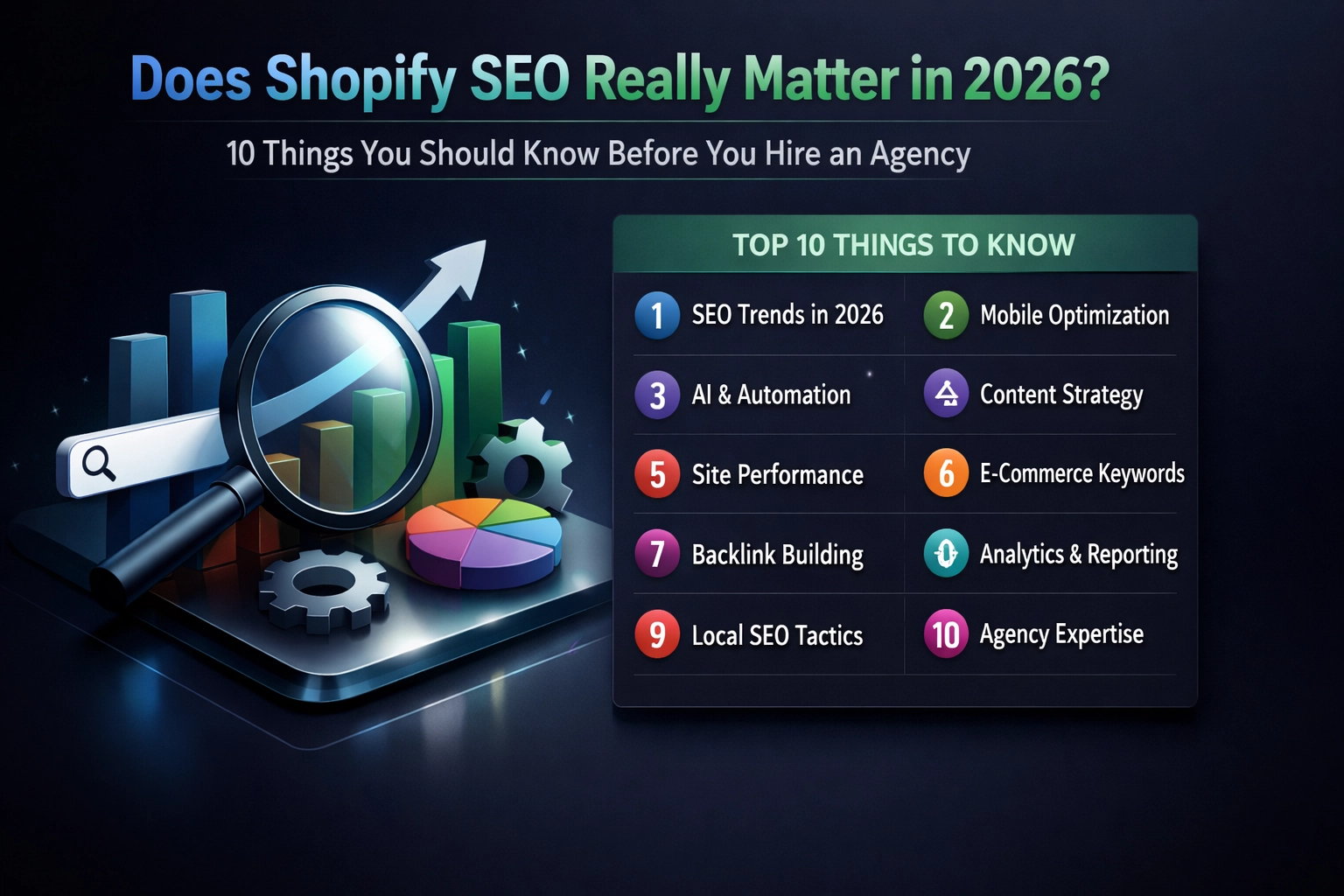
  • Does Shopify SEO Really Matter in 2026? 10 Things You Should Know Before You Hire an Agency

    Does Shopify SEO Really Matter in 2026? 10 Things You Should Know Before You Hire an Agency

    Let’s be honest: the digital landscape in 2026 is louder than ever. If you’re running a D2C brand in the fashion, beauty, or jewelry space, you’ve probably felt the squeeze. Ad costs are climbing, social media algorithms are unpredictable, and the "quick win" hacks of five years ago just don't move the needle anymore.

    You’ve likely asked yourself: Does Shopify SEO really matter in 2026?

    The short answer is yes, but not in the way it used to. SEO isn't just about "ranking for keywords" anymore. It’s about building a repeatable growth system that captures high-intent customers while your competitors are busy burning their margins on expensive PPC campaigns.

    Before you sign a contract with a Shopify agency, you need to understand how the game has changed. Here are the 10 things you must know to ensure your investment leads to actual scaling, not just a fancy report of "vanity metrics."


    Layer 1: Discovery (The Technical Engine)

    In the Discovery phase, your goal is to ensure search engines can actually find, crawl, and understand your store. If your technical foundation is shaky, no amount of pretty product photos will save you.

    1. Indexing and Structure Trump "Best Practices"

    In 2026, simply having a sitemap isn't enough. Search engines are more selective about what they index to save on "crawl budget." A professional Shopify expert knows that your store’s architecture, how your collections link to products and how your navigation is nested, is the primary signal of relevance.

    If your site structure is a mess of "tag" pages and duplicate content, you're essentially invisible. You need a clean, logical hierarchy that tells search engines exactly what you sell and why it matters.

    2. Speed is a Revenue Metric, Not Just a Technical One

    We’ve moved past the era where a 3-second load time was "okay." In 2026, site speed is a direct ranking factor and a massive conversion killer. For fashion and beauty brands with high-res imagery, this is a constant battle.

    When conducting a Shopify audit, look for "Interaction to Next Paint" (INP) scores. It's not just about how fast the page loads; it's about how responsive it feels when a user clicks a "Buy Now" button. High-performance stores use optimized image formats and lean code to stay ahead.

    A glowing stopwatch illustrating Shopify site speed and performance optimization for D2C brand stores.

    3. Mobile-First is the Only Index

    If your store isn't optimized for a flawless mobile experience, you are losing. Search engines now primarily evaluate the mobile version of your site. For streetwear and jewelry brands, where the majority of discovery happens on mobile devices during "scroll-time," this is non-negotiable. Your Shopify SEO services should focus on mobile usability, touch-target spacing, and mobile-specific speed optimizations.

    Pro Tip: Don't just check your site on an iPhone. Test it on mid-range Android devices. That’s where you’ll find the real performance bottlenecks.


    Layer 2: Trust (The Authority Builder)

    Once you’re discoverable, you have to prove you’re a legitimate brand. In 2026, search engines prioritize stores that demonstrate Experience, Expertise, Authoritativeness, and Trustworthiness (E-E-A-T).

    4. Quality Backlinks Over Quantity

    The days of buying 500 directory links for $50 are long gone. In fact, doing that in 2026 will likely get your store penalized. Today, authority is built through genuine brand mentions.

    Think digital PR, high-end fashion blog features, and partnerships with industry leaders. When a reputable jewelry magazine links to your collection, it sends a massive trust signal to search engines. A top-tier Shopify agency focuses on earning these "power links" rather than chasing volume.

    5. Structured Data is Your Secret Weapon

    Have you noticed how some search results show star ratings, prices, and stock levels directly on the results page? That’s Schema Markup (Structured Data). Shopify doesn't always handle this perfectly out of the box.

    By injecting specific code into your product and review pages, you help search engines display "rich snippets." This significantly increases your click-through rate (CTR) because it builds immediate trust with the shopper before they even click your link.

    6. The "Human" Factor in Content

    Search engines are getting incredibly good at spotting AI-generated fluff. While AI is a great co-pilot for brainstorming, your brand's voice must be human. For a beauty brand, this means showing real results, featuring expert advice from aestheticians, and sharing authentic customer stories. Real expertise creates a moat around your brand that robots can't replicate.


    Layer 3: Intent (The Conversion Engine)

    SEO is useless if it brings the wrong people to your store. You need to capture shoppers at the moment they are ready to pull out their credit cards.

    7. Collection Pages are Your Profit Centers

    Most D2C brands spend all their energy on the homepage or individual product pages. But for SEO, Collection Pages are the real heavy hitters.

    Think about it: someone searching for "oversized sustainable hoodies" doesn't want to land on a single product; they want to see your entire range. Your collection pages should be treated as "mini-homepages," complete with optimized headers, descriptive copy, and internal links that guide the user (and the search engine) through your catalog.

    Infographic showing organized Shopify collection page architecture for beauty and fashion brand growth.

    8. Target Buyer Intent, Not Just Keywords

    Generic keywords like "shoes" are impossible to rank for and rarely convert. In 2026, successful brands target "long-tail" keywords that signal high intent.

    • Low Intent: "Skincare"
    • High Intent: "Organic vitamin C serum for sensitive skin"

    By focusing your Shopify SEO services on these specific queries, you're attracting customers who have already decided what they want: they’re just looking for someone to buy it from.

    9. Blogging with a Purpose (Topic Clusters)

    Don't just blog for the sake of blogging. Use your blog to create "Topic Clusters." If you sell high-end watches, write about "How to care for automatic movements" or "The history of dive watches."

    These articles support your main commercial pages by building topical authority. When you link from an informative blog post to a product page, you’re passing "link equity" and telling search engines, "We aren't just selling products; we are experts in this field."


    Layer 4: Decision (Hiring Your Partner)

    The final step is choosing who will help you execute this system. This is where most brands make their biggest mistake.

    10. System-Based Growth vs. One-Off Tasks

    Many agencies offer "SEO packages" that include a set number of blogs and links per month. This is a red flag. SEO in 2026 requires a dynamic, system-based approach.

    You need a partner who understands the intersection of technical performance, content strategy, and user experience (UX). You aren't just looking for someone to "do SEO"; you’re looking for a Shopify expert who can integrate into your growth strategy and treat your store as a living, breathing ecosystem.

    Key Insight: A great agency won't promise you "Rank #1 in 30 days." They will talk about sustainable traffic growth, conversion rate improvements, and long-term brand equity.


    Challenges to Expect

    While the rewards are massive, Shopify SEO in 2026 isn't without its hurdles:

    • App Bloat: Every new app you add to your Shopify store can slow it down and create code conflicts.
    • Algorithm Volatility: Search engines update their logic constantly. You need a strategy that is resilient to these shifts.
    • Content Saturation: There is a lot of noise out there. Standing out requires genuine creativity and a unique brand perspective.

    Start small, stay creative. You don't need to fix everything overnight. Focus on your technical foundation first, then move to your collection pages.


    Your 2026 Shopify SEO Checklist

    If you’re ready to stop guessing and start growing, follow these next steps to prepare your store for the future:

    1. Run a Professional Audit: Don't rely on free online tools. Get a comprehensive Shopify audit that looks at your code, speed, and architecture.
    2. Clean Up Your Redirects: Ensure you don't have broken links (404 errors) dragging down your site's health.
    3. Optimize Your Top 5 Collections: Add unique, helpful content to your best-selling categories.
    4. Audit Your App List: Remove any Shopify apps you aren't actively using to boost your site speed.
    5. Check Your Mobile UX: Spend 15 minutes trying to buy something from your own store using an old mobile phone. Fix the friction points.
    6. Partner with the Right Experts: Look for a team that understands the nuances of the Shopify platform.

    At Thriftizer, we don’t believe in "one-size-fits-all" marketing. We build custom growth engines for D2C brands that want to scale without losing their soul. Whether you need a technical deep dive or a full-scale SEO strategy, our team of Shopify experts is here to help you navigate the complexities of 2026.

    Ready to see what's actually holding your store back? Visit Thriftizer and let’s build something that lasts. Never ever think of giving up on organic growth: it’s the most valuable asset your brand can own.

  • The ROI Engine: Why Speed and Design are the New D2C Currency

    The ROI Engine: Why Speed and Design are the New D2C Currency

    In the world of high-growth fashion, beauty, and streetwear, "growth" is often treated like a mystery. Brands throw money at social media ads and hope for the best. But here is the reality of 2026: traffic is expensive, and attention spans are shorter than a 5-second video clip.

    If your online store isn’t converting, pouring more money into ads is like trying to fill a bucket with a massive hole in the bottom. To scale, you need a system. At Thriftizer, we view growth not as a series of "hacks," but as a repeatable, high-performance engine.

    The fuel for this engine? Shopify speed optimization and Shopify website design.

    When your site loads in the blink of an eye and looks like a high-end editorial magazine, you aren't just selling a product: you are building an ROI machine. Let’s break down the architecture of the modern D2C system.


    The Four-Layer ROI Engine

    To understand how your brand scales, you have to stop looking at your website as a static page. It is a layered system of psychological triggers and technical benchmarks.

    Layer Focus Area Goal
    Layer 1: Discovery Mobile Speed & Technical SEO Ensure the visitor actually reaches the site.
    Layer 2: Trust Brand Design & Visual Hierarchy Stop the scroll and build immediate credibility.
    Layer 3: Intent Conversion Rate Optimization (CRO) Turn passive browsers into active shoppers.
    Layer 4: Decision Frictionless Checkout & LTV Maximize the value of every single click.

    Layer 1: The Discovery Gate (Shopify Speed Optimization)

    You can have the most beautiful jewelry or streetwear brand in the world, but if your site takes more than three seconds to load on a mobile device, half of your audience is gone before they even see your logo.

    Speed is no longer a "technical detail." It is the gatekeeper of your ROI. In the mobile-first era, search engines and social platforms prioritize sites that deliver instant gratification.

    Why Mobile Speed is Non-Negotiable

    Most fashion and beauty purchases happen during "micro-moments": on the bus, during a lunch break, or while lounging on the sofa. These users are often on cellular data, not high-speed fiber.

    Pro Tip: Aim for a "Time to Interactive" of under 2.5 seconds. Anything slower, and your cost-per-acquisition (CPA) starts to climb because you are paying for clicks that never actually land on your site.

    How to optimize for speed without losing quality:

    1. Lazy Loading Images: Ensure images only load as the user scrolls.
    2. App Audit: Delete any Shopify apps you aren't using. They carry "ghost code" that slows everything down.
    3. Next-Gen Image Formats: Use modern file types that offer high resolution at a fraction of the file size.

    Mobile phone displaying a fast-loading Shopify store interface for superior speed optimization and performance.


    Layer 2: The Trust Anchor (Shopify Website Design)

    Once the site loads, you have exactly 50 milliseconds to make a good impression. This is where Shopify website design does the heavy lifting.

    For niches like premium jewelry or high-end beauty, design is the product. If your site looks cluttered or "templated," consumers subconsciously associate that lack of polish with your product quality.

    The Aesthetics of Conversion

    A high-converting design for 2026 isn't about adding more "stuff." It’s about high-contrast layouts and intentional whitespace.

    • Visual Hierarchy: Your most important information (the "Buy" button or the value proposition) should be the most visually dominant element on the page.
    • Mobile-First Navigation: Since 80%+ of your traffic is mobile, your menu should be easy to navigate with a thumb, not a mouse.
    • Editorial Photography: Use high-resolution, lifestyle-oriented imagery that tells a story.

    Key Insight: Good design makes the price irrelevant. Great design makes the purchase feel like an investment.


    Layer 3: The Intent Catalyst (Shopify Conversion Rate Optimization)

    You’ve got the speed. You’ve got the look. Now, you need the action. This is the realm of Shopify conversion rate optimization (CRO).

    CRO is the art of removing friction. Every click a user has to make is an opportunity for them to leave. Your job is to build a "slippery slope" that leads directly to the checkout.

    CRO Tactics for Growth Brands

    1. Sticky "Add to Cart": On mobile, keep the buy button visible even as the user scrolls through product details.
    2. Social Proof Integration: Don't just hide reviews at the bottom. Bring "Verified Buyer" badges and user-generated content (UGC) closer to the product title.
    3. Predictive Search: Help users find what they want faster with a search bar that suggests products in real-time.

    The Challenges of CRO:
    While CRO is powerful, the biggest challenge is "Over-Optimization." If you add too many countdown timers, pop-ups, and "5 people are looking at this" notifications, you destroy the trust you built in Layer 2. Be persuasive, not annoying.

    Modern infographic showing the stages of Shopify conversion rate optimization and the digital customer journey.


    Layer 4: The Decision (Frictionless Checkout)

    The final step of the ROI engine is the transition from "Cart" to "Thank You."

    In the jewelry and beauty sectors, unexpected shipping costs or a complicated multi-step checkout are the primary reasons for cart abandonment. To fix this:

    • Use one-page checkouts.
    • Offer multiple "Buy Now, Pay Later" options.
    • Clearly display shipping and return policies right on the product page.

    Marketing as a Repeatable System

    Scaling a brand isn't about catching lightning in a bottle. It’s about building a system where:
    [Optimized Speed] + [High-End Design] + [Aggressive CRO] = Higher Average Order Value (AOV).

    When these three elements work together, your marketing spend becomes significantly more efficient. Instead of needing 1,000 visitors to make 10 sales, you start making 30 sales from the same 1,000 visitors. That is how you win in a competitive market.

    Pros and Cons of Systemic Growth

    Pros:

    • Lower Ad Costs: Higher conversion rates mean you can afford to bid more for premium traffic.
    • Brand Longevity: Good design builds a brand that people remember, not just a product they bought once.
    • Data-Driven: You can measure exactly which "layer" of your engine is underperforming.

    Cons:

    • Initial Investment: Proper design and speed optimization require time and expertise upfront.
    • Continuous Maintenance: As you add new products or apps, the "engine" needs regular tuning to stay fast.

    Your "Next Steps" Checklist

    Ready to turn your Shopify store into a high-performance ROI engine? Follow this sequence:

    1. Run a Speed Audit: Test your site on a mobile device using 4G data. If it feels slow, it is slow.
    2. Simplify Your Header: Remove any navigation links that don't directly lead to a sale.
    3. High-Contrast CTAs: Ensure your "Add to Cart" buttons stand out clearly against the background.
    4. Optimize Product Images: Compress your files to ensure your visual storytelling doesn't kill your load times.
    5. Seek Expert Eyes: Sometimes, you're too close to the brand to see the friction points.

    Building a dominant D2C brand in 2026 requires a partner who understands the intersection of aesthetics and analytics. At Thriftizer, we specialize in turning Shopify stores into conversion machines. As a verified Shopify Expert, we don't just build websites; we build the infrastructure for your growth.

    Start small, stay creative, and remember: your website is either an expense or an engine. It’s up to you to decide which one it will be.


    Need a Second Opinion on Your Store?

    Whether you are in jewelry, streetwear, or beauty, your digital storefront is your most valuable asset. If you’re ready to stop guessing and start growing, let’s talk. We can help you identify the gaps in your ROI engine and get your brand moving at the speed of 2026.

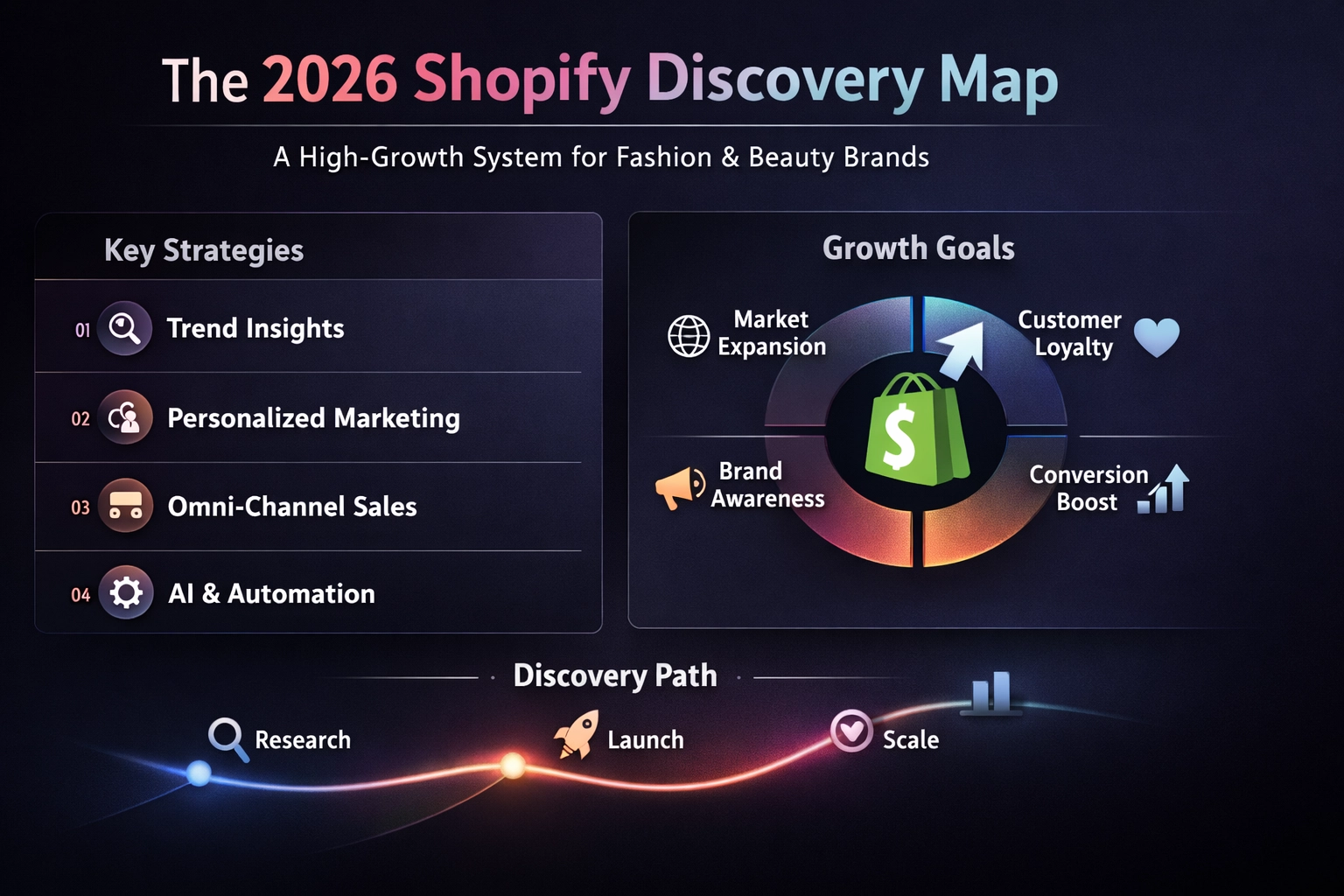
  • The 2026 Shopify Discovery Map: A High-Growth System for Fashion & Beauty Brands

    The 2026 Shopify Discovery Map: A High-Growth System for Fashion & Beauty Brands

    Scaling a fashion or beauty brand in 2026 isn't a guessing game. It is an operating system.

    The days of simply "running ads" and "writing keywords" are over. Today, the e-commerce landscape is dominated by AI-driven search agents, zero-click searches, and hyper-personalized discovery. If your brand isn’t mapped out to satisfy both human desire and AI algorithms, you are essentially invisible.

    At Thriftizer, we’ve analyzed the shift. We’ve seen how top-tier D2C brands move the needle. To help you navigate this, we’ve built the 2026 Shopify Discovery Map. This is a four-layer system designed to turn cold browsers into loyal brand advocates.

    Think of this as your brand’s growth architecture.


    Layer 1: Discovery (AI Search & Semantic SEO)

    In 2026, discovery doesn't just happen on Google. It happens inside ChatGPT, Perplexity, and Shopify’s own AI-powered conversational environments. If an AI agent can’t "understand" what your brand stands for, you won't appear in the recommendations.

    The Goal: Moving from keyword-stuffing to Entity-Based SEO.

    The Discovery Checklist:

    • Semantic Data Markup: Use advanced schema to tell AI agents exactly what your product is (e.g., "cruelty-free vegan lipstick" vs. just "lipstick").
    • Conversational Content: Write blog posts and FAQs that answer the exact questions your customers ask their AI assistants.
    • Brand Mentions & PR: High-quality backlinks are still king, but "brand sentiment" across the web now influences AI rankings.
    • Visual Search Optimization: Ensure every image on your Shopify store has descriptive, context-rich alt-text for AI visual recognition.

    Key Insight: AI agents prioritize Trust + Relevance. If your technical SEO is broken, no amount of creative marketing will save your discovery layer. This is why a comprehensive Shopify SEO services strategy is no longer optional: it's the foundation.

    Infographic showing a four-stage Shopify discovery system and SEO strategy for fashion brands.


    Layer 2: Trust (Brand Authority & Proof)

    Once a user (or an AI agent) finds you, the next hurdle is Trust. In the fashion and beauty world, skepticism is at an all-time high. Consumers in 2026 can spot a "drop-shipping vibe" from a mile away. You need to prove you are a legitimate authority.

    The Goal: Building a "Moat" of Social Proof.

    The Trust Checklist:

    • UGC Integration: Feature real customers wearing your clothes or using your skincare directly on the homepage and PDPs.
    • Expert Endorsements: For beauty brands, dermatological certifications; for fashion, sustainability audits.
    • Transparent Reviews: Move beyond 5-star ratings. Use video reviews and "verified buyer" tags that show the product in different lighting and sizes.
    • The "Human" Element: Your 'About Us' page shouldn't be corporate fluff. It should be a manifesto.

    Pro Tip: Run a periodic Shopify audit. Look for broken links, outdated trust badges, or inconsistent branding. Small "trust leaks" lead to massive conversion drops.


    Layer 3: Intent (PDP Optimization)

    Discovery brings them in, and Trust keeps them interested, but the Product Detail Page (PDP) is where the "Intent" is captured. In 2026, a PDP is not just a photo and a price tag. It is a high-performance sales machine.

    The Goal: Turning "I'm just looking" into "I need this."

    The Intent Checklist:

    • 3D & AR Visualization: Let customers "see" the jewelry on their hand or the dress in their room using Shopify’s native AR features.
    • Dynamic Bundling: Use AI to suggest "Complete the Look" or "Perfect Pairing" based on the user’s browsing history.
    • Hyper-Specific Copy: Don't just list features. Sell the transformation. Instead of "100% Cotton," try "Breathable, wrinkle-resistant fabric designed for your 14-hour workday."
    • Predictive Sizing: Use AI-driven size charts to reduce return rates: a massive pain point for any Shopify agency for fashion brands.

    Shopify product page optimization guide for fashion and beauty brands using AR and AI tools.


    Layer 4: Decision (Frictionless Checkout & Speed)

    This is the final "kill zone." You’ve done the hard work of discovery and persuasion. Now, don't let a slow loading bar or a complicated checkout ruin the sale. In 2026, the "Decision" layer must be invisible. It should feel like the product just "appears" in the customer's life.

    The Goal: Zero Friction.

    The Decision Checklist:

    • Shopify Speed Optimization: If your site takes more than 1.5 seconds to load on mobile, you are losing 30% of your revenue. Period.
    • One-Tap Payments: Ensure Shop Pay, Apple Pay, and Google Pay are front and center.
    • Post-Purchase Clarity: Real-time tracking and instant confirmation via WhatsApp or SMS.
    • AI-Chat Support: A bot that can actually solve problems (like changing a shipping address) without making the customer wait for a human.

    Key Takeaway: Speed is a feature. It is perhaps the most underrated part of your SEO and CRO strategy. If you haven't prioritized Shopify speed optimization this year, you are leaving money on the table for your competitors to grab.


    Challenges to Anticipate in 2026

    Building this system isn't without its hurdles. As you implement the Discovery Map, watch out for these common roadblocks:

    Challenge Solution
    Data Privacy Move toward first-party data collection (quizzes, email signups) as third-party cookies vanish.
    AI Hallucinations Ensure your product data is clean and structured so AI agents don't give false info about your brand.
    Ad Fatigue Shift budget from "interruption ads" to "discovery-based content" that provides actual value.
    Technical Debt Avoid "app bloating." Too many Shopify apps will destroy your site speed and user experience.

    Five-step Shopify growth strategy checklist for site speed and performance optimization.


    The "Next Steps" Checklist for Growth

    Ready to implement the 2026 Shopify Discovery Map? Don't try to do everything at once. Start small, stay creative, and follow this sequence:

    1. Perform a Deep Audit: Identify where your "Trust Leaks" are. Is it your slow mobile speed? Your lack of UGC?
    2. Optimize for AI: Update your meta-objects and schema. Make sure AI search engines can "read" your brand values.
    3. Fix Your Speed: Run your site through PageSpeed Insights. If you aren't hitting 90+ on mobile, call an expert.
    4. Enhance the PDP: Add one interactive element this month: whether it’s a fit-finder quiz or a 360-degree video.
    5. Simplify Checkout: Remove any unnecessary form fields. Make it possible to buy in two clicks.

    Final Thoughts: The System is the Strategy

    In 2026, you cannot afford to treat your Shopify store as a static digital brochure. It is a living, breathing ecosystem that needs to be optimized at every layer: from the way an AI agent discovers your brand to the millisecond it takes for your checkout page to load.

    Scaling a D2C brand is hard work, but you don't have to do it alone. Whether you need expert Shopify SEO services or a complete Shopify speed optimization overhaul, we are here to help you build your "moat."

    Ready to map out your growth?

    At Thriftizer, we specialize in building high-performance systems for fashion, beauty, and lifestyle brands. As a verified Shopify Expert, we know exactly what it takes to win in the 2026 landscape.

    Build your own package today and let’s start scaling.

    Never ever think of giving up. The world needs your brand: it just needs to be able to find it first.

  • The Death of Traditional Shopify SEO: Why ‘Simple’ Isn’t Enough for 2026 Fashion Brands

    The Death of Traditional Shopify SEO: Why ‘Simple’ Isn’t Enough for 2026 Fashion Brands

    If you are still following a 2022 SEO checklist for your Shopify store, you aren't just standing still: you are moving backward.

    In 2026, the game has changed. The "simple" stuff: optimizing your meta titles, stuffing keywords into product descriptions, and hoping for the best: is no longer a competitive advantage. It is merely the price of entry. For high-growth fashion, beauty, and streetwear brands, the traditional SEO playbook is officially dead.

    The digital landscape is shifting from "Search" to "Discovery." With the rise of SearchGPT, TikTok as a search engine, and AI-driven curation, your customers aren't just looking for products; they are looking for authority and experience. If your brand feels "simple," it won't be shared. And if it isn't shared, it won't rank.

    The "Simple" Trap: Why Your Checklist is Failing You

    We see it every day at Thriftizer. Founders come to us wondering why their traffic has plateaued despite "doing everything right." They have the keywords. They have the alt text. They even have a blog.

    The problem? Simple doesn't share.

    Search engines in 2026 are highly sophisticated. They aren't just reading your text; they are measuring how users feel when they land on your site. If your store looks like every other dropshipping template, Google notices. If your page takes three seconds to load on a 5G connection, Google notices.

    Traditional SEO focuses on what the bot wants. Modern SEO focuses on what the human wants, because that is what the bot is now trained to reward.

    The Shift from Keywords to "Experience Signals"

    In the past, you could rank a jewelry brand by repeating "handmade gold necklace" ten times on a page. Today, that is a one-way ticket to the bottom of page ten.

    Today’s algorithms prioritize:

    • Time on Site: Are they actually scrolling through your Lookbook?
    • Visual Engagement: Are they watching the product videos?
    • Brand Authority: Is your brand being mentioned on social media and high-authority fashion niches?
    • Technical Perfection: Is your Shopify speed optimization actually elite, or just "okay"?

    Visual representation of Shopify speed optimization and user experience signals replacing traditional keywords.
    Caption: The shift from traditional keyword density to holistic user experience signals in 2026.

    Performance is the New PR: The Reality of Shopify Speed Optimization

    Let’s talk about the elephant in the room: speed. In 2026, speed is not a "technical detail." It is a foundational pillar of SEO.

    Research shows that bounce rates increase by 32% for every extra second of load time. For a fashion brand, this is lethal. Fashion is an emotional, visual purchase. If a customer clicks an ad or a search result for a "limited edition streetwear hoodie" and the image takes two seconds to pop in, the emotional connection is broken.

    Shopify speed optimization in 2026 isn't just about compressing images. It's about:

    1. Critical CSS: Loading only what the user sees first.
    2. Edge Delivery: Making sure your store loads instantly in New York, London, and Tokyo.
    3. App Hygiene: Removing the "zombie apps" that bloat your liquid code.
    4. Predicative Loading: Using AI to guess which page the user will click next and pre-loading it.

    If your site feels sluggish, no amount of "high-quality content" will save your rankings. Google’s Core Web Vitals are more aggressive than ever. If you want to stay ahead, you need a technical partner who understands the intricacies of the Shopify platform. That’s why many top brands look for a specialized Shopify agency for fashion brands to handle the heavy lifting.

    From Search to Discovery: The AI Factor

    We are living in the era of "Answer Engines." When a user asks an AI, "What are the best sustainable beauty brands for sensitive skin?" the AI doesn't just look for keywords. It looks for context, reviews, and authority.

    To rank in 2026, your fashion brand needs to move beyond simple product listings. You need Rich Content Integration.

    How to Build "Discovery-Ready" Content:

    • Editorialized Collections: Stop just listing products. Build "The Summer Edit" or "The Midnight Collection" with storytelling blocks, trend reports, and embedded social proof.
    • Video-First SEO: Google is increasingly indexing short-form video. If your product pages don't have high-quality, fast-loading video, you are leaving SEO money on the table.
    • Conversational Data: Optimize for how people talk, not just how they type.

    Digital fashion lookbook highlighting editorial storytelling to boost discovery rankings on Shopify stores.
    Caption: Integrating editorial storytelling with product grids to increase user dwell time and discovery rankings.

    The Challenges of the New Era (Pros & Cons)

    Transitioning from "Simple SEO" to "High-Authority SEO" isn't easy. It requires a shift in mindset and resources.

    The Challenges (Cons):

    • Higher Upfront Investment: You can't just hire a cheap freelancer to "do the SEO." You need developers and strategists.
    • Continuous Monitoring: Performance metrics change weekly. You need to stay on top of your Shopify speed optimization constantly.
    • Content Fatigue: Creating "shareable" content is harder than writing basic descriptions.

    The Rewards (Pros):

    • Compounding Growth: Unlike paid ads, which stop the moment you stop paying, high-authority SEO builds value over time.
    • Lower Customer Acquisition Cost (CAC): Organic discovery is essentially "free" traffic once the foundation is built.
    • Brand Resilience: Brands that rank for "experience" are much harder to disrupt than brands that rank for "cheap keywords."

    Key Insight: Never think of SEO as a "task" to complete. Think of it as the digital reputation of your brand. In 2026, your "rankings" are simply a reflection of how much value you provide to the internet.

    Why Your Fashion Brand Needs a Specialized Shopify Agency

    Most generalist SEO agencies treat a fashion store the same way they treat a plumbing website. They focus on backlink counts and keyword volume.

    But fashion is different. It’s visual. It’s fast-paced. It’s seasonal.

    A dedicated Shopify agency for fashion brands understands that your collection pages are your most important assets. They know how to optimize for "Visual Search" and how to ensure your high-res imagery doesn't destroy your site speed.

    At Thriftizer, we don't just "fix SEO." We build high-performance digital machines. We are proud to be listed among the top experts in the Shopify Expert Directory, helping D2C brands scale without the technical headaches.

    High-tech tailoring tools representing a specialized Shopify agency for fashion brands and technical expertise.
    Caption: The difference between a generalist approach and a specialized fashion-forward SEO strategy.

    Next Steps: Moving Beyond "Simple"

    Ready to stop playing small with your SEO? Here is your checklist to transition into the 2026 era of Shopify growth:

    1. Audit Your Speed: Use tools like PageSpeed Insights, but focus on "Perceived Speed." Does the site feel fast to a human?
    2. Kill the "Keyword Stuffing": Rewrite your top 10 product descriptions to sound like a conversation with a stylist, not a manual for a robot.
    3. Implement Video: Add at least one short-form video to your top-selling collection pages.
    4. Check Your Navigation: Is your site easy to browse on a mobile device with one hand? If not, fix your UX immediately.
    5. Focus on Authority: Start reaching out to niche fashion creators for genuine mentions, not just paid ads.
    6. Partner Up: If this feels overwhelming, reach out to an expert Shopify agency for fashion brands to handle the technical complexity for you.

    The Bottom Line

    The "simple" days of Shopify SEO are over. In 2026, the brands that win are the ones that prioritize speed, experience, and authority.

    Stop trying to trick the algorithm and start building a store that people actually want to visit, share, and return to. It’s a harder path, but it’s the only one that leads to sustainable, long-term growth.

    Start small, stay creative, and don't let a slow site kill your brand's potential.

    If you're ready to take your fashion or beauty brand to the next level, let's talk. Check out our Build Your Own Package page to see how we can customize a strategy for your specific needs. The future of search is waiting( make sure your brand is ready to be discovered.)

  • Why Your ‘Simple’ Shopify SEO Strategy Is Costing You Sales (And How to Fix It)

    Why Your ‘Simple’ Shopify SEO Strategy Is Costing You Sales (And How to Fix It)

    Let’s be honest. Most SEO advice for Shopify founders is mind-numbingly boring.

    "Optimize your meta tags." "Add ALT text to your images." "Write a 500-word blog post once a week."

    If you’ve been following this "simple" checklist and wondering why your Shopify store’s traffic is as flat as a week-old soda, here is the cold, hard truth: Simple might be easy to execute, but simple doesn’t share.

    In 2026, basic SEO is no longer a competitive advantage. It’s table stakes. If you’re a D2C founder in the fashion, beauty, or streetwear space, relying on "simple" SEO is actually costing you sales. You’re invisible in a sea of brands doing exactly what you’re doing.

    It’s time to move past the basics and build Shareable Authority.

    A vibrant green prism standing out from identical grey spheres, representing unique Shopify SEO strategy.


    The Commodity Crisis: Why "Best Practices" Are Failing You

    The problem with most Shopify SEO services is that they treat your brand like a library book instead of a culture-shifter. They focus on "ranking" when they should be focusing on "discovery."

    When every jewelry brand uses the same keyword research tools to find the same "gold hoop earrings" keywords, everyone ends up with the same generic content. Google sees this. More importantly, your customers see this.

    The "Simple" Trap

    Standard Shopify SEO is built on a "set it and forget it" mentality.

    • The Result: You rank for a few low-intent keywords.
    • The Reality: Your bounce rate is high because your content has no soul.
    • The Cost: You’re paying for traffic that doesn’t convert because you haven't given them a reason to stay: or to share.

    Key Insight: In the age of SearchGPT and AI-driven discovery, the algorithm doesn't just look at your keywords; it looks at how much people talk about you across the web. If your site is "simple" and boring, nobody talks.


    The Collection Page Goldmine: Beyond the Grid

    Most D2C founders spend 90% of their time on product pages and 10% on collection pages. This is a massive mistake.

    In the world of Shopify agency for fashion brands, we know that collection pages are your real power players. They have the highest potential to rank for "top of funnel" searches, yet most stores leave them as empty grids of products.

    How to Fix Your Collections:

    1. Stop treating them as filters: A collection page isn't just a way to sort products; it’s a landing page.
    2. Add "Editorial" Copy: Include 150–200 words of original, punchy copy at the top (or bottom) of the page. Talk about the vibe of the collection, not just the items.
    3. Visual Hierarchy: Use H2 and H3 headers to break up the page. Instead of just "Summer Dresses," use "Sustainable Summer Dresses for High-Heat Days."

    Pro Tip: Treat your collection page like a magazine spread. If a customer lands there, they should feel the brand’s identity immediately, even before they click a product.

    An elevated glowing pedestal within a grid, highlighting a premium Shopify collection page design strategy.


    The Shareable Authority Framework

    If you want to scale, you need to stop thinking about keywords and start thinking about Authority. Shareable Authority is the intersection of high-intent SEO and viral-ready content.

    1. The Death of the Generic Blog

    If you are writing "Top 5 Trends for 2026" just because a tool told you to, stop. It’s noise. Instead, create "Contrarian Content."

    • Bad: "How to style a streetwear hoodie."
    • Good: "Why your oversized hoodie makes you look like a teenager (and how to fix it)."

    The second headline is provocative. It challenges the reader. It gets shared. And because it gets shared, Google sees those social signals and boosts your ranking.

    2. Intent over Volume

    Stop chasing high-volume keywords you’ll never rank for. If you’re a new jewelry brand, you aren't ranking for "Diamond Ring" today. But you can rank for "Ethical lab-grown diamond rings for minimalist weddings."

    Shopify expert tip: Use Google Search Console to find the "long-tail" phrases people are actually using to find you. Double down on those.


    Technical Debt: The "Speed Tax" You’re Paying

    You can have the best copy in the world, but if your site takes 4 seconds to load, you’re invisible. Page speed is a confirmed Google ranking factor, and in the D2C world, every millisecond is a dollar lost.

    The Common Culprits:

    • App Bloat: You don't need 25 Shopify apps. Every script you add slows down your Liquid files.
    • Unoptimized Images: High-res photography is vital for fashion and beauty, but uncompressed files are killers. Use modern formats like WebP.
    • The "Heavy" Theme: If your theme is trying to do too much, it’s probably doing it slowly.

    Glowing light trails breaking free from heavy blocks, illustrating fast Shopify store performance and speed.

    Performance Checklist:

    • Run a Lighthouse report weekly.
    • Delete any app you haven't used in 30 days.
    • Compress every single image before it hits your Shopify admin.

    Challenges: The Reality of Modern SEO

    Let’s be real: SEO isn't a magic wand. It has challenges that many agencies won't tell you about.

    Challenge The Reality The Fix
    Algorithm Volatility Google changes the rules every few months. Build an audience, not just a search profile.
    Long Lead Times Real SEO results take 3–6 months. Start small, stay creative, and stay consistent.
    AI Content Saturation Everyone is pumping out AI garbage. Write with a distinct human voice. Be witty. Be weird.

    Pro Tip: Don't let your technology replace your creativity. Use AI as a co-pilot for research, but never for the final "soul" of your content.


    Why Your Strategy Needs a Human Soul

    At the end of the day, Google is trying to mimic a human. It wants to show users the most helpful, interesting, and authoritative result.

    If your "Simple SEO" strategy involves keyword stuffing and generic descriptions, you are essentially betting against the smartest engineers in the world. You won't win that bet.

    Real growth comes from being a brand that people want to find. This means your product descriptions should read like a conversation, your collection pages should feel like an experience, and your site should be fast enough to keep up with a Gen-Z attention span.

    A glowing silhouette hand touching a digital grid, representing the human touch in Shopify SEO services.


    Next Steps: Moving from Simple to Strategic

    Stop being invisible. Start building a store that commands attention. Here is your 4-step plan to fix your Shopify SEO today:

    1. Audit Your Collections: Pick your top 3 collections. Add 200 words of high-quality, intent-focused copy to each. Ensure your H1s and H2s are optimized for "long-tail" searches.
    2. Kill the Bloat: Go to your Shopify app settings. Delete at least two apps that are slowing you down without adding significant revenue.
    3. Inject Personality: Rewrite three product descriptions. Remove the manufacturer's specs and replace them with a story. Tell the customer how they will feel wearing or using your product.
    4. Work with a Partner: If you’re ready to stop DIYing your growth, consult a professional.

    At Thriftizer, we don't do "simple." We do strategic. We help D2C brands navigate the complex world of modern digital marketing without the fluff. As an official Shopify expert, we specialize in turning "invisible" stores into "unmissable" brands.

    Whether you need a full SEO overhaul or a high-performance Shopify agency for fashion brands, we’re here to help you scale.

    Start small, stay creative, and never settle for simple.

    A glowing obsidian staircase leading upward, representing a Shopify expert's path to strategic brand growth.