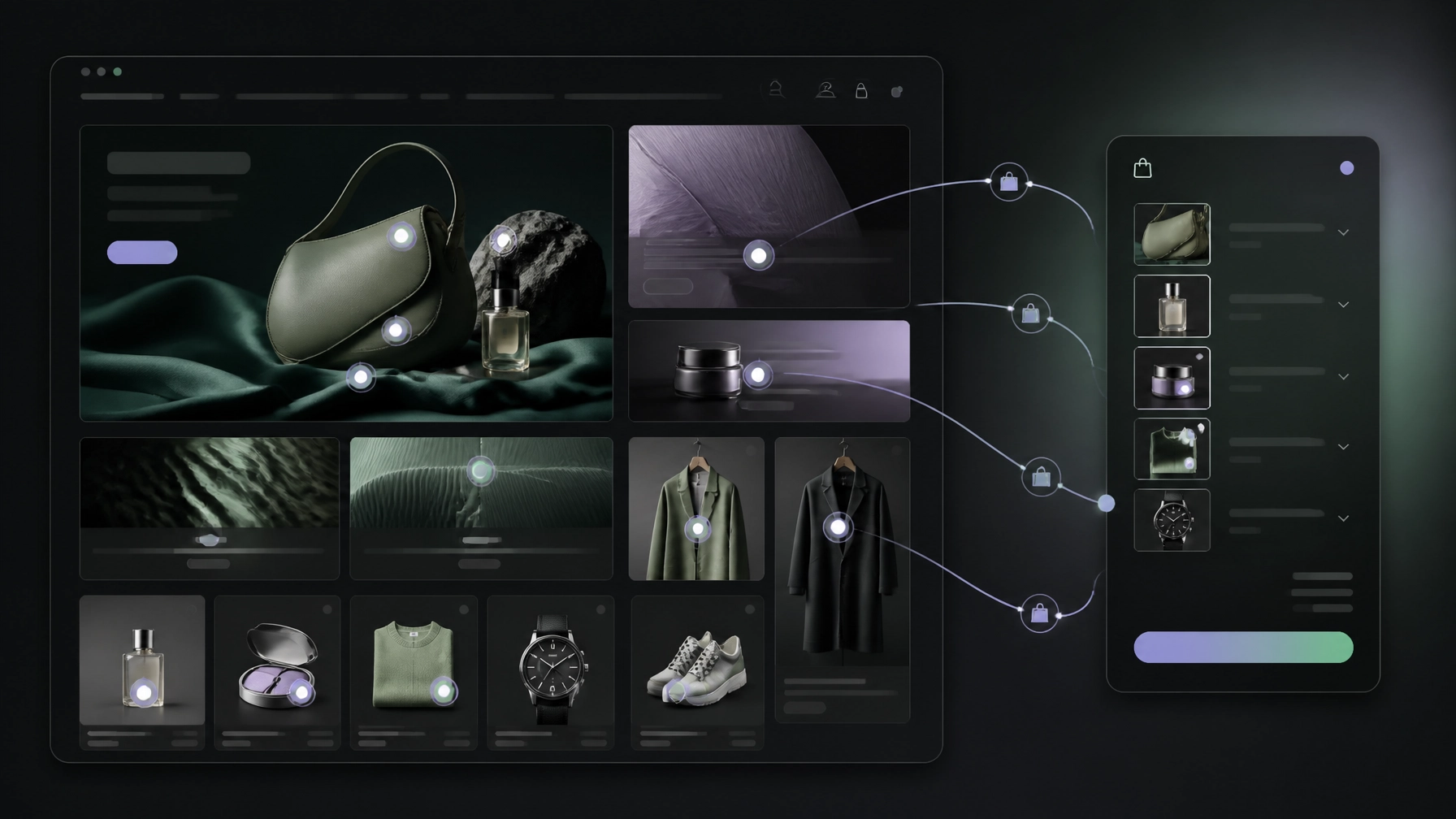
Your customers should not have to stop reading, watching, or exploring before they can shop. Ambient merchandising turns every meaningful brand interaction into a contextual buying opportunity: helping D2C fashion, beauty, makeup, and apparel brands improve discovery, increase basket size, and reduce the distance between inspiration and checkout.
This matters even more in 2026. Customers discover products through social content, creators, editorial stories, quizzes, search, and community: not only through a traditional “Shop” menu.
For Shopify Plus brands, the opportunity is to build a store where commerce feels naturally present without becoming intrusive. Think of it as Shopify merchandising beyond the product grid.
What Is Ambient Merchandising?
Ambient merchandising means placing products inside the content and experience your customers are already engaging with.
Instead of asking visitors to:
- Read a style guide.
- Remember the products they like.
- Navigate to a collection.
- Search for each item.
- Rebuild the look or routine manually.
You let them discover and shop products directly within the story.
Examples include:
- A fashion editorial with “Shop this look” product cards.
- A makeup tutorial with clickable product hotspots.
- A skincare ritual page with a recommended routine bundle.
- A quiz that suggests products based on skin type or style preference.
- A lifestyle image where each visible product can be explored and added to cart.
Traditional Merchandising vs. Ambient Merchandising
Traditional ecommerce merchandising usually organizes products by:
- Category.
- Collection.
- Price.
- Color.
- Size.
- Availability.
- Best-selling status.
This structure is useful. Customers need clear navigation and efficient search. However, it assumes that shoppers already know what they want.
Ambient merchandising supports the customer who is still deciding.
| Traditional merchandising | Ambient merchandising |
|---|---|
| Starts with the product catalog | Starts with the customer’s context |
| Relies on menus and collection pages | Uses content, stories, and experiences |
| Often separates inspiration from purchase | Connects inspiration to purchase |
| Works well for known intent | Builds intent during discovery |
| Focuses on individual products | Connects products into looks, routines, and solutions |
Key takeaway: Ambient merchandising does not replace your catalog. It gives your catalog more entry points.
Why Ambient Merchandising Matters for Shopify Plus Brands in 2026
Shopify Plus for fashion brands is no longer only about handling high traffic or complex operations. It is also about creating a flexible, premium customer experience at scale.
1. It strengthens premium positioning
Premium customers buy into a point of view. They want to understand how a garment fits into their lifestyle or how a beauty product fits into their routine.
An editorial product experience can communicate:
- Styling guidance.
- Product craftsmanship.
- Ingredient education.
- Usage occasions.
- Brand philosophy.
- Complementary products.
This creates a more considered experience than a standard product grid.
2. It can increase average order value
A single product may solve one need. A contextual bundle can solve the complete need.
For example:
- A streetwear brand can show a jacket with coordinated trousers, shoes, and accessories.
- A makeup brand can pair a foundation with primer, concealer, and setting spray.
- A beauty brand can present a morning routine rather than one cleanser.
- A jewelry brand can show a stack instead of a single necklace.
The result is not simply more selling. It is better product relevance.
3. It improves engagement without adding friction
Customers can interact with a lookbook, tutorial, or quiz while seeing clear paths to purchase. They do not need to leave the experience to find the products mentioned.
That can improve:
- Product discovery.
- Time spent on key pages.
- Product confidence.
- Cross-selling.
- Conversion opportunities.
- Return visits.
Shopify’s 2026 guide to retail environments reinforces the importance of cohesive physical and digital touchpoints. Ambient merchandising applies the same principle to your online store.

The Four-Layer Ambient Merchandising Framework
Use this framework to plan your experience systematically. Do not begin by installing more apps. Begin by deciding how each layer should work.
1. Discovery: Help Customers Find Their Way In
Discovery is the first contact between a customer and a product.
Your discovery surfaces may include:
- Homepage editorial modules.
- Social and creator content.
- Search landing pages.
- Buying guides.
- Seasonal campaigns.
- Email content.
- Collection introductions.
- Quiz entry points.
- Shoppable video or image galleries.
Action checklist
- List your highest-value customer questions.
- Map each question to a content format.
- Identify which products naturally answer that question.
- Create clear but low-pressure links to explore or shop.
For a fashion brand, “How do I style linen for a city weekend?” is a stronger discovery question than simply “Browse linen.”
2. Context: Show the Product in a Real Situation
Context explains when, why, and how a product is used.
This is especially important for Shopify Plus beauty brands, where customers may need education before purchasing. It is equally valuable for apparel, jewelry, makeup, and streetwear.
Useful contextual formats include:
Shoppable lookbooks
Create a complete visual story around a collection, occasion, or aesthetic. Add product cards beside each look so customers can shop individual pieces or the complete outfit.
Lifestyle imagery with hotspots
Use an image of a styled room, outfit, vanity, or travel scene. Add discreet hotspots that reveal product details when clicked or tapped.
Editorial-style product pages
Move beyond specifications and gallery images. Add:
- “How to wear it” content.
- Ingredient or material explanations.
- Fit notes.
- Routine instructions.
- Related editorial stories.
- Customer imagery.
- Complementary product modules.
This is a major opportunity for Shopify product page optimization.
Content-driven collection pages
Instead of beginning with a product grid, open with a short editorial introduction. Explain the collection’s purpose, then guide customers into curated product groups.
Pro Tip: Place context before the product grid when customers need education. Place the grid first when shoppers have strong purchase intent.
3. Intent: Make the Next Action Obvious
Context creates interest. Intent determines what the customer does next.
Your interface should answer one question: What is the most useful next step for this visitor?
That step may be:
- View product details.
- Choose a size.
- Add the full look.
- Compare two products.
- Take a quiz.
- Select a routine.
- Save an item.
- Join a waitlist.
Outfit and ritual bundling
Build bundles around outcomes, not just discounts.
Examples:
- “Complete the look.”
- “Your five-minute morning routine.”
- “Travel-ready skincare.”
- “Three-piece layering system.”
- “Everyday gold stack.”
- “First festival makeup kit.”
Quiz-driven recommendations
A quiz can help customers make confident choices while collecting useful first-party preference data.
Ask only questions that improve the recommendation, such as:
- Skin type.
- Coverage preference.
- Clothing fit.
- Color preference.
- Occasion.
- Budget range.
- Existing routine.
- Styling confidence.
Use the result page to explain why each product was recommended. Personalization should feel helpful, not mysterious.

4. Trust: Remove the Final Doubt
Customers may discover a product through beautiful content but still hesitate before buying.
Build trust into the experience with:
- Verified reviews.
- Customer photos and videos.
- Fit and sizing guidance.
- Ingredient transparency.
- Shipping estimates.
- Return information.
- Care instructions.
- Clear stock availability.
- Social proof connected to the specific product.
For makeup and skincare, explain suitability and usage clearly. For apparel, show garments on different body types where possible. For jewelry, provide scale references and close-up details.
Key Insight: Trust should appear at the moment of uncertainty: not only in a separate FAQ page.
How to Implement Ambient Merchandising on Shopify Plus
Shopify Plus provides the infrastructure, but your implementation still needs a clear content and data model.
Use metafields for structured context
Create product and collection metafields for information such as:
- Style family.
- Skin concern.
- Routine stage.
- Occasion.
- Color story.
- Fabric or finish.
- Complementary products.
- Editorial category.
- Bundle role.
This lets your team reuse content across templates without hardcoding every relationship.
Build reusable Shopify Sections
Use flexible sections for:
- Shoppable image galleries.
- Lookbook cards.
- Product carousels.
- Routine builders.
- “Complete the look” blocks.
- UGC modules.
- Editorial product callouts.
- Recommendation panels.
Reusable sections help your marketing team launch campaigns quickly without waiting for a developer for every update.
Create custom templates
Develop templates for specific experiences, such as:
- Collection story pages.
- Seasonal lookbooks.
- Beauty routines.
- Campaign landing pages.
- Gift guides.
- Editorial PDPs.
- Quiz result pages.
This approach supports premium Shopify website design while preserving operational consistency.
Choose apps carefully
Apps can support:
- Reviews and UGC.
- Product recommendations.
- Quizzes.
- Bundles.
- Visual merchandising.
- Search and filtering.
- Personalization.
- Analytics.
However, evaluate every app for performance, accessibility, data quality, and theme compatibility. More features do not automatically create a better experience.
Use Shopify Functions for commerce logic
Shopify Functions can help power:
- Bundle discounts.
- Tiered offers.
- Customer-specific promotions.
- Cart validation.
- Product eligibility rules.
- Free-gift logic.
Keep the logic aligned with the customer context. Do not present a complex promotion when a simple recommendation would be clearer.
Consider headless only when the experience requires it
A headless build may be appropriate when you need:
- Highly interactive editorial experiences.
- Multiple frontends.
- Advanced personalization.
- A custom content system.
- Complex international storefronts.
- Unusual performance requirements.
Shopify’s Plus platform supports extensible and headless commerce options, but headless is not automatically the faster choice. For many brands, a well-structured theme with custom sections delivers a better balance of speed, flexibility, and maintainability.

Pros and Cons of Ambient Merchandising
Pros
- Improves product discovery for customers who are not ready to search.
- Supports higher AOV through relevant bundles and complete solutions.
- Builds premium positioning through editorial storytelling.
- Creates more shoppable content from existing campaigns and assets.
- Makes content commercially measurable.
- Gives fashion and beauty brands more ways to express their identity.
Cons and challenges
- Content production can increase. You need strong photography, copy, and product relationships.
- Poor implementation can create clutter. Every page should still have a clear hierarchy.
- Personalization requires clean data. Incorrect recommendations reduce trust.
- App overload can affect performance. Test scripts and third-party dependencies.
- Attribution can be complicated. A customer may interact with several content surfaces before converting.
- Teams need governance. Define who owns content, merchandising, data, and testing.
Never ever think of giving up because the first version is not perfect. Start small, stay creative, and improve based on evidence.
A Faster Way to Launch the Framework
Traditional agencies often turn a focused merchandising improvement into a long discovery cycle. Thriftizer takes a more agile approach.
We position Thriftizer as the Amazon of Shopify Services: a faster, more efficient marketplace-style alternative for brands that need specialized strategy, design, development, and growth support without unnecessary delay.
Our 4-hour onboarding is designed to move your project from initial conversation to a clear working direction quickly. You identify the business goal, share the current store context, and align on the first action plan.
That is our Speed as a Feature philosophy. Speed does not mean skipping strategy. It means removing avoidable waiting time.

Next Steps: Launch Your Ambient Merchandising System
Use this checklist to begin:
- Audit your current content. List lookbooks, tutorials, guides, UGC, quizzes, and campaign pages.
- Identify high-intent products. Choose products with strong margins, repeat potential, or cross-sell opportunities.
- Map content to context. Define which products belong in each story, look, routine, or occasion.
- Create your data structure. Set up metafields for product relationships, use cases, styles, and routines.
- Build one pilot experience. Start with a shoppable lookbook, editorial PDP, or routine bundle.
- Test the customer journey. Check mobile usability, page speed, accessibility, tracking, and checkout flow.
- Measure meaningful outcomes. Review engagement, product discovery, add-to-cart rate, AOV, and assisted conversions.
- Scale what works. Turn successful modules into reusable Shopify Sections and templates.
If you are planning a new experience or need help with Shopify Plus for fashion brands, visit Thriftizer to explore a faster path from strategy to execution. You can also review Thriftizer’s Shopify Expert profile when evaluating support for design, development, optimization, and growth.
Make your content useful. Make your products discoverable. Make speed part of the system.