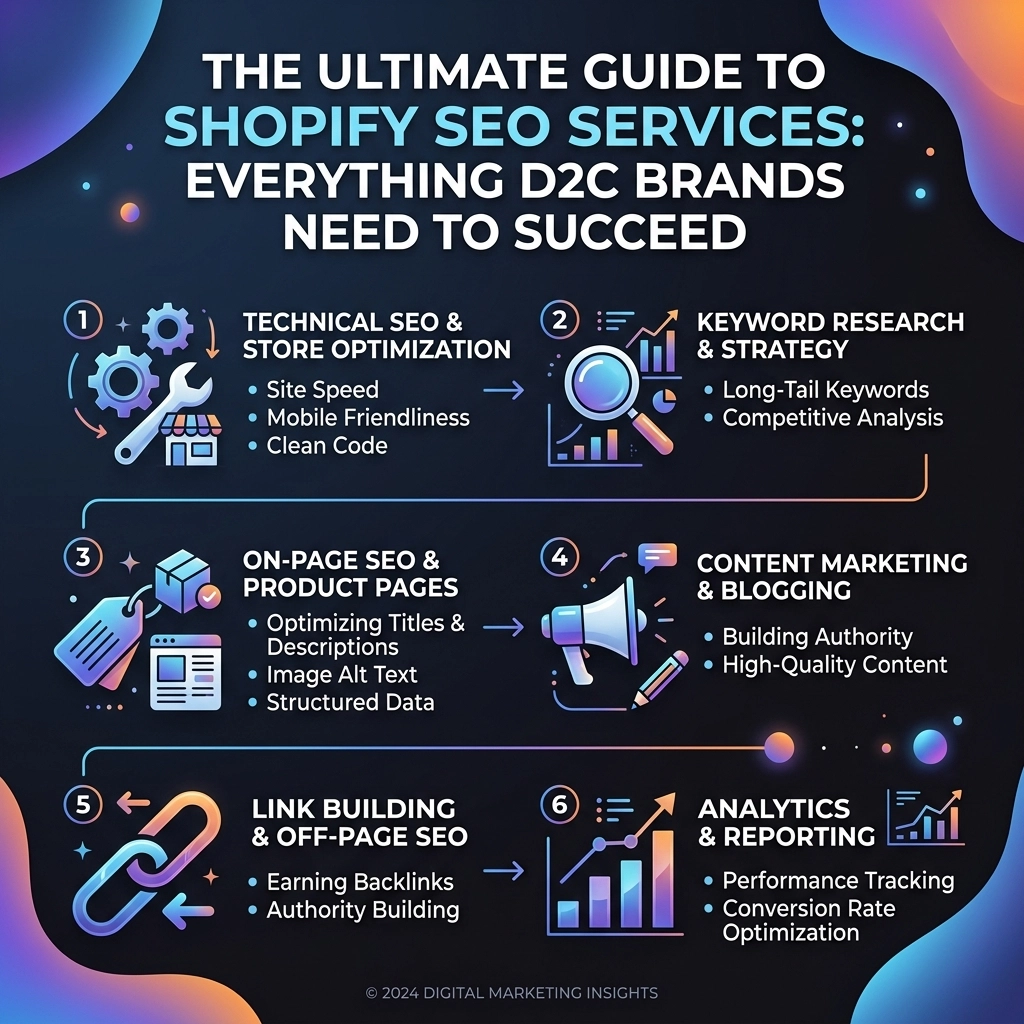
If you are running a D2C brand in the fashion, beauty, or apparel space in 2026, you already know the competition is fierce. You aren't just competing with the shop down the street; you are competing with global giants and thousands of other niche brands vying for the same "scroll-time."
The secret to winning isn't just spending more on Meta or TikTok ads. It’s about building an organic engine that brings in customers while you sleep. That is where Shopify SEO services come into play. SEO isn't a "set it and forget it" task; it is the heartbeat of your digital storefront.
In this guide, we’ll dive deep into how you can transform your Shopify store into a high-ranking, high-converting machine. Whether you are selling minimalist jewelry or oversized streetwear, these strategies are designed to help you scale.
Why SEO is the Growth Engine for D2C Brands
Most D2C founders start with paid ads. It’s fast and provides immediate feedback. But as acquisition costs rise, your margins get squeezed. Organic search is the only channel that offers a compounding return on investment.
When you invest in quality Shopify website design and SEO, you are building digital equity. You aren't just "renting" traffic from Mark Zuckerberg; you are owning your presence on the web.
Key Insight: In the fashion and beauty world, search intent is everything. Someone searching for "organic vegan night cream" is much further down the funnel than someone just browsing Instagram. SEO captures that intent.
Pillar 1: The Technical Foundation (The Discovery Layer)
Google won't rank what it can't understand or crawl. Before you write a single blog post, your technical house must be in order.
1. Site Speed and Core Web Vitals
In 2026, a slow site is a dead site. Mobile users in the streetwear and apparel niche expect instant gratification. If your collection page takes more than 3 seconds to load, you’ve already lost the sale.
- Compress your images: High-res lifestyle shots are great, but they shouldn't be 5MB each.
- Audit your apps: Every Shopify app adds a script. If you aren't using it, delete it.
- Use a fast theme: Start with a performance-optimized Shopify theme.
2. Mobile-First Architecture
Most of your customers are shopping on their phones while commuting or lounging. Your Shopify website design must be thumb-friendly. Large buttons, easy navigation, and a seamless checkout process are non-negotiable.
3. Fixing Duplicate Content
Shopify is notorious for creating duplicate URLs for products (via collection paths). Ensure your canonical tags are correctly set up so Google knows which version of the page is the "master" copy.

Pillar 2: Keyword Strategy for Fashion and Beauty
Generic keywords like "dresses" or "makeup" are impossible to rank for as a growing D2C brand. You need to go long-tail.
Target Niche Intent
Instead of "jewelry," target "handcrafted gold vermeil earrings for sensitive ears." Instead of "hoodies," target "heavyweight oversized streetwear hoodies acid wash."
How to find these gems:
- Search Suggest: Type your main product into Google and see what the auto-complete suggests.
- Competitor Gaps: Look at what your competitors are not talking about.
- Customer Reviews: Use the exact language your customers use in their reviews.
Pro Tip: Use keywords that reflect the lifestyle of your brand, not just the product features. If you sell sustainable apparel, keywords like "eco-friendly capsule wardrobe essentials" should be in your arsenal.
Pillar 3: On-Page Optimization (The Intent Layer)
Your product and collection pages are your primary revenue drivers. They need to be optimized for both robots and humans.
1. Master the Meta Tags
Your Page Title and Meta Description are your "ad copy" in the search results.
- Title Tag: Include your primary keyword and your brand name. (e.g., Sustainable Linen Dresses | [Your Brand Name])
- Meta Description: Give them a reason to click. Mention free shipping, unique materials, or a current sale.
2. Descriptive Product Narratives
Stop using the manufacturer's descriptions. Write unique, engaging copy for every product.
- For Beauty: Focus on ingredients, skin types, and "the glow" factor.
- For Fashion: Focus on fit, fabric feel, and styling tips.
3. Image Alt Text
Google can’t "see" your beautiful jewelry photos. Use Alt Text to describe them. Instead of "IMG_1234.jpg," use "Model wearing 18k gold chunky hoop earrings with white silk blouse."
Pillar 4: Content Strategy and Authority Building
Content is how you build trust before the transaction. For D2C brands, a blog isn't just for news; it’s a tool for education and inspiration.
The "How-To" and "Style Guide" Approach
Create content that solves problems for your audience:
- "How to Layer Jewelry Like a Pro"
- "5 Streetwear Trends to Watch in Summer 2026"
- "The Ultimate 10-Step Skincare Routine for Dry Skin"
This type of content ranks for informational keywords and introduces your brand to potential customers early in their journey.
Key Insight: Don't just write text. Use video embeds and high-quality lookbooks. Shopify's native blogging platform is a great starting point, but you need to be consistent. Start small, stay creative.

Common Shopify SEO Challenges
Even with the best Shopify SEO services, you will face hurdles. Here is how to handle them:
| Challenge | Impact | Solution |
|---|---|---|
| App Bloat | Slows down site speed significantly. | Conduct a monthly app audit. Remove what you don't use. |
| Out of Stock Products | Lose SEO value and frustrate users. | Don't delete the page. Redirect it to a similar product or a collection page. |
| Thin Content | Collection pages with only images. | Add 200-300 words of descriptive text at the bottom of collection pages. |
| URL Structure | Shopify has a rigid URL structure. | Focus on what you can control: the handles and the hierarchy. |
The Synergy: SEO meets CRO
Traffic is a vanity metric; revenue is a sanity metric. This is where Conversion Rate Optimization (CRO) comes in. Your SEO brings them to the door, but your Shopify website design and user experience (UX) get them to check out.
- Trust Signals: Display reviews, "As Seen In" badges, and secure payment icons.
- Clear CTAs: Make the "Add to Cart" button pop.
- Simplified Navigation: Don't make people hunt for your bestsellers.
Never ever think of giving up on a page just because it has low traffic. Sometimes, a page with 10 visitors and a 20% conversion rate is more valuable than a page with 1,000 visitors and 0% conversion.
Your 2026 Shopify SEO Checklist
Ready to take action? Follow this step-by-step implementation plan:
- Audit Your Technicals: Use tools like Google Search Console to find crawl errors.
- Optimize Your Homepage: Ensure your main value proposition and primary keywords are in the H1 tag.
- Update Product Meta Data: Go through your top 10 bestsellers and refine their titles and descriptions.
- Implement Schema Markup: Use "Product Schema" so your prices and star ratings show up directly in Google search results.
- Build Your Internal Link Map: Link from your blog posts to your collection pages to pass along "link juice."
- Create a Backlink Plan: Reach out to fashion bloggers or beauty influencers for features and reviews.
- Review Mobile UX: Place a test order on your phone today. Was it easy? If not, fix it.
Conclusion: Partnering for Success
Building a dominant D2C brand requires a mix of creativity and technical precision. You handle the brand vision; let the experts handle the heavy lifting of search algorithms.
At Thriftizer, we specialize in helping D2C brands in the fashion, jewelry, and beauty sectors dominate the digital landscape. Whether you need comprehensive Shopify SEO services or a complete Shopify website design overhaul, we are your co-pilot in growth.
Our team understands the nuances of the Shopify platform and the unique needs of D2C retailers. We don't just aim for rankings; we aim for revenue.
Ready to scale your brand?
- Explore our solutions at Thriftizer.
- Check out our work and credentials on our Shopify Expert Profile.
Start small, stay creative, and watch your organic growth transform your business. The best time to start was yesterday; the second best time is right now. Let's get to work.