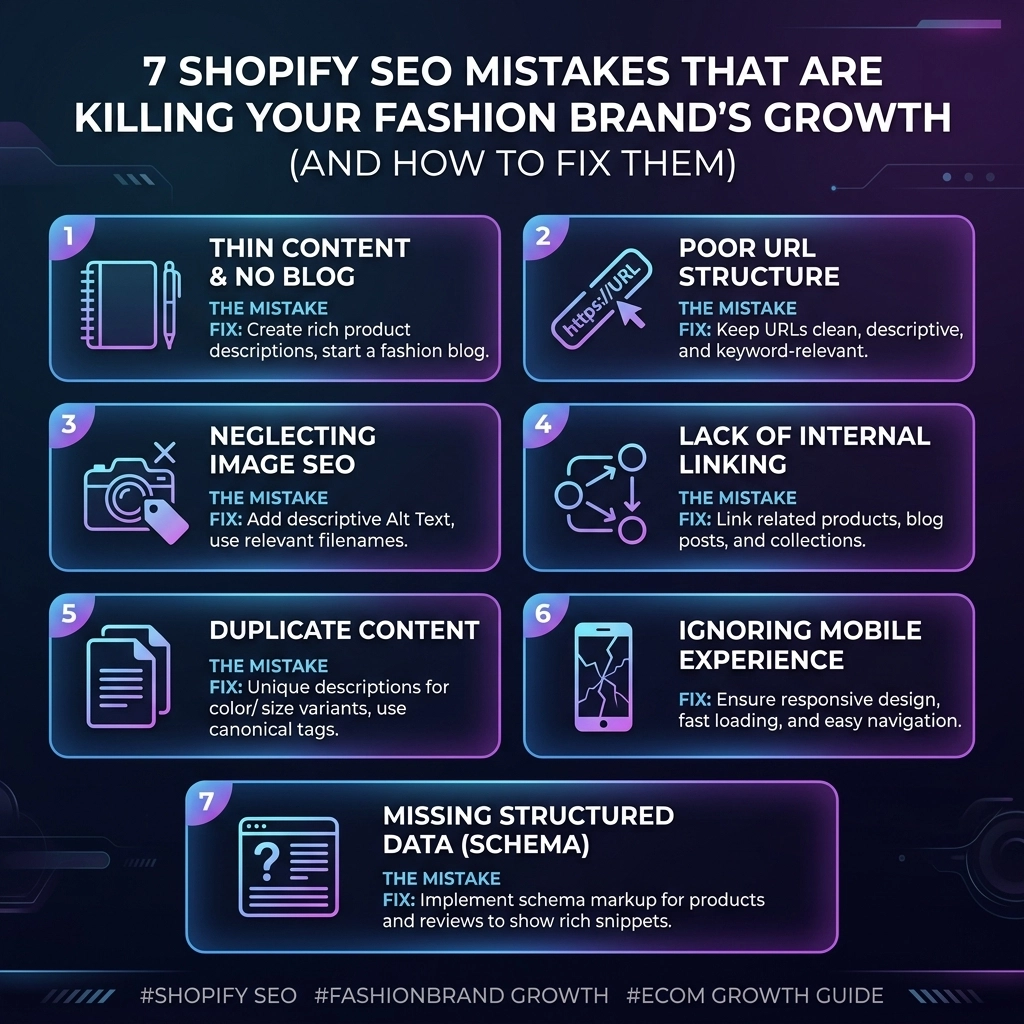
If you’re running a fashion brand on Shopify in 2026, you already know the competition is fierce. The barrier to entry has never been lower, but the barrier to scaling has never been higher. You might have a stunning Shopify website design, a killer collection, and a growing Instagram following, but if your organic traffic is flatlining, you likely have an SEO problem.
Most D2C founders treat SEO as an afterthought: something to "fix later" once they’ve exhausted their meta-ad budget. But in an era where customer acquisition costs are skyrocketing, organic search is your most sustainable engine for growth. If your store isn't appearing when someone searches for "sustainable streetwear" or "handmade gold jewelry," you’re leaving six figures on the table.
Let’s dive into the seven most common Shopify SEO mistakes we see at Thriftizer and, more importantly, how you can fix them today to dominate the 2026 and 2027 fashion landscape.
1. The "Lazy Title" Syndrome
One of the most frequent mistakes in fashion SEO is using generic or non-descriptive product titles. Many brands simply use the internal name given by the designer, such as "Aria Top – Blue" or "Product #405."
While those names might mean something to your inventory team, they mean nothing to Google. If a potential customer is looking for a "navy blue silk camisole," your "Aria Top" will never show up in the results.
The Fix:
- Be Descriptive: Include the product type, material, color, and fit in the H1 and Title tag.
- Think Like a Customer: Use terms your audience actually searches for. Instead of "Midnight Dreamer," try "Midnight Blue Silk Sleepwear Set."
- Optimize Meta Descriptions: Don't let Shopify auto-generate these. Write a compelling, 150-character hook that encourages clicks.
Pro Tip: Use tools like Google Search Console to see which keywords people are already using to find your site, then weave those into your product titles naturally.
2. Using Manufacturer or Duplicate Descriptions
In the rush to launch a new season, it’s tempting to copy and paste the fabric details from your manufacturer or use the same description for five different variants of a dress. This is a massive red flag for search engines.
Duplicate content makes it impossible for Google to decide which page is the "authority," often resulting in none of the pages ranking well. In the fashion world, unique storytelling is what sells.
The Fix:
- Write Unique Copy: Every product deserves its own story. Describe the drape, the feel, and the occasion.
- Canonical Tags: If you must have multiple pages for similar items, use canonical tags to tell Google which one is the "master" page.
- Focus on Benefits: Instead of just listing "100% Cotton," explain that it’s "breathable, organic cotton that stays cool during summer garden parties."

3. Ignoring the Power of Collection Pages
Collection pages are the secret weapon of fashion SEO. While individual product pages are great for long-tail searches, your collection pages (like "Women’s Winter Coats" or "Eco-friendly Activewear") are what capture high-volume, high-intent traffic.
Most Shopify brands leave their collection pages as a simple grid of photos. This offers zero context to search engines.
The Fix:
- Add "SEO Text": Add 200-300 words of descriptive text at the top or bottom of your collection pages. Explain the style, the materials used, and why your brand is the best choice.
- Internal Linking: Link from your blog posts back to these collection pages to build "link equity."
- Optimized URLs: Ensure your URLs are clean. Use
/collections/mens-streetwear-hoodiesrather than something cryptic.
4. Heavy Images and Zero Alt Text
Fashion is visual. You want high-resolution, editorial-grade photography to showcase your designs. However, if those images are 5MB each, your site speed will tank. A slow site is one of the fastest ways to kill your conversion rate and your SEO ranking.
Furthermore, Google "crawlers" can't "see" your photos. They rely on Alt Text to understand what is in the image.
The Fix:
- Compress Everything: Use Shopify apps or external tools to compress images without losing quality. Aim for web-optimized formats like WebP.
- Descriptive Alt Text: Instead of leaving Alt Text blank, write "Woman wearing a sustainable oversized beige trench coat in a city setting."
- Consistent Aspect Ratios: This helps with Shopify website design stability, preventing "layout shifts" which Google penalizes.
5. The "App Overload" Performance Drag
Shopify makes it incredibly easy to add features via apps. Want a countdown timer? There’s an app. Want a loyalty program? There’s an app. Every time you install an app, you’re adding code (JavaScript) to your site that can slow it down significantly.
The Fix:
- Audit Your Apps: If you haven't looked at an app's analytics in a month, delete it.
- Check Speed Impact: Use Google PageSpeed Insights to see which scripts are slowing down your "Time to Interactive."
- Custom Coding: For essential features, consider hiring Shopify SEO services like Thriftizer to custom-code the functionality into your theme, which is much cleaner than using a bulky app.

6. Neglecting a Long-Form Content Strategy
Many fashion brands think a blog is a waste of time. They believe, "People just want to look at the clothes." While that’s true for some, your blog is where you capture people at the "Discovery" stage of the funnel.
Topics like "How to Style a Blazer for a Wedding" or "5 Trends to Watch in 2027" allow you to rank for keywords that your product pages can't reach.
The Fix:
- Create Style Guides: These are high-value for readers and great for internal linking.
- Answer FAQs: Use your blog to answer sizing questions, care instructions, or sustainability practices.
- Consistency is Key: One high-quality post per week is better than five low-quality posts in a single day.
Key Insight: Content isn't just about text. It’s about building authority. When you provide value, you build trust, and trust leads to higher Conversion Rate Optimization (CRO).
7. Broken Internal Links and "Dead Ends"
As your fashion brand grows, products go out of stock or collections are retired. Many brands simply delete these pages, leading to 404 errors. When a search engine hits a 404, it stops crawling. When a customer hits a 404, they leave.
The Fix:
- Implement 301 Redirects: If a product is gone forever, redirect that URL to the most relevant collection page.
- Fix Broken Links: Use a tool to scan your site for broken internal links regularly.
- Smart Out-of-Stock Management: Instead of deleting a page for a temporary out-of-stock item, keep the page up but offer an "Email me when back in stock" option.
The Challenges of Fashion SEO
SEO isn't a "set it and forget it" task. For fashion brands, the challenges are unique:
- Seasonality: You have to optimize for "Summer Dresses" months before summer actually hits.
- High Turnover: Managing SEO for hundreds of products that may only be in stock for one season.
- Visual Balance: Maintaining a high-end look while ensuring the site remains fast and accessible.
Pros and Cons of In-House vs. Agency SEO
| Feature | In-House SEO | Professional Shopify SEO Services |
|---|---|---|
| Cost | Fixed salary, often lower upfront. | Project-based or retainer. |
| Expertise | Focused solely on your brand. | Broad experience across many D2C brands. |
| Tools | You pay for your own software. | Agency usually provides high-end tools. |
| Speed | Can be slower to implement. | Faster execution with a dedicated team. |
Why SEO is Your Best Co-Pilot
Think of SEO as the co-pilot to your creative vision. You provide the style, the brand voice, and the quality products. SEO provides the map and the fuel to ensure the right people actually find you. It’s not about "gaming the system"; it’s about making your brand as accessible as possible to the people who will love it.
If you’re feeling overwhelmed by the technicalities of site speed, keyword mapping, or theme optimization, don't worry. You don't have to do it alone. At Thriftizer, we specialize in helping D2C brands scale through technical excellence and strategic growth. As a verified member of the Shopify Expert directory, we’ve helped countless fashion labels turn their stores into high-performance sales machines.
Next Steps: Your Shopify SEO Checklist
Ready to stop killing your growth and start scaling? Follow this step-by-step checklist to get your fashion store back on track:
- Audit Your Titles: Change five of your top-selling product titles to be more descriptive and keyword-rich today.
- Compress Your Homepage: Run your homepage through a speed test and compress the three largest images.
- Add Collection Text: Write 150 words of "About this Collection" text for your most popular category.
- Check for 404s: Use a free broken link checker and set up redirects for any dead ends.
- Alt Text Sprint: Spend 30 minutes adding descriptive Alt Text to your newest product arrivals.
- Plan One Blog Post: Identify one styling question your customers always ask and outline a 500-word blog post to answer it.
- Consult the Experts: If you're serious about 2026 growth, reach out to the team at Thriftizer for a deep-dive audit of your store.
Start small, stay creative, and never ever think of giving up on your organic growth. The brands that win in 2027 will be the ones that started optimizing today.