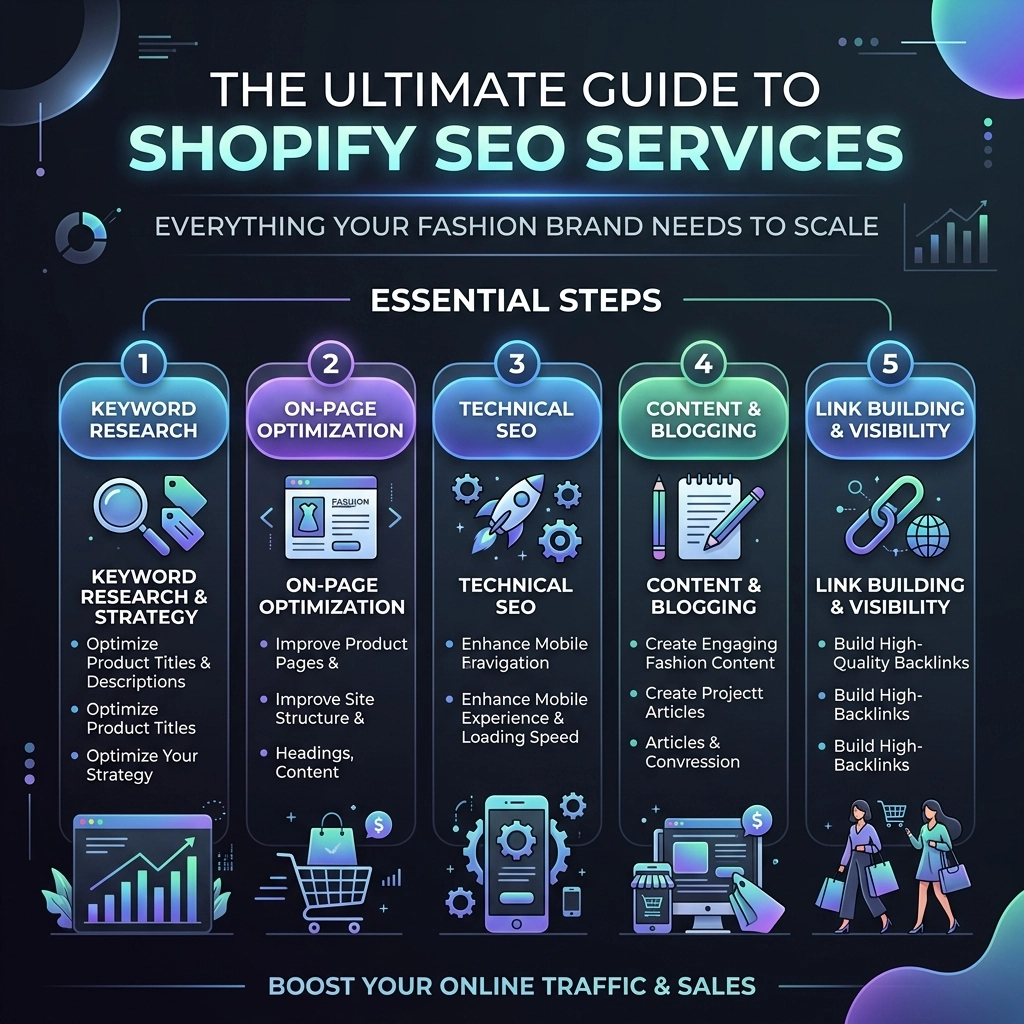
If you are running a fashion brand in 2026, you already know the drill: the digital runway is more crowded than ever. Relying solely on paid social ads is no longer the "cheat code" for scaling. With rising acquisition costs and privacy shifts, the most sustainable way to grow your D2C apparel or beauty brand is through organic search.
You’ve likely invested heavily in Shopify website design to make your store look like a high-end boutique. But if your target audience can’t find you when they search for "sustainable linen dresses" or "minimalist gold jewelry," your beautiful design is essentially a billboard in the middle of a desert.
Scaling requires a shift from "hoping people find you" to "ensuring search engines reward you." This guide breaks down the essential Shopify SEO services and strategies tailored specifically for the fast-paced world of fashion and apparel.
The Foundation: Why Fashion SEO is a Different Beast
Most SEO guides focus on generic blogs or SaaS products. Fashion is different. It is visual, seasonal, and highly emotive. Users don't just search for "clothes"; they search for specific vibes, fits, materials, and trends.
In 2026, Google’s algorithms are smarter at understanding visual intent. This means your SEO strategy must go beyond just keywords: it needs to encompass technical excellence, visual optimization, and a deep understanding of the customer journey.
The Problem: Why Most Fashion Brands Stall
Many D2C founders hit a plateau. They have a great product and a decent Shopify setup, but organic traffic stays flat. Often, the culprits are:
- Thin content: Product pages with only two sentences of description.
- Technical bloat: Too many apps slowing down the site.
- Zero keyword mapping: Ranking for your brand name is easy; ranking for "oversized streetwear hoodies" is where the real scale happens.
Pillar 1: Technical SEO – Building the Digital Runway
Think of technical SEO as the infrastructure of your store. If the foundation is shaky, no amount of pretty photography will save you.
Site Speed and Performance
In the fashion world, first impressions are everything. If your site takes more than three seconds to load, your bounce rate will skyrocket. Shopify is generally fast, but custom themes and heavy high-res imagery can bog it down.
- Image Compression: Use WebP formats and lazy loading for your lookbooks.
- App Audit: Delete any unused Shopify apps. They often leave behind "ghost code" that slows down your liquid files.
- Mobile-First Design: Over 80% of fashion discovery happens on mobile. Your Shopify website design must be flawless on a 6-inch screen.

Clean Site Architecture
A clean structure helps Google crawl your site and helps users find products faster. For fashion brands, we recommend a "shallow" hierarchy:
- Homepage > Category (Collections) > Sub-Category > Product Page.
Keep your URLs descriptive. Instead ofyourstore.com/products/item123, useyourstore.com/products/vintage-denim-jacket-light-wash.
Structured Data (Schema Markup)
Rich snippets are non-negotiable. By implementing Product Schema, you allow Google to show your price, availability, and star ratings directly in the search results. This significantly increases your click-through rate (CTR) compared to plain text links.
Pillar 2: On-Page Optimization – Speaking the Language of Style
On-page SEO is where you tell Google exactly what you are selling. For fashion, beauty, and jewelry brands, this is a delicate balance between being descriptive and staying "on brand."
Keyword Research for the Fashion Niche
Avoid chasing high-volume, generic terms like "shoes." You will never outrank the giants on day one. Instead, focus on long-tail keywords that indicate high purchase intent:
- Instead of "earrings," target "hypoallergenic gold hoop earrings for sensitive ears."
- Instead of "skincare," target "vegan cruelty-free vitamin C serum for hyperpigmentation."
Pro Tip: Use tools like Pinterest Trends and TikTok Creative Center to see what terminology your audience is actually using. If they are calling it "balletcore" or "quiet luxury," those are the keywords you need to weave into your headers.
Product Descriptions that Convert
Never, ever use the default manufacturer descriptions. It’s a death sentence for your rankings because of duplicate content.
- Write for humans first: Describe the hand-feel of the fabric, the fit (true to size?), and styling tips.
- Optimize for bots second: Include your primary and secondary keywords naturally in the first 100 words and in the H2 tags.
The Power of ALT Text
In a visual industry, your images are your greatest asset. Every image on your Shopify store should have descriptive ALT text. This helps you rank in Google Images, which is a massive traffic driver for apparel brands.
- Bad ALT text: "image1.jpg"
- Good ALT text: "Model wearing sustainable hemp midi dress in sage green, front view."

Pillar 3: Content Marketing – Building Authority and EEAT
Google prioritizes EEAT (Experience, Expertise, Authoritativeness, and Trustworthiness). For a fashion brand, this means you need to be more than just a shop: you need to be a style authority.
Styling Guides and Trend Reports
Don't just sell a product; sell a look. Create blog posts that solve problems for your customers:
- "5 Ways to Style a Blazer from Desk to Dinner"
- "The Ultimate Guide to Choosing the Right Jewelry for Your Face Shape"
- "What to Wear to a Summer Wedding in 2026"
These posts allow you to capture "top of funnel" traffic: people who are looking for inspiration but haven't decided where to buy yet.
Building Trust Through Transparency
Create dedicated pages for your sustainability efforts, your manufacturing process, and your "About Us" story. This builds the "Trust" component of EEAT and helps convert skeptical first-time visitors into loyal brand advocates.
Pillar 4: Conversion Rate Optimization (CRO) – The Silent Partner of SEO
Traffic is a vanity metric; sales are a sanity metric. Professional Shopify SEO services should always go hand-in-hand with CRO. If you drive 10,000 new visitors to your site but your checkout process is clunky, you’ve wasted your effort.
How SEO and Design Intersect
Your Shopify website design should guide the user toward the "Add to Cart" button with zero friction.
- Clear CTAs: Use high-contrast colors for your buttons.
- Social Proof: Integrate customer reviews and "As Seen On" sections.
- Internal Linking: Use "Complete the Look" or "Recommended for You" sections to increase your average order value (AOV) and keep users on the site longer (which signals to Google that your content is valuable).

Challenges to Scaling: The Pros and Cons
Scaling a fashion brand isn't always a straight line up. It's important to have a balanced perspective on what to expect.
| Feature | Pros | Challenges |
|---|---|---|
| Organic SEO | High ROI over time; builds long-term brand equity. | Takes 3-6 months to see significant results. |
| Niche Keywords | Lower competition; higher conversion rates. | Lower search volume than generic terms. |
| Shopify Apps | Easy to add functionality (reviews, upsells). | Can slow down site speed if not managed. |
| High-Res Video | Huge engagement; shows product movement. | Very difficult to optimize for technical speed. |
Key Insight: SEO is a marathon, not a sprint. The brands that win in 2026 are the ones that started building their organic "moat" today.
Why Partner with Experts?
Let’s be honest: you’re a founder or a marketing manager. Your time is best spent on product development, brand vision, and creative direction. Managing the minutiae of 404 redirects, schema code, and keyword mapping can be overwhelming.
This is where professional Shopify SEO services come in. At Thriftizer, we specialize in helping D2C brands navigate the technical and creative hurdles of scaling. Whether you need a complete overhaul of your Shopify website design or a surgical SEO strategy to dominate your niche, we act as your growth co-pilot.
We don't believe in generic "one-size-fits-all" packages. Every fashion brand has a unique DNA, and your digital strategy should reflect that. Explore how we can help you scale by visiting Thriftizer or check out our verified track record on the Shopify Expert directory.

Your 2026 Implementation Checklist: Next Steps
Ready to stop guessing and start growing? Follow this step-by-step checklist to get your Shopify store on the right track.
- Submit Your Sitemap: Ensure your sitemap.xml is submitted to Google Search Console.
- Conduct a Speed Test: Use Google PageSpeed Insights. If you're under 50 on mobile, address your image sizes and app scripts immediately.
- Map Your Keywords: Identify 5-10 "money keywords" for your top-selling collections.
- Audit Your ALT Text: Spend an afternoon updating the ALT text for your top 50 products.
- Fix Broken Links: Use a tool to find 404 errors and redirect them to active collections.
- Update Meta Titles: Make sure every page has a unique Meta Title and Description that includes a call to action.
- Create One Authority Post: Write a 1,000-word guide on a topic your customers care about (e.g., "The History of Streetwear" or "How to Care for Silk").
- Activate Rich Snippets: Ensure your theme supports JSON-LD structured data for products.
Never ever think of giving up. The first few months of SEO can feel quiet, but the compound interest of organic traffic is the most powerful force in e-commerce. Start small, stay creative, and focus on providing genuine value to your style-conscious audience.
Your brand deserves to be seen. Let's make sure the world can find it.