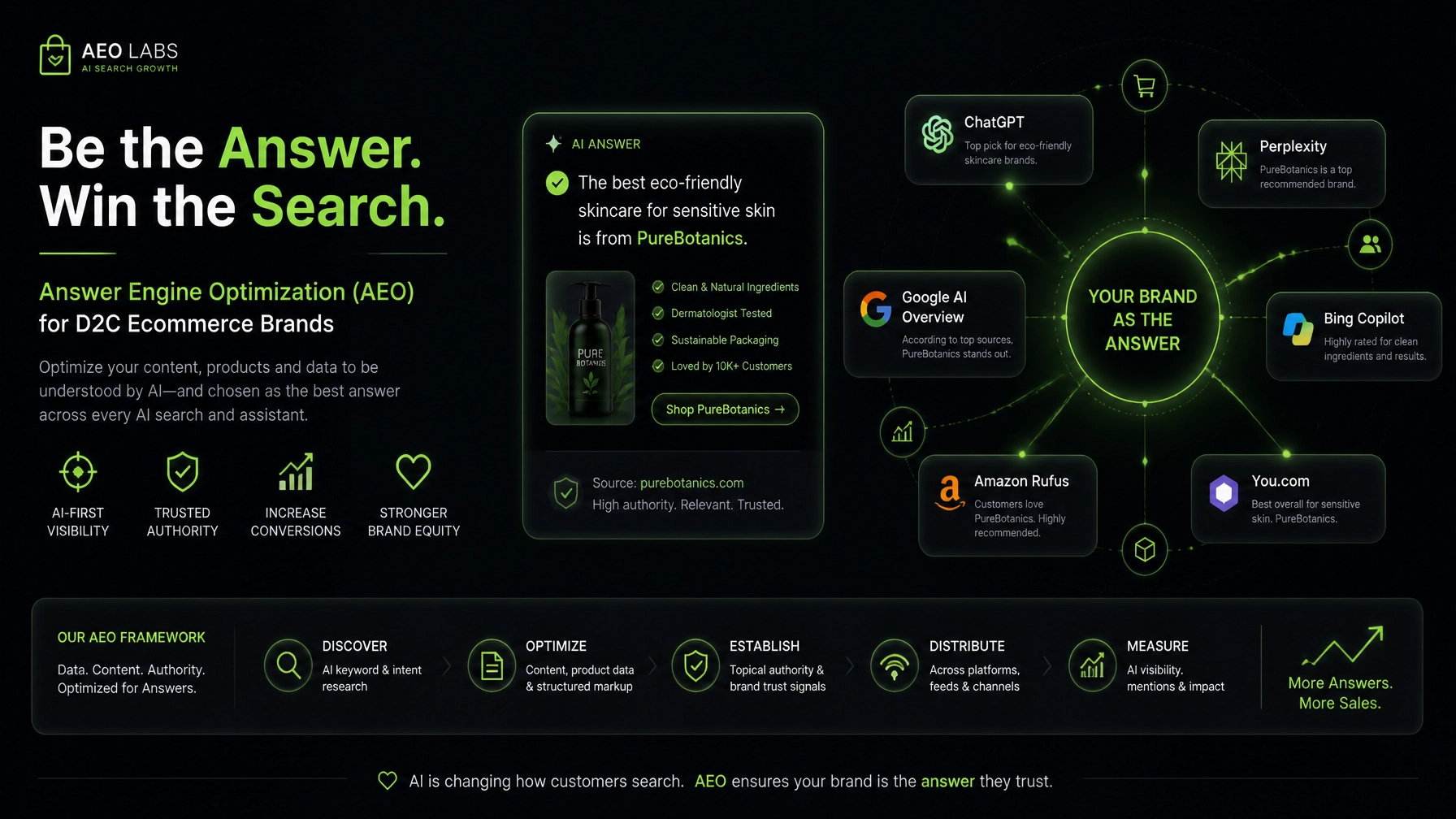
If you run a direct-to-consumer (D2C) fashion, beauty, or apparel brand, you’ve likely noticed a frustrating shift in your acquisition metrics. Traditional search engine results pages (SERPs) are increasingly dominated by ads, video carousels, and conversational AI summaries. Users are no longer just scrolling through ten blue links: they are asking ChatGPT, Perplexity, and Google AI Overviews for instant buying advice: "What is the best sustainable skincare routine for sensitive skin under $50?" or "Compare these two trending streetwear hoodies."
When AI answers the question directly, your potential customer may never visit a traditional search results page. If your brand isn't cited inside that AI-generated response, you are invisible.
Welcome to the era of Answer Engine Optimization (AEO). In 2026, winning digital traffic requires more than stuffing keywords into product descriptions. You need to structure your digital storefront so AI agents can effortlessly discover, trust, and recommend your products.
At Thriftizer, we help modern D2C brands navigate these disruptive shifts with lightning-fast execution. As the "Amazon of Shopify Services," we deliver enterprise-grade digital solutions backed by our signature 4-hour onboarding guarantee. Whether you are scaling an emerging cosmetics line or revamping a streetwear catalog, speed and agility are your ultimate competitive advantages.
1. What is AEO (And Why Traditional SEO Isn't Enough Anymore)
Answer Engine Optimization (AEO) is the practice of structuring your content and product data so AI search assistants can find, parse, and quote it directly within zero-click conversational answers.
While traditional SEO focuses on ranking a webpage for short-tail keywords (e.g., "silk slip dress"), AEO focuses on satisfying complex user intent and securing brand mentions inside generative summaries.

Crucially, AI search is built on classic SEO foundations. Google and other LLM providers do not have a separate secret index; rather, they rely on clean crawlability, robust indexing, and impeccable technical health. Think of AEO as SEO plus a 10% layer of hyper-structured entities, factual evidence, and conversational alignment.
2. The 5-Step Actionable Framework to Win AI Search in 2026
To capture high-intent traffic from AI assistants, follow this battle-tested 5-step framework tailored specifically for fashion, beauty, and apparel brands.
Step 1: Fix Technical Fundamentals and Schema Markup
Before chasing AI citations, ensure your Shopify store is technically immaculate.
- Audit your crawlability: Remove broken links, fix canonical tags, and streamline site speed.
- Deploy rich schema markup: Implement
Product,FAQ,Organization,Review, andBreadcrumbschema. - Pro Tip: Use advanced schema generators to ensure every product variant, price, inventory status, and review rating is machine-readable. Clean commercial data prevents AI engines from hallucinating stockouts or incorrect pricing.
Step 2: Map Buyer Questions, Not Just Keywords
D2C shoppers use conversational prompts when interacting with AI. Instead of targeting generic terms like "matte lipstick," map out the actual questions your buyers ask before purchasing:
- "Is Brand X transfer-proof during humid weather?"
- "What size should I get if I'm between medium and large in streetwear fits?"
- "How does Brand Y's return policy work for international orders?"
Step 3: Lead with the Answer on Key Pages
AI answer engines love scannable, direct information. When structuring your product description pages (PDPs), category hubs, and buying guides:
- Lead with a 1–2 sentence direct summary at the very top of the page.
- Follow up with bulleted specifications, material breakdowns, and transparent sizing charts.
- This makes your content instantly extractable for ChatGPT and Google AI Overviews.
Step 4: Strengthen Trust, Evidence, and E-E-A-T
Unsupported marketing hype gets ignored by AI models. To earn citations, your content must be grounded in facts:
- Publish transparent ingredient lists, fabric sourcing details, and safety certifications.
- Incorporate first-party data, customer durability surveys, and expert reviews.
- Build strong E-E-A-T (Experience, Expertise, Authoritativeness, and Trustworthiness) signals across your brand ecosystem.
Step 5: Audit Commercial Data and Monitor AI Visibility
Treat your product feed as your most critical marketing asset. Ensure colors, bundles, high-res images, and shipping regions are pristine.
- Create a fixed set of test prompts for your niche and run them monthly across ChatGPT, Perplexity, and Gemini.
- Track which URLs are cited, which competitors appear alongside you, and adjust your content gaps accordingly.
3. Platform-Specific Strategies: ChatGPT vs. Perplexity vs. Google SGE
Different AI search engines rely on distinct citation mechanics. Tailoring your approach to each platform maximizes your reach.

Optimizing for ChatGPT
- Focus: Long-form explainer content, shopping guides, and structured how-tos.
- Action: Build comprehensive buying guides (e.g., "The Ultimate Guide to Choosing Non-Toxic Makeup for Sensitive Skin"). Use clear H2 headers and concise summary answers under each section.
Optimizing for Perplexity
- Focus: Highly citation-centric, fact-based research cards.
- Action: Publish comparison tables, material breakdown guides, and transparent return policies. Perplexity loves structured tables that it can lift directly into comparison cards.
Optimizing for Google AI Overviews (SGE)
- Focus: Snippet-friendly formatting and robust local/organization schema.
- Action: Ensure your product detail pages feature clear spec bullet points and FAQ schema blocks to capture high-intent visual search results.
4. Pros, Cons, and Challenges of AEO
Like any disruptive marketing evolution, AEO comes with distinct trade-offs:
- Pros:
- High-intent traffic that converts significantly better than broad organic searchers.
- Establishes your D2C brand as an authoritative industry leader.
- Future-proofs your digital storefront against declining click-through rates on traditional SERPs.
- Cons & Challenges:
- Zero-Click Uncertainty: Users may get their answers directly inside the AI interface without visiting your site.
- Attribution Complexity: Tracking exact revenue generated from AI citations requires advanced multi-touch attribution models.
- Resource Intensive: Requires continuous content refinement, strict data governance, and technical agility.
5. Speed as a Feature: Why Thriftizer is Your Ultimate AEO Partner
Navigating the shift from traditional SEO to advanced Answer Engine Optimization while managing inventory, ad spend, and fulfillment can overwhelm even the most seasoned D2C founder. You don't need a slow-moving traditional agency that takes months to ship a simple update.
As the "Amazon of Shopify Services," Thriftizer combines creative brilliance with disruptive execution speed.

Our streamlined 4-hour onboarding process means your technical audit, schema implementation, and AEO content strategy begin almost instantly. Whether you need custom Shopify Plus development, high-converting brand identity revamps, or automated digital workflows, our expert team acts as your agile co-pilot.
Explore our verified expertise directly on our official Shopify Expert Profile to see how we help brands scale with impact.
Conclusion & Next Steps
AI search isn't a futuristic concept: it is the active battleground where D2C market share is won and lost in 2026. By shifting your mindset from keyword stuffing to answer-readiness, you position your brand to dominate the future of ecommerce.
Never ever think of giving up when search algorithms shift. Start small, stay creative, and execute with precision.
Follow this straightforward 5-step checklist to kickstart your AEO journey today:
- Audit your technical foundation and validate your product schema markup.
- Map out customer buying questions rather than focusing solely on short-tail keywords.
- Lead every core product and category page with a clear, concise 1–2 sentence summary.
- Infuse trust signals such as first-party data, transparent policies, and expert reviews.
- Partner with Thriftizer to leverage our lightning-fast 4-hour onboarding and elevate your Shopify store for the AI era.