Author: Nivi

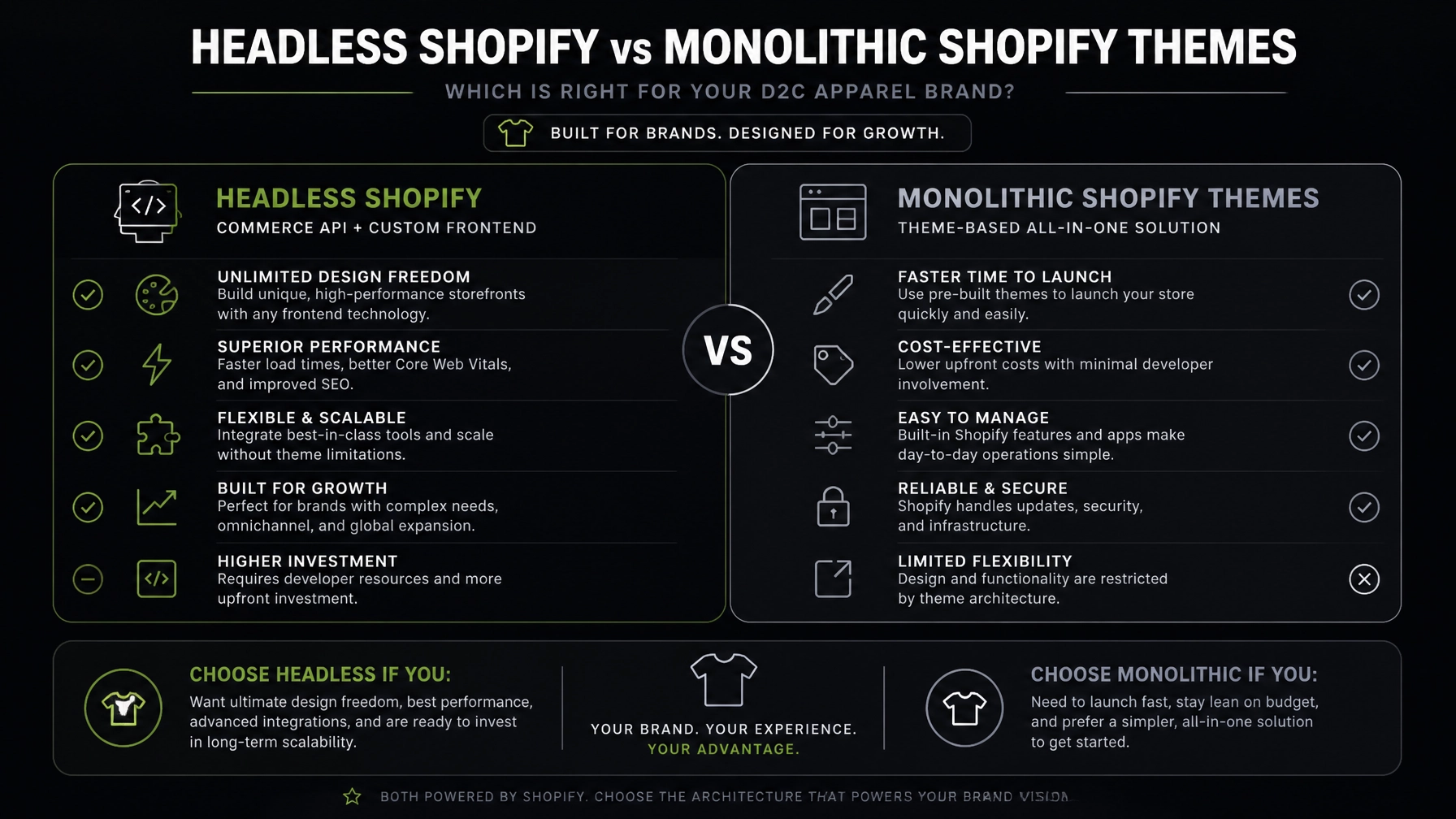
  • Why Headless Shopify is Overrated for Mid-Market Apparel Brands (And What to Do Instead)

    Why Headless Shopify is Overrated for Mid-Market Apparel Brands (And What to Do Instead)

    If you are running a growing D2C fashion or apparel brand doing between $1M and $10M in annual revenue, you have likely sat through a pitch where an agency breathlessly recommends Headless Shopify. They will tell you that traditional themes are holding you back, that your site speed is costing you millions, and that you need a custom React or Hydrogen front-end decoupled from your backend.

    Before you sign a six-figure contract and commit your engineering team to a nine-month replatforming marathon, take a deep breath.

    For 90% of mid-market apparel brands, headless architecture is expensive overkill. It introduces staggering maintenance overhead, bloated development budgets, and timeline delays without delivering a proportional return on investment.

    At Thriftizer, we champion a "Speed as a Feature" philosophy: not just in how fast your pages load, but in how quickly you can launch campaigns, test new collections, and scale your storefront. In this guide, we break down why headless is often a hype trap for mid-market brands, what it actually costs, and the high-performance middle-ground strategy that gets you 90% of the benefits at a fraction of the price.


    The Headless Hype: Why Mid-Market Brands Fall for the Trap

    Headless commerce undeniably has its place in the enterprise stratosphere. If you are operating across twelve global regions with multilingual storefronts, custom ERP integrations in every warehouse, and a massive internal engineering squad, decoupling your front-end from Shopify makes absolute sense.

    However, agencies often pitch headless as a silver bullet to mid-market apparel brands struggling with basic conversion rate optimization (CRO) or slow page loads that are actually caused by bloated third-party tracking apps: not Shopify’s theme engine.

    The Hidden Costs of Headless for $1M–$10M Brands

    When evaluating headless architecture, most founders focus solely on the initial build estimate while ignoring the ongoing operational tax.

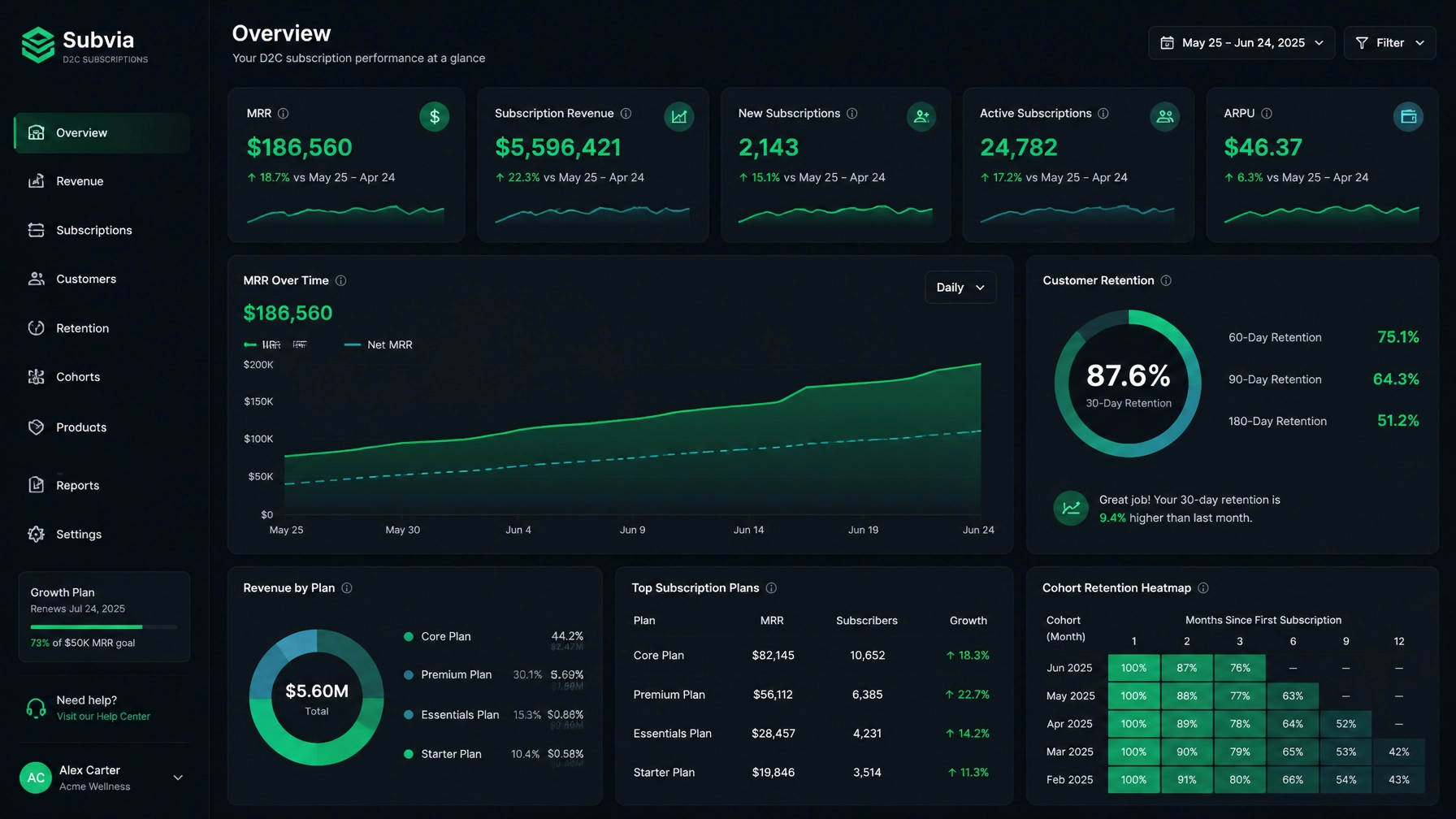
    Shopify performance metrics and conversion rate analytics dashboard

    Consider the real-world benchmarks between a traditional custom Shopify build and a mid-market headless deployment:

    • Initial Build Costs: A professional, high-converting monolithic custom Shopify theme typically ranges from $30k to $120k and launches in 2 to 8 weeks. In contrast, a mid-market headless implementation (Hydrogen or Next.js + headless CMS) routinely costs $100k to $350k+ and takes 4 to 8 months minimum to reach production.
    • Ongoing Engineering & Maintenance: With a traditional theme, your marketing team can swap banners, adjust sections, and launch flash sales using native visual builders. With headless, every minor layout change or landing page update requires an engineering ticket, translating to ongoing developer retainers of $8k to $40k per month.
    • Total Cost of Ownership (3-Year TCO): Independent benchmarks show that headless implementations result in a 3-year TCO of $690k to $1.44M+, whereas a robust monolithic setup averages $375k to $865k.

    Key Insight: Headless commerce rarely saves you money; it shifts your budget from customer acquisition and growth into infrastructure maintenance and developer salaries.


    The Modern Monolith: How to Get 90% of Headless Benefits Without the Headache

    You do not need a headless stack to achieve lightning-fast load times, flawless mobile UX, and sophisticated merchandising. Modern Shopify (especially on Shopify Plus) has evolved past rigid monolithic templates.

    By leveraging native platform features smartly, you can build a blazing-fast apparel storefront that satisfies both your shoppers and your CFO.

    1. Leverage Section-Based Architecture & Custom Liquid

    Today’s Online Store 2.0 theme architecture allows developers to build modular, reusable sections. Instead of hardcoding static templates, use Custom Liquid blocks to embed custom calculators, sizing widgets, or interactive lookbooks directly into the native theme customizer. This gives your marketing team drag-and-drop flexibility without sacrificing site speed.

    2. Harness Shopify Metafields & Metaobjects

    Apparel brands live and die by rich product data: fit guides, fabric care instructions, model sizing, and material origin. Instead of relying on heavy third-party apps that slow down your DOM, use native Shopify Metafields and Metaobjects to structure complex product attributes natively.

    3. Deploy Shopify Functions for Custom Checkout Logic

    Historically, brands went headless to customize the checkout or shipping logic. Today, Shopify Functions allow developers to execute custom backend logic directly on Shopify's lightning-fast infrastructure. Whether you are offering dynamic bundling discounts, custom loyalty tiers, or localized shipping rules, Shopify Functions execute securely at the edge without a custom server.


    Decision Framework: When is Headless Actually Worth It?

    To help you evaluate whether your apparel brand is ready for headless, use this quick scorecard.

    Headless is likely NOT for you if:

    • Your annual revenue is currently between $1M and $10M.
    • Your marketing team needs to launch landing pages and flash sales within hours, not weeks.
    • You do not have a dedicated, full-time React/Next.js developer on your payroll.
    • Your current performance bottlenecks are caused by unoptimized imagery and excessive tracking pixels rather than Shopify's Liquid rendering engine.

    Headless MIGHT make sense if:

    • You operate multiple distinct storefronts across international regions with complex localized currencies and multi-warehouse ERP logic.
    • You have a multi-person internal engineering squad ready to maintain custom frontend codebases.
    • Your brand identity requires deeply experimental, non-standard 3D WebGL animations or highly custom interactive shopping experiences that push browser limits.

    The Thriftizer Advantage: Agility Over Complexity

    At Thriftizer, we believe that speed is the ultimate competitive advantage for D2C brands. While traditional agencies drag out projects for months with bloated discovery phases and expensive architectural overhauls, we operate as the "Amazon of Shopify Services": delivering elite design, robust engineering, and rapid execution.

    Streamlined 4-hour onboarding and modern Shopify architecture roadmap

    We know that time kills momentum. That is why we pioneered our signature 4-Hour Onboarding process. From the moment you partner with our strategists and designers, we audit your technical stack, map out your conversion funnels, and initiate execution within hours: not weeks.

    As an officially recognized partner, you can also explore our verified credentials directly through our Shopify Expert profile to see how we help apparel and beauty brands scale efficiently.


    Pros and Cons of Sticking with a Monolithic Shopify Setup

    To maintain complete transparency, let’s weigh the trade-offs of choosing a high-performance native Shopify theme over a headless stack:

    Pros

    • Faster Time-to-Market: Launch your new store in weeks instead of quarters.
    • Lower Upfront Capital: Preserve cash flow for paid acquisition, inventory, and brand marketing.
    • Empowered Marketing Teams: Visual theme editors allow non-technical staff to update pages instantly.
    • Reliable Ecosystem: Seamless compatibility with thousands of vetted Shopify apps and payment gateways.

    Cons / Challenges

    • Platform Constraints: Deeply unorthodox user experience flows may require creative workaround development.
    • Theme Lock-In: Migrating between complex themes requires careful data and style mapping.

    Next Steps to Scale Your Apparel Brand Today

    Stop letting tech hype drain your marketing budget. If you want to maximize your conversion rate and scale revenue without the engineering nightmares of headless, follow this actionable checklist:

    1. Audit Your Current Tech Stack: Review every installed app and remove any redundant scripts or legacy tracking pixels dragging down your site speed.
    2. Optimize Native Assets: Compress your high-res apparel lookbooks, implement lazy loading, and leverage modern WebP image formats.
    3. Upgrade Your Theme Architecture: Transition to an Online Store 2.0 OS-compliant custom theme utilizing native Metafields and section blocks.
    4. Partner with Experts: Skip the slow agency bloat. Contact Thriftizer today to experience our rapid 4-Hour Onboarding and turn your store into a high-converting growth engine.

    Start small, stay creative, and never ever think of giving up on your brand's vision.
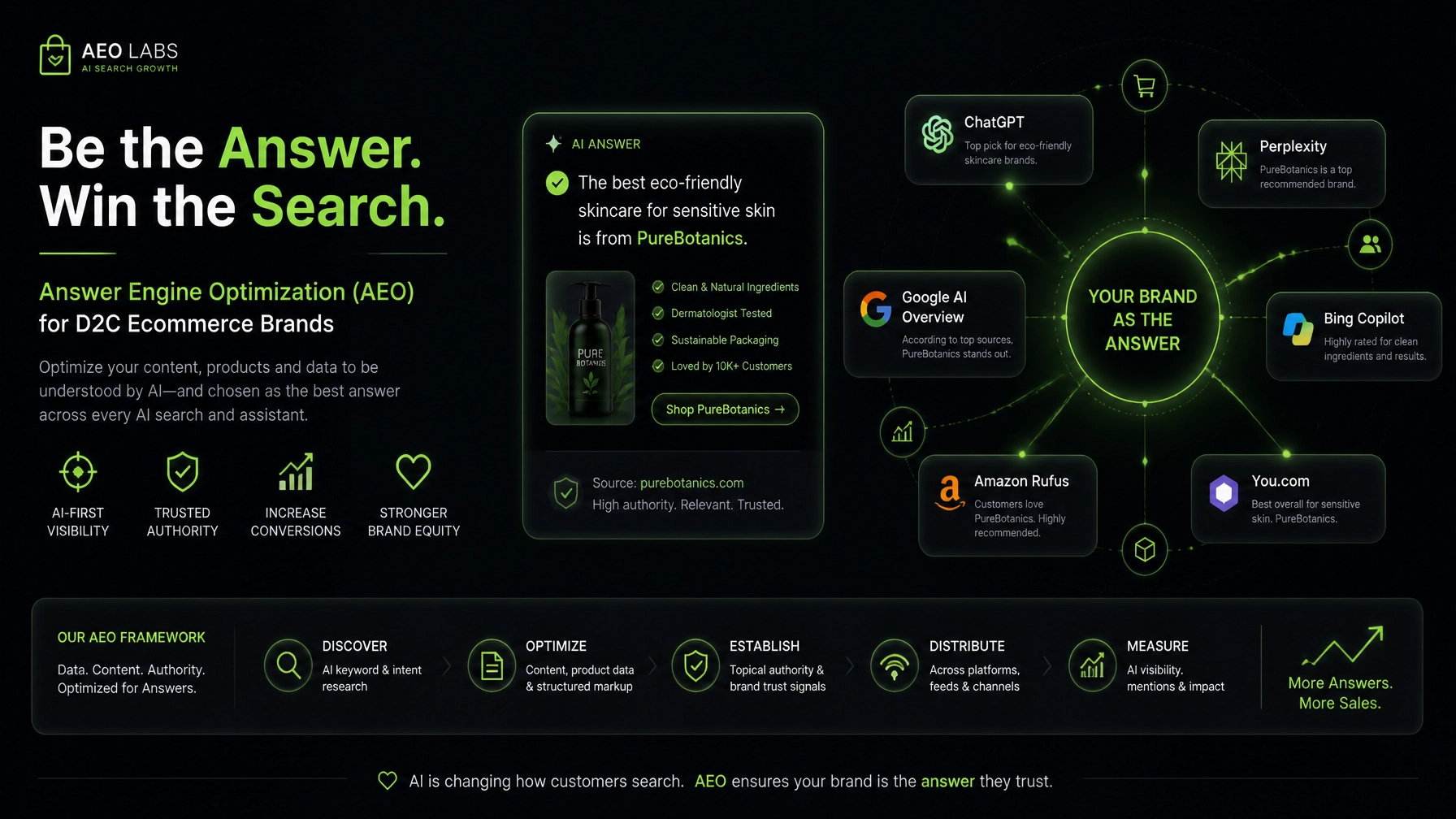
  • Struggling For Traffic? 5 Ways to Win at AI Search (AEO) in 2026

    Struggling For Traffic? 5 Ways to Win at AI Search (AEO) in 2026

    If you run a direct-to-consumer (D2C) fashion, beauty, or apparel brand, you’ve likely noticed a frustrating shift in your acquisition metrics. Traditional search engine results pages (SERPs) are increasingly dominated by ads, video carousels, and conversational AI summaries. Users are no longer just scrolling through ten blue links: they are asking ChatGPT, Perplexity, and Google AI Overviews for instant buying advice: "What is the best sustainable skincare routine for sensitive skin under $50?" or "Compare these two trending streetwear hoodies."

    When AI answers the question directly, your potential customer may never visit a traditional search results page. If your brand isn't cited inside that AI-generated response, you are invisible.

    Welcome to the era of Answer Engine Optimization (AEO). In 2026, winning digital traffic requires more than stuffing keywords into product descriptions. You need to structure your digital storefront so AI agents can effortlessly discover, trust, and recommend your products.

    At Thriftizer, we help modern D2C brands navigate these disruptive shifts with lightning-fast execution. As the "Amazon of Shopify Services," we deliver enterprise-grade digital solutions backed by our signature 4-hour onboarding guarantee. Whether you are scaling an emerging cosmetics line or revamping a streetwear catalog, speed and agility are your ultimate competitive advantages.


    1. What is AEO (And Why Traditional SEO Isn't Enough Anymore)

    Answer Engine Optimization (AEO) is the practice of structuring your content and product data so AI search assistants can find, parse, and quote it directly within zero-click conversational answers.

    While traditional SEO focuses on ranking a webpage for short-tail keywords (e.g., "silk slip dress"), AEO focuses on satisfying complex user intent and securing brand mentions inside generative summaries.

    AEO 5-Step Framework for D2C Brands

    Crucially, AI search is built on classic SEO foundations. Google and other LLM providers do not have a separate secret index; rather, they rely on clean crawlability, robust indexing, and impeccable technical health. Think of AEO as SEO plus a 10% layer of hyper-structured entities, factual evidence, and conversational alignment.


    2. The 5-Step Actionable Framework to Win AI Search in 2026

    To capture high-intent traffic from AI assistants, follow this battle-tested 5-step framework tailored specifically for fashion, beauty, and apparel brands.

    Step 1: Fix Technical Fundamentals and Schema Markup

    Before chasing AI citations, ensure your Shopify store is technically immaculate.

    • Audit your crawlability: Remove broken links, fix canonical tags, and streamline site speed.
    • Deploy rich schema markup: Implement Product, FAQ, Organization, Review, and Breadcrumb schema.
    • Pro Tip: Use advanced schema generators to ensure every product variant, price, inventory status, and review rating is machine-readable. Clean commercial data prevents AI engines from hallucinating stockouts or incorrect pricing.

    Step 2: Map Buyer Questions, Not Just Keywords

    D2C shoppers use conversational prompts when interacting with AI. Instead of targeting generic terms like "matte lipstick," map out the actual questions your buyers ask before purchasing:

    • "Is Brand X transfer-proof during humid weather?"
    • "What size should I get if I'm between medium and large in streetwear fits?"
    • "How does Brand Y's return policy work for international orders?"

    Step 3: Lead with the Answer on Key Pages

    AI answer engines love scannable, direct information. When structuring your product description pages (PDPs), category hubs, and buying guides:

    • Lead with a 1–2 sentence direct summary at the very top of the page.
    • Follow up with bulleted specifications, material breakdowns, and transparent sizing charts.
    • This makes your content instantly extractable for ChatGPT and Google AI Overviews.

    Step 4: Strengthen Trust, Evidence, and E-E-A-T

    Unsupported marketing hype gets ignored by AI models. To earn citations, your content must be grounded in facts:

    • Publish transparent ingredient lists, fabric sourcing details, and safety certifications.
    • Incorporate first-party data, customer durability surveys, and expert reviews.
    • Build strong E-E-A-T (Experience, Expertise, Authoritativeness, and Trustworthiness) signals across your brand ecosystem.

    Step 5: Audit Commercial Data and Monitor AI Visibility

    Treat your product feed as your most critical marketing asset. Ensure colors, bundles, high-res images, and shipping regions are pristine.

    • Create a fixed set of test prompts for your niche and run them monthly across ChatGPT, Perplexity, and Gemini.
    • Track which URLs are cited, which competitors appear alongside you, and adjust your content gaps accordingly.

    3. Platform-Specific Strategies: ChatGPT vs. Perplexity vs. Google SGE

    Different AI search engines rely on distinct citation mechanics. Tailoring your approach to each platform maximizes your reach.

    AI Search Analytics and Citation Tracking

    Optimizing for ChatGPT

    • Focus: Long-form explainer content, shopping guides, and structured how-tos.
    • Action: Build comprehensive buying guides (e.g., "The Ultimate Guide to Choosing Non-Toxic Makeup for Sensitive Skin"). Use clear H2 headers and concise summary answers under each section.

    Optimizing for Perplexity

    • Focus: Highly citation-centric, fact-based research cards.
    • Action: Publish comparison tables, material breakdown guides, and transparent return policies. Perplexity loves structured tables that it can lift directly into comparison cards.

    Optimizing for Google AI Overviews (SGE)

    • Focus: Snippet-friendly formatting and robust local/organization schema.
    • Action: Ensure your product detail pages feature clear spec bullet points and FAQ schema blocks to capture high-intent visual search results.

    4. Pros, Cons, and Challenges of AEO

    Like any disruptive marketing evolution, AEO comes with distinct trade-offs:

    • Pros:
      • High-intent traffic that converts significantly better than broad organic searchers.
      • Establishes your D2C brand as an authoritative industry leader.
      • Future-proofs your digital storefront against declining click-through rates on traditional SERPs.
    • Cons & Challenges:
      • Zero-Click Uncertainty: Users may get their answers directly inside the AI interface without visiting your site.
      • Attribution Complexity: Tracking exact revenue generated from AI citations requires advanced multi-touch attribution models.
      • Resource Intensive: Requires continuous content refinement, strict data governance, and technical agility.

    5. Speed as a Feature: Why Thriftizer is Your Ultimate AEO Partner

    Navigating the shift from traditional SEO to advanced Answer Engine Optimization while managing inventory, ad spend, and fulfillment can overwhelm even the most seasoned D2C founder. You don't need a slow-moving traditional agency that takes months to ship a simple update.

    As the "Amazon of Shopify Services," Thriftizer combines creative brilliance with disruptive execution speed.

    D2C AI Shopping Assistant and Brand Growth

    Our streamlined 4-hour onboarding process means your technical audit, schema implementation, and AEO content strategy begin almost instantly. Whether you need custom Shopify Plus development, high-converting brand identity revamps, or automated digital workflows, our expert team acts as your agile co-pilot.

    Explore our verified expertise directly on our official Shopify Expert Profile to see how we help brands scale with impact.


    Conclusion & Next Steps

    AI search isn't a futuristic concept: it is the active battleground where D2C market share is won and lost in 2026. By shifting your mindset from keyword stuffing to answer-readiness, you position your brand to dominate the future of ecommerce.

    Never ever think of giving up when search algorithms shift. Start small, stay creative, and execute with precision.

    Follow this straightforward 5-step checklist to kickstart your AEO journey today:

    1. Audit your technical foundation and validate your product schema markup.
    2. Map out customer buying questions rather than focusing solely on short-tail keywords.
    3. Lead every core product and category page with a clear, concise 1–2 sentence summary.
    4. Infuse trust signals such as first-party data, transparent policies, and expert reviews.
    5. Partner with Thriftizer to leverage our lightning-fast 4-hour onboarding and elevate your Shopify store for the AI era.

  • Are You Making These 7 Common Shopify Checkout Extensibility Mistakes?

    Are You Making These 7 Common Shopify Checkout Extensibility Mistakes?

    For D2C fashion, beauty, and lifestyle brands on Shopify, the checkout has always been the ultimate conversion battleground. For years, customising it meant hacking checkout.liquid, injecting arbitrary JavaScript, and holding your breath during peak traffic events like Black Friday.

    Today, that era is firmly behind us. With Shopify fully transitioning to Checkout Extensibility, legacy code, script tags, and checkout.liquid have been sunsetted in favour of a secure, modular, app-based architecture powered by Checkout UI Extensions, Web Pixels, and Shopify Functions.

    However, many growing brands are treating this shift as a simple code copy-paste exercise rather than a fundamental architectural rebuild. The result? Broken tracking, silent checkout errors, and lost revenue.

    At Thriftizer, we view speed as a feature. In this deep-dive guide, we will unpack the 7 most common Shopify Checkout Extensibility mistakes D2C brands make during migration, and how you can fix them before your conversion rates take a hit.


    Why Checkout Extensibility is a Rebuild, Not a Migration

    Shopify green shopping bag logo representing digital commerce solutions

    When checkout.liquid was deprecated, merchants lost the ability to hard-code raw HTML and JavaScript directly into the checkout flow. While this initially caused panic among developers accustomed to unrestricted overrides, the new framework is vastly superior. It guarantees lightning-fast loading speeds, seamless mobile checkouts, native Shop Pay compatibility, and robust enterprise-grade security.

    Yet, because the system sandboxes your UI components and moves business logic to server-side functions, you cannot simply migrate old code. You have to redesign your checkout experience using modern, approved primitives.

    Let's examine where most brands stumble.


    The 7 Common Shopify Checkout Extensibility Mistakes

    1. Treating Checkout Extensibility Like a Direct Code Migration

    The Mistake: Assuming that your legacy checkout.liquid snippets, custom CSS, and DOM-manipulation scripts can be automatically translated into the new checkout environment.

    • The Reality: Shopify's secure sandbox completely blocks unverified scripts. Even if legacy code remains in your theme files, it simply will not execute.
    • The Fix: Open Settings → Checkout in your Shopify admin and review your customisation report. Back up your old code for historical reference, then rebuild your UI modifications from scratch using official Checkout UI Extensions.

    Key Insight: Never try to force old habits into new infrastructure. Embrace the modular component library provided by Shopify to build cleaner, faster, and conversion-optimised checkout steps.

    2. Leaving Critical Tracking in Deprecated Additional Scripts

    The Mistake: Relying on the legacy Additional Scripts box or global script tags for your Meta, TikTok, Google Ads, or affiliate tracking pixels, assuming they will continue firing indefinitely.

    • The Reality: For non-Plus and Plus stores alike, legacy script injection on thank-you and order-status pages has strict deprecation deadlines. When these cutoffs hit, your ad pixels go dark overnight, blinding your attribution models.
    • The Fix: Audit your tracking setup immediately. Migrate every single conversion event over to the Web Pixels API under Settings → Customer events. This ensures your data is collected securely, complies with privacy regulations, and feeds accurately back into your ad manager.

    E-commerce checkout workflow blueprint with nodes and glowing lines

    3. Attempting to Inject Custom HTML, CSS, or JS into the Checkout UI

    The Mistake: Trying to bypass Shopify’s UI restrictions by writing custom hacks that inject raw HTML or manipulate the DOM directly at checkout.

    • The Reality: Unsandboxed JavaScript introduced severe security vulnerabilities and crashed mobile checkouts in the past. Shopify's modern architecture strictly forbids raw code injection.
    • The Fix: Use approved Checkout UI Extensions components and APIs. If you require advanced custom layouts or unique fields (like gift message boxes or delivery date selectors), build them as dedicated app extensions that run securely inside Shopify's sandboxed environment.

    4. Ignoring Shopify Functions and Relying on Deprecated Shopify Scripts

    The Mistake: Assuming that custom discount rules, bundle pricing, and advanced shipping calculations managed by old Shopify Scripts will keep working without intervention.

    • The Reality: Legacy Shopify Scripts have been replaced by Shopify Functions. Functions run server-side with zero latency impact, offering infinitely better performance than client-side scripts.
    • The Fix: Inventory every single script running in your store. Rebuild your custom discount logic, volume-based pricing tiers, and custom shipping fee rules as Shopify Functions. Combine them with cart attributes to pass necessary customer selections seamlessly.

    5. Failing to Audit Checkout-Dependent Apps for Compatibility

    The Mistake: Assuming that because an app is installed in your Shopify admin, it is fully compatible with Checkout Extensibility and Post-Purchase pages.

    • The Reality: Many third-party review, upsell, and loyalty apps were built for the old script-tag ecosystem. If they haven't updated to Checkout Extensibility, they will silently fail or break your checkout flow.
    • The Fix: Review every app that touches your cart, checkout, or thank-you page. Check their changelogs for official Checkout UI Extensions and Web Pixels support. If an app vendor hasn't upgraded, replace them with modern, certified alternatives before peak shopping seasons.

    6. Misusing Checkout Metafields Instead of Cart Attributes for Functions

    The Mistake: Storing customer selections collected in UI extensions inside checkout metafields, expecting Shopify Functions to read them instantly.

    • The Reality: Shopify’s architecture maintains strict data boundaries. Checkout metafields are often not exposed to Shopify Functions in real time.
    • The Fix: Always use cart attributes (and cart metafields where supported) to store data collected from UI extensions (such as gift-wrapping toggles or monogram instructions). Shopify Functions can easily read cart attributes to dynamically adjust pricing and shipping rates.

    7. Skipping Rigorous Cross-Device Mobile & Payment Testing

    The Mistake: Making changes in a development environment, testing once on a desktop browser, and immediately pushing live to production.

    • The Reality: Over 80% of D2C fashion and beauty traffic happens on mobile devices, often through accelerated checkouts like Shop Pay, Apple Pay, and Google Pay. UI extensions can render differently across mobile viewports.
    • The Fix: Run comprehensive test checkouts across multiple mobile devices, tablets, and desktop browsers using test payment modes. In your Checkout editor, toggle extensions on and off to isolate rendering bugs and verify that your web pixels fire test conversion events correctly.

    The Pros & Cons of the New Checkout Architecture

    Every major platform evolution comes with trade-offs. Understanding them helps you plan your engineering and marketing roadmap effectively:

    Pros (Advantages) Cons (Challenges)
    Lightning-Fast Speeds: Server-side execution and sandboxed UI load checkouts up to twice as fast. Steeper Learning Curve: Requires developers skilled in React, GraphQL, and Shopify Extensions.
    Flawless Shop Pay Integration: Native compatibility with one-click checkout boosts conversion rates. Strict UI Boundaries: Less visual customisation freedom compared to old wild-west checkout.liquid hacks.
    Enterprise-Grade Security: Eliminates malicious script injections and payment data leaks. Mandatory Rebuilds: Zero automatic translation of old code means upfront development investment.

    Meet Thriftizer: The "Amazon of Shopify Services"

    Professional team collaborating on Shopify store migration on modern dual monitors

    Migrating your D2C store to Checkout Extensibility shouldn't take months of downtime or drain your marketing budget. Traditional agencies move slowly, burdening you with bloated retainers and endless status meetings.

    That is why brands call Thriftizer the "Amazon of Shopify Services". We combine elite technical craftsmanship with disruptive speed. Whether you need a complete checkout overhaul, custom Shopify Functions, or lightning-fast Web Pixel migration, we deliver enterprise results with startup agility.

    Experience our signature 4-Hour Onboarding process: where our strategists audit your store, map your architecture, and deploy rapid fixes before your competitors even finish their morning standup.

    Explore our proven track record and services at Thriftizer, or check out our verified credentials directly on the official Shopify Expert Profile.


    Conclusion & Next Steps Checklist

    Migrating away from legacy checkout infrastructure is no longer optional: it is a critical requirement for maintaining store security, tracking accuracy, and conversion velocity. Use this quick checklist to get started today:

    1. Audit your admin: Go to Settings → Checkout and review all warning banners regarding legacy code and checkout.liquid.
    2. Catalog your scripts: Document every tracking script in the Additional Scripts box and plan their migration to Web Pixels.
    3. Upgrade your logic: Replace deprecated Shopify Scripts with robust, scalable Shopify Functions.
    4. Partner with experts: Skip the migration headaches and let Thriftizer handle your technical upgrade with our rapid 4-Hour Onboarding.

    Start small, stay creative, and never let outdated code hold your brand back from scaling to eight figures and beyond.


  • 7 Reasons Your Shopify Subscription Revenue Is Stalling (And How to Fix It)

    7 Reasons Your Shopify Subscription Revenue Is Stalling (And How to Fix It)

    For D2C fashion, beauty, and apparel brands, launching a "Subscribe & Save" program feels like the ultimate holy grail. You lock in predictable recurring revenue, smooth out cash flow volatility, and dramatically multiply customer lifetime value (LTV). But months after rollout, many founders hit a brick wall: subscriber growth flattens, churn creeps past 10% monthly, and that predictable revenue stream starts leaking faster than you can acquire new sign-ups.

    If your Shopify subscription metrics have plateaued, you are not alone. Most brands treat recurring revenue as a simple checkout toggle rather than a comprehensive retention engine.

    At Thriftizer, we operate as the "Amazon of Shopify Services": delivering elite design, engineering, and growth architecture with lightning-fast agility. Through our signature 4-Hour Onboarding protocol, we help scaling D2C brands audit, overhaul, and scale their subscription infrastructure without the weeks of waiting typical of traditional agencies.

    Let’s examine the 7 core reasons your Shopify subscription revenue is stalling: and exactly how to fix them.


    1. You Built a "Checkbox" Instead of a Retention Strategy

    Too many apparel and skincare brands simply bolt on a basic subscription app, apply a flat 10% discount, and wonder why customers cancel after two cycles. If your subscription is viewed solely as a discount mechanism rather than a curated experience, price-sensitive shoppers will churn the moment a competitor offers a cheaper promo.

    • The Fix: Shift from transactional discounts to membership value. Bundle your subscription with exclusive perks: early access to new seasonal shade drops, member-only loyalty point multipliers, or bespoke product samples tailored to their skin type or style preferences.
    • Pro Tip: Position the subscription not as "buy and save," but as an automated curation club where convenience and exclusivity take center stage.

    2. Poor Product-Subscription Fit (The Discovery Box Trap)

    In the beauty and fashion niches, brands often try to put everything on auto-ship: including one-off items, seasonal statement pieces, or complex color cosmetics that don't match natural depletion rates. When customers receive a replenishment order for a makeup palette they haven't finished yet, frustration sets in.

    • The Fix: Restrict subscriptions to high-replenishment consumable SKUs: daily cleansers, moisturizers, SPF, haircare essentials, and underwear/socks replenishment packs.
    • Key Insight: Match your billing intervals to true usage data. If your serum is a 30-day bottle, offer flexible refill cadences at 30, 45, or 60 days so the product never outpaces consumption.

    Infographic style checklist for D2C Shopify subscription optimization


    3. Friction-Heavy Customer Portals

    If your subscribers have to email support or dig through a maze of account settings just to pause, skip, or swap a product variant, they will abandon ship entirely. In fashion and beauty, preferences change rapidly: shades shift with seasons, and skincare routines evolve.

    • The Fix: Implement an ultra-frictionless customer self-service portal using top-tier Shopify apps like Recharge, Skio, or Bold. Give customers one-click controls right from their mobile device to skip a month, swap a shade, or delay shipment without logging in with a complicated passwordless link every time.
    • Actionable Step: Audit your customer portal on mobile today. If it takes more than two taps to skip an order, your portal is actively driving churn.

    4. Zero Lifecycle Nurturing or Onboarding Flows

    Acquiring a subscriber is only half the battle. If a customer receives their first recurring order with zero communication on how to use the product, what results to expect, or when to adjust their refill schedule, buyer’s remorse takes over.

    • The Fix: Build a dedicated automated subscription onboarding flow via Klaviyo or Attentive.
      • Day 1: Welcome email with usage tips, application tutorials, and setting expectations.
      • Day 14 (Mid-Cycle Check-in): Friendly SMS asking how the product is working and offering cadence adjustments.
      • Day 25 (Pre-Shipment Alert): Transparent notification giving them full control before the next charge hits.

    5. Ignoring the "Cancel-Save" Interception Opportunity

    When a subscriber decides to cancel, do you make it an instantaneous goodbye? Letting frustrated customers walk away without asking why or offering alternatives means you are bleeding recoverable revenue every single day.

    • The Fix: Install a smart cancel-save survey and retention flow. When a customer clicks cancel, present tailored alternatives:
      • “Need more time? Push your next shipment back 30 days.”
      • “Traveling? Skip just this upcoming order.”
      • “Want to try a different shade or scent instead?”
    • The Result: Even if 30% of canceling customers accept a skip or delay instead of full cancellation, you instantly slash your net churn rate.

    6. Rigid Pricing and Lack of Tiered Membership Benefits

    Stalling revenue often stems from offering a one-size-fits-all subscription model. Modern D2C consumers expect flexibility: not just in logistics, but in how their membership evolves over time.

    • The Fix: Introduce tiered subscription models. For example:
      • Tier 1 (Replenishment): Standard auto-ship with free shipping and 10% off.
      • Tier 2 (VIP Club): Higher discount, free surprise samples, and quarterly exclusive gifts.
    • Pro Tip: Use data analytics to identify your highest-LTV subscriber cohorts and tailor upsells specifically for them. If you need expert guidance structuring high-converting membership tiers, explore our tailored solutions at Thriftizer.

    7. Disconnected Tech Stack Causing Checkout & Billing Failures

    Nothing kills subscription momentum faster than payment gateway rejections, expired credit cards, and clunky checkout experiences that drop mobile conversion rates. If your tech stack relies on outdated or poorly integrated plugins, your recurring revenue will constantly leak due to technical friction.

    • The Fix: Upgrade your Shopify Plus architecture with modern subscription engines integrated seamlessly into Shop Pay. Ensure your dunning management (failed payment recovery) workflows are fully automated with smart retries and SMS alerts for expiring cards.
    • Speed as a Feature: Don’t let slow tech bog down your store performance. Through Thriftizer's lightning-fast 4-Hour Onboarding, our specialists audit your store, integrate robust subscription apps, and optimize your checkout flow with unmatched agility.

    Mobile phone mockup displaying a user-friendly subscription customer portal with pause, skip, and swap options


    Your 5-Step Action Plan to Revive Subscription Revenue

    Ready to turn your stalling subscription model into a high-growth compounding machine? Follow this quick checklist today:

    1. Audit your SKU catalog: Keep subscriptions strictly on high-frequency consumables.
    2. Upgrade your self-service portal: Ensure one-click pause, skip, and swap functionality.
    3. Deploy lifecycle flows: Set up proactive SMS and email reminders before every renewal.
    4. Implement cancel-save interventions: Convert hard cancellations into paused shipments.
    5. Partner with experts: Stop wrestling with clunky code and slow agencies. Experience the speed of our 4-Hour Onboarding by connecting with our certified engineers via our Shopify Expert Profile.

    Conclusion

    Subscription revenue is the lifeblood of resilient D2C fashion and beauty brands. By shifting away from rigid "checkbox discounts" and embracing a customer-centric retention framework, you can transform sporadic buyers into lifelong brand advocates.

    Never ever think of giving up on recurring revenue: start small, optimize your flows, and scale with speed. Ready to accelerate your Shopify growth? Visit Thriftizer and let’s build your high-converting subscription engine today.

    Thriftizer brand identity logo

  • TikTok Shop Vs Instagram Shopping: Which Is Better For Your Fashion Brand?

    TikTok Shop Vs Instagram Shopping: Which Is Better For Your Fashion Brand?

    In the hyper-competitive world of 2026 D2C fashion, resting on your laurels is a recipe for irrelevance. Your customers aren't just browsing anymore; they are living inside social feeds, and their path from discovery to checkout has shrunk from days to seconds.

    For fashion, apparel, and beauty brands, the ultimate question has shifted from "Should we sell on social?" to "Where should we double down: TikTok Shop or Instagram Shopping?"

    Choosing the wrong platform doesn't just mean fewer sales: it means wasted ad spend, diluted brand equity, and lost momentum. At Thriftizer, we believe in speed as a feature. We help brands move faster than the competition by identifying where their high-intent customers are actually spending their money.

    Let’s break down the 2026 social commerce landscape and help you decide which platform will drive your next stage of growth.

    The State of Social Commerce in 2026

    Social commerce has evolved into a two-headed giant. On one side, you have the "Discovery Engine" (TikTok), and on the other, the "Aspiration Engine" (Instagram). While both offer native checkout, the psychological triggers they pull are fundamentally different.

    TikTok Shop: The Impulse Sales Engine

    TikTok Shop has disrupted the traditional funnel. It is no longer just for viral dances; it is a high-velocity sales machine. In 2026, TikTok Shop conversion rates for trend-driven fashion items are consistently hitting 4.7%, nearly double that of traditional social commerce benchmarks.

    • Native Checkout: The entire transaction happens within the app, removing the "link-in-bio" friction.
    • Live Shopping Mastery: TikTok Live has become the modern version of QVC, but for Gen Z and Millennials, often seeing conversion peaks of 8% to 12%.
    • Affiliate Ecosystem: The platform’s robust affiliate network allows fashion brands to scale micro-influencer partnerships overnight.

    Instagram Shopping: The Digital Flagship Store

    Instagram remains the "Vogue" of social media. It is where brand stories are told and lifestyle aspirations are built. While it may not always match TikTok's raw impulse-buy volume, it excels in Average Order Value (AOV) and customer retention.

    • Visual Excellence: The grid-based layout and high-quality Reels support premium fashion aesthetics better than any other platform.
    • Nurtured Intent: Instagram users often follow a brand for weeks before their first purchase, leading to a 31% repeat purchase rate in the 25–34 demographic.
    • Trust & Reliability: For higher-ticket items (over $100), Instagram’s mature ecosystem provides the "trust signals" necessary for a considered purchase.

    Comparison of social commerce platform strengths

    Head-to-Head: The Data-Driven Breakdown

    To choose the right platform, you need to look at the cold, hard numbers. Here is how they stack up for fashion and beauty brands this year.

    Feature TikTok Shop Instagram Shopping
    Primary Audience Gen Z & Younger Millennials (22–32) Millennials & Gen X (28–45)
    Avg. Conversion Rate 3.1% – 4.7% 1.9% – 3.5%
    Ideal Price Point Under $80 Over $100
    Winning Content Raw, Lo-fi, Entertaining Polished, Editorial, Lifestyle
    Discovery Logic Algorithmic (Interest-based) Social Graph (Follower-based)
    Repeat Purchase Rate Moderate (~18%) High (~31%)

    Pro Tip: If you are a jewelry or high-end apparel brand, Instagram is your digital showroom. If you sell streetwear or viral beauty gadgets, TikTok is your high-speed checkout lane.

    The Decision Framework: Which Platform Fits Your Brand?

    Instead of guessing, use this layered framework to audit your brand's current position and goals.

    1. Discovery: How do people find you?

    If you are a new D2C brand with zero followers, TikTok Shop is your best bet. The "For You" page doesn't care about your follower count; it cares about content engagement. You can go from zero sales to a thousand-unit sell-out with a single viral video.

    2. Trust: How do you build authority?

    For premium fashion brands, trust is the primary currency. Instagram Shopping provides a more stable environment for brand storytelling. Through curated Stories, Highlights, and a cohesive grid, you build a "digital flagship" that justifies a higher price point.

    3. Intent: What is the buyer's mindset?

    • TikTok = Impulse: "I didn't know I needed this 3 minutes ago, but I want it now."
    • Instagram = Intent: "I've been looking for a dress like this for my friend's wedding next month."

    Modern fashion workspace with high-growth metrics

    Scaling at Speed: Why Your Tech Stack Matters

    Regardless of the platform you choose, the backend remains the same: Shopify. Both TikTok and Instagram integrate directly with Shopify, but the complexity of managing multi-channel inventories can slow you down.

    At Thriftizer, we position ourselves as the "Amazon of Shopify Services." We don't believe in long-winded agency meetings and six-month roadmaps. We prioritize speed and agility.

    Our 4-Hour Onboarding process is designed for the modern fashion founder who needs to move now. We help you sync your Shopify store with TikTok Shop and Instagram Shopping, ensuring your inventory, pricing, and orders are unified in real-time. Never let a technical glitch stop a viral moment.

    Whether you are building a powerful brand identity or delivering a high-converting digital experience, our team of strategists and developers is here to help you set the trends, not just follow them.

    Challenges to Consider

    Neither platform is a "magic button" for sales. You will face hurdles:

    • Content Fatigue: TikTok requires a high volume of fresh content; what worked yesterday won't work tomorrow.
    • Platform Fees: Both platforms take a cut of sales, which can squeeze margins for low-priced apparel.
    • Ad Costs: CPMs (Cost Per Mille) on Instagram are rising, making organic growth more difficult for smaller brands.

    Checklist for D2C brand decision making

    Next Steps Checklist: Launch Your Strategy

    Ready to dominate social commerce? Follow these steps to implement your choice:

    1. Identify Your Hero Product: Choose your most "shoppable" item under $50 for TikTok or your most "aspirational" item for Instagram.
    2. Audit Your Shopify Integration: Ensure your Shopify store is optimized for mobile checkout.
    3. Select Your Pilot Platform: Don't try to master both at once. Pick the one that aligns with your AOV and target demographic.
    4. Onboard with Experts: Contact the team at Thriftizer to leverage our 4-hour onboarding and get your shop live before the next trend cycle ends.
    5. Test and Iterate: Run 30 days of consistent content on your chosen platform, track the conversion data, and pivot based on real-time performance.

    Start small, stay creative. The future of fashion isn't just about what you sell; it's about how fast you can get it in front of the right person.

  • Does Classic SEO Really Matter in 2026? How to Prep Your Shopify Store for AI Discovery

    Does Classic SEO Really Matter in 2026? How to Prep Your Shopify Store for AI Discovery

    The "Golden Age" of the ten-blue-link search result page is officially in the rearview mirror.

    For years, the formula for Shopify success was predictable: find a high-volume keyword, build a few backlinks, and watch the organic traffic roll into your fashion or beauty store. But as we move through 2026, the landscape has shifted beneath our feet. We aren't just optimizing for Google anymore; we are optimizing for AI Discovery Engines.

    Whether it’s Perplexity, ChatGPT Search, or Google’s own AI Overviews, the way customers find your brand has fundamentally changed. They aren't scrolling through pages of results; they are asking questions and receiving curated, authoritative answers.

    If your brand isn’t being cited as the answer, you effectively don’t exist.

    The Great Pivot: SEO vs. AEO

    In the past, SEO was about "Ranking." In 2026, the game is "Citation and Attribution." This shift is known as Answer Engine Optimization (AEO).

    While traditional Shopify SEO services still provide the necessary technical foundation, AEO is the layer that ensures your brand is the one an AI chooses to recommend. When a user asks, "What’s the best non-comedogenic foundation for humid weather?" the AI doesn't just look for keywords. It looks for context, authority, and structured data.

    Infographic comparing Traditional SEO (Keywords, Backlinks) vs AI Discovery (Structured Data, Intent, Citations).

    Why 'Classic SEO' is Evolving (Not Dying)

    Let's be clear: keywords still matter, but they are no longer the "stars" of the show. They are the supporting cast.

    • Traditional SEO: Focuses on what people are typing.
    • AI Discovery (AEO): Focuses on why people are asking and how your product solves their specific problem.

    At Thriftizer, we’ve seen that the brands winning in 2026 are those that have stopped chasing individual keywords and started building Topical Authority.

    Pillar 1: The Technical Foundation (Speed is Your Entry Ticket)

    Before you can even think about AI discovery, your technical house must be in order. AI crawlers are more demanding than traditional bots. They prioritize sites that are fast, clean, and easily "digestible."

    If your Shopify store takes three seconds to load, an AI engine might skip your content entirely in favor of a faster competitor. This is where a comprehensive Shopify audit becomes non-negotiable.

    The Thriftizer "Speed-First" Philosophy

    We believe in Speed as a Feature. A slow store is a leaky bucket for your ad spend and a barrier to AI indexing. Our team functions as the "Amazon of Shopify Services": we move with disruptive speed to optimize your Core Web Vitals, ensuring that when an AI engine comes knocking, your site responds instantly.

    Pro Tip: Don't just look at your desktop speed. AI engines primarily simulate mobile experiences. If your mobile performance is lagging, your AEO potential is capped.

    Pillar 2: Structured Data (The Language of AI)

    If you want an AI to understand your product, you have to speak its language. In 2026, that language is Schema Markup.

    Standard Shopify themes do a basic job with schema, but "basic" doesn't win in a competitive AI landscape. To stand out, fashion and beauty brands need deep, granular structured data.

    Essential Schema for 2026:

    1. Product Schema: Moving beyond price and availability. You need to include color, material, size, and specifically for beauty, ingredients and skinType.
    2. Review Schema: AI engines prioritize "Consensus." They look for aggregate ratings and specific phrases within reviews to verify your claims.
    3. FAQ Schema: This is the most direct way to feed "answers" to an AI engine. By structuring your FAQs properly, you increase the chances of being featured in an AI Overview.
    4. Author Schema: Who wrote your style guide? AI engines want to see expertise. Linking your content to a real, verifiable expert (like a licensed esthetician or a professional stylist) boosts your E-E-A-T.

    Pillar 3: Brand Authority & The E-E-A-T Factor

    AI models are trained to avoid misinformation. They prioritize sources that demonstrate Experience, Expertise, Authoritativeness, and Trustworthiness (E-E-A-T).

    For a D2C beauty brand, this means your "About Us" page is no longer just a place for a nice story. It’s a technical asset that needs to link to external press, certifications, and social proof. AI discovery engines build an "Authority Graph" of your brand. If you have zero mentions on reputable third-party sites, an AI is unlikely to recommend you as a "top-tier" choice.

    Pros and Cons of AI-Driven Search for Brands

    Feature The Upside (Pros) The Challenge (Cons)
    User Intent High-intent traffic. AI only recommends you when you are a perfect fit. Lower overall "top of funnel" traffic as AI answers queries directly.
    Brand Loyalty Being the "Chosen Answer" builds instant massive trust with the user. Competition is fierce; only the top 2-3 brands get the citation.
    Conversion Users coming from AI citations often convert at 2x-3x higher rates. Requires constant technical maintenance and content updates.

    Actionable Strategy: How to Future-Proof Your Fashion/Beauty Store

    You don't need to reinvent your entire business, but you do need to sharpen your approach. Here is how you can start preparing for the AI-first world today:

    1. Build "Content Clusters"

    Stop writing random blog posts. Instead, create deep-dive pillars. If you sell sustainable streetwear, create a pillar page on "The Future of Sustainable Fabrics in 2026" and link every product and sub-article to it. This signals to AI that you are an authority on that specific topic.

    2. Optimize for Conversational Queries

    People talk to AI; they don't just type keywords.

    • Old way: "Red silk dress"
    • AI way: "What should I wear to a semi-formal summer wedding in Tuscany?"

    Your content should answer these long-tail, situational questions. Check out our guide on optimizing for SGE and AI search for more tactical advice on this.

    3. Implement the "4-Hour Onboarding" Advantage

    The biggest hurdle for most brands is the "Slow Agency Problem." Traditional agencies take weeks to audit a site. As a specialized Shopify agency, Thriftizer prides itself on our 4-Hour Onboarding. We jump straight into the technical debt and AI-readiness of your store, so you don't miss the next algorithm shift.

    Next Steps: Your AI-Discovery Checklist

    Ready to move from "Classic SEO" to "AI Dominance"? Follow these steps to ensure your Shopify store is ready for 2026.

    1. Run a Technical Audit: Identify and fix any speed bottlenecks or crawl errors.
    2. Audit Your Schema: Ensure every product has granular, high-quality structured data.
    3. Mine Conversational Data: Look at your customer service logs. What questions are they actually asking? Turn those into FAQ sections.
    4. Boost Your E-E-A-T: Collect and highlight first-party reviews that mention specific use cases (e.g., "This serum cleared my hormonal acne in 2 weeks").
    5. Monitor Citations: Use tools to track how often your brand is mentioned in AI responses, not just where you rank on Google.

    Conclusion

    The transition to AI discovery isn't something to fear: it's an opportunity to outpace competitors who are still stuck in the 2020 playbook. By focusing on technical excellence, structured data, and genuine authority, you can position your Shopify brand as the definitive answer in your niche.

    Don't let your brand get left behind in the "ten blue links" era. Whether you need a top-tier Shopify expert to overhaul your technical SEO or a strategic partner to guide your AEO transition, we’re here to help you scale with impact.

    Never ever think of giving up. The digital landscape is changing fast, but with the right co-pilot, your brand can lead the charge.


  • Struggling With Sales? 10 Reasons Your Shopify Conversion Rate Optimization Isn’t Working (And How to Fix It)

    Struggling With Sales? 10 Reasons Your Shopify Conversion Rate Optimization Isn’t Working (And How to Fix It)

    You’ve got the traffic. You’ve got the ads running on TikTok and Instagram. Your apparel or beauty brand is getting eyeballs, but the "Add to Cart" button is gathering digital dust. If your Shopify conversion rate optimization (CRO) feels like a game of whack-a-mole, you aren't alone.

    In 2026, the D2C space is faster and more competitive than ever. Shoppers don't just want a product; they want a seamless, friction-free experience that mirrors the speed of their favorite apps. At Thriftizer, we call this "Speed as a Feature." We position ourselves as the Amazon of Shopify Services: we don’t believe in six-month turnaround times. We believe in disruptive speed, high agility, and a 4-hour onboarding process that gets your store from "stalled" to "scaling" before your next coffee break.

    If your sales have hit a plateau, here are the 10 most common reasons your Shopify CRO isn't working: and exactly how to fix them.


    1. The "Desktop-First" Delusion

    Most founders design their stores on a 27-inch iMac. Your customers? They’re on a 6-inch iPhone while waiting for a latte. If your mobile site is just a "shrunk-down" version of your desktop site, you’re losing money.

    • The Problem: Deep, nested menus, tiny tap targets, and banners that take up the whole screen without showing a single product.
    • The Fix: Adopt a mobile-first UI. Flatten your navigation. Ensure your "Add to Cart" button is sticky or always within thumb’s reach. In fashion and beauty, if they can't see the product and the price in the first 2 seconds of scrolling, they're gone.

    2. Speed Killers: App Bloat and "Heavy" Themes

    Every "cool" app you add to your Shopify store: the spinning wheels, the fancy pop-ups, the extra widgets: adds a layer of code that slows your site down.

    • The Problem: A slow-loading site kills intent. For every second of delay, conversion drops by roughly 7%.
    • The Fix: Conduct a professional Shopify speed optimization audit. Delete any app you haven't used in the last 30 days. Use a high-performance theme (like Dawn or a custom headless build) and ensure your images are in WebP format. Never ever think of giving up on speed.

    Infographic showcasing the top 10 Shopify CRO mistakes and their quick fixes in a clean, grid-based layout

    3. Product Descriptions That Are "Spec Sheets"

    Your beauty brand isn't just selling "Hydrating Serum with 2% Hyaluronic Acid." You're selling the glow they feel before a first date.

    • The Problem: Listing technical features instead of emotional benefits.
    • The Fix: Rewrite your copy. Use short, punchy sentences. Use bold text to highlight key benefits. Address the reader directly. Instead of "100% Cotton Shirt," try "The last white tee you’ll ever need to buy: breathable, durable, and fits like a dream."

    4. Missing Visual Nuance (The "Zoom" Factor)

    In fashion and jewelry, texture is everything. If your customer can’t see the weave of the fabric or the sparkle of the gemstone, they won't trust the quality.

    • The Problem: Low-resolution images or only one product angle.
    • The Fix: Invest in high-res zoom functionality and at least 5-7 images per product, including lifestyle shots and UGC (User Generated Content). Show the product in motion using short-form video.

    5. The "Mystery" Shipping and Returns Policy

    Nothing kills a sale faster than getting to the final checkout screen and seeing a $15 shipping fee you didn't expect.

    • The Problem: Hiding shipping costs or having a complicated, hard-to-find return policy.
    • The Fix: Be transparent. Put your shipping policy directly on the product page. Use a "Free Shipping Over $X" bar to increase Average Order Value (AOV). A clear "30-Day Easy Returns" badge near the Buy Button builds instant trust.

    6. High-Friction Checkout Flows

    If your checkout requires a 10-field form and a mandatory account creation, you’re essentially putting a brick wall in front of the finish line.

    • The Problem: Too many steps to pay.
    • The Fix: Enable Shop Pay, Apple Pay, and Google Pay. These accelerated checkouts allow customers to buy in one click. As a Shopify Plus agency, we often see conversion rates jump by 20% just by simplifying the final three screens.

    7. The "Social Proof" Desert

    Shoppers are skeptical. They want to know that other people have bought your clothes or makeup and loved them.

    • The Problem: Zero reviews, or worse, reviews that look fake/generic.
    • The Fix: Integrate a review app that allows for photo and video reviews. Feature "Real Customer Style" galleries. Trust is the currency of D2C. If you lack reviews, start a sampling program today to get that initial feedback.

    8. Navigation Maze: Too Many Choices

    If a customer lands on your jewelry site and has to click through four layers of menus to find "Silver Earrings," they’ll likely give up.

    • The Problem: Over-categorization and lack of robust filters.
    • The Fix: Simplify. Use broad categories and let advanced filters (size, color, price, material) do the work. Your search bar should be prominent and "intelligent," offering suggestions as they type.

    9. Ad-to-Landing Page Mismatch

    If your Instagram ad promises "20% off Summer Dresses" but the link takes them to your homepage where they have to hunt for the sale, you’ve lost the scent.

    • The Problem: Broken marketing funnels.
    • The Fix: Always send paid traffic to a dedicated landing page or a pre-filtered collection page that matches the ad's creative. Consistency is key to maintaining "buying momentum."

    10. Lack of Personalization

    In 2026, "Hello [Customer Name]" is the bare minimum. If you’re showing beard oil to a customer who only buys floral perfumes, your CRO will suffer.

    • The Problem: Generic "You May Also Like" sections that aren't actually relevant.
    • The Fix: Use AI-driven product recommendations. If you're a fashion brand, use "Complete the Look" bundles. This doesn't just improve conversion; it spikes your AOV.

    The Thriftizer Approach: Speed as a Feature

    Traditional agencies move like snails. They want three weeks of "discovery" before they even look at your Shopify theme. At Thriftizer, we operate differently. We are built for the fast-paced world of fashion and beauty D2C.

    Our 4-Hour Onboarding means that from the moment you sign, we are already inside your store, identifying the "leaks" in your funnel. Whether you need a top-tier Shopify development agency for a custom build or a Shopify audit to find out why your bounce rate is so high, we act with the agility of a startup and the precision of an industry leader.

    Pros and Cons of In-House vs. Agency CRO

    Feature In-House Team Traditional Agency Thriftizer (Agile)
    Speed Moderate Slow (Weeks) Disruptive (Hours)
    Specialization Deep but limited Broad D2C Fashion/Beauty Experts
    Onboarding N/A 2-4 Weeks 4-Hour Onboarding
    Cost High (Salaries) High (Retainers) Value-Driven / Scalable

    Next Steps Checklist: Take Action Now

    Don't let another day of low sales go by. Follow this checklist to start your Shopify conversion rate optimization journey:

    1. Run a Speed Test: Use Google PageSpeed Insights. If your mobile score is under 50, prioritize Shopify speed optimization immediately.
    2. Audit Your Mobile UI: Open your store on your phone. Can you buy a product in under 30 seconds? If not, identify the friction points.
    3. Review Your PDPs: Add at least one "Benefit-driven" bullet point to your top 10 selling products.
    4. Simplify Checkout: Enable at least two accelerated payment methods (Shop Pay/Apple Pay).
    5. Check Your Trust Signals: Ensure your return policy and reviews are visible "above the fold."
    6. Book a Professional Audit: Sometimes you're too close to the project to see the flaws.

    Ready to stop struggling with sales and start scaling?

    As a recognized Shopify expert, Thriftizer helps brands tell their story and grow with impact. We are the agile partner you've been looking for: the one that moves as fast as the trends you set.

    View our Shopify Expert Profile to see our work, or Connect with Thriftizer today to start your 4-hour onboarding. Let’s build something high-converting together.

    Start small, stay creative, and never stop optimizing.


  • Does Shopify SEO Really Matter in 2026? (How to Win at GEO and AI Shopping)

    Does Shopify SEO Really Matter in 2026? (How to Win at GEO and AI Shopping)

    Let’s be real: the classic "10 blue links" on Google are officially a relic of the past. If you’re a D2C fashion or beauty brand owner, you’ve likely noticed that search looks different today than it did even 12 months ago. In 2026, the game isn't just about ranking #1: it’s about being the chosen answer in an AI-driven ecosystem.

    Welcome to the era of Generative Engine Optimization (GEO).

    At Thriftizer, we operate as the "Amazon of Shopify Services": we’re built for disruptive speed and high agility. We don't believe in the slow-moving agency model. We believe in helping you scale faster by mastering the technologies that define the modern shopping experience. Whether you need a comprehensive Shopify audit or a complete Shopify website design overhaul, speed is our core feature.

    The Shift: From Traditional SEO to GEO

    In 2026, SEO has evolved into GEO. Instead of just matching keywords, search engines like Google (with AI Overviews) and platforms like Perplexity or ChatGPT are now "generative engines." They don't just point to a website; they summarize information and recommend products directly.

    For your beauty or apparel brand, this means your Shopify SEO services need to focus on Entity Recognition. AI needs to understand that your brand is a trusted authority in "organic skincare" or "streetwear."

    Infographic showing the transition from traditional SEO to GEO with checklists for Entity Recognition and AI Summaries.

    Why GEO Matters for D2C Brands:

    • Zero-Click Results: AI provides answers without users ever leaving the search page. Your goal is to be the source that AI cites.
    • Conversational Discovery: People are asking questions like, "What’s the best sweat-proof foundation for oily skin?" Your content must answer this directly.
    • Visual-First Discovery: AI shopping copilots use image recognition. If your Shopify development agency hasn't optimized your visual data, you’re invisible.

    Key Insight: GEO isn't about gaming an algorithm; it's about providing the most structured, trustworthy, and authoritative data so AI wants to recommend you.

    Pillar 1: The Technical Foundation (Speed & Structure)

    You can have the best products in the world, but if your site is slow or your architecture is messy, AI will ignore you. In 2026, Shopify speed optimization isn't just a "nice-to-have": it's a fundamental ranking signal for AI engines.

    The 3-Layer Architecture

    We recommend a shallow, high-efficiency structure for Shopify stores to ensure crawlers and AI can map your inventory effortlessly.

    Grid-based infographic showing the 3-Layer Shopify Architecture: Root Collections, Sub-Collections, and Product SKUs.

    1. Root Collection: Broad categories (e.g., /collections/menswear)
    2. Sub-Collection: Targeted niches (e.g., /collections/mens-oversized-tees)
    3. Product SKU: The final destination with rich metadata.

    Pro Tip: Avoid over-nesting. If a customer (or an AI) has to click more than three times to find a product, you’re losing conversion points.

    Pillar 2: The "Search Everywhere" Strategy

    Search is no longer confined to a single box on a browser. For fashion and beauty brands, the "search surface" has exploded.

    • TikTok & Reels: These are now primary search engines for Gen Z.
    • Pinterest: Still the king of visual discovery for apparel.
    • AI Shopping Assistants: Tools that aggregate reviews and prices.

    As a leading Shopify agency for fashion brands, we focus on a "Search Everywhere" philosophy. This means your brand identity: names, descriptions, and tone: must be consistent across all these nodes so AI can connect the dots.

    Infographic illustrating the 'Search Everywhere' concept with a central brand node connected to TikTok, Pinterest, and AI engines.

    Pillar 3: EEAT & Trust (The Social Proof Layer)

    In the age of AI-generated junk content, Experience, Expertise, Authoritativeness, and Trustworthiness (EEAT) are your strongest weapons. AI engines prioritize brands that have genuine human backing and verified social proof.

    How to win the Trust Pillar:

    1. Rich Snippets & Schema: Ensure your Shopify Plus agency has correctly implemented Product Schema (price, availability, and especially reviews).
    2. Expert Content: Don't just post product photos. Post dermatologist-backed skincare guides or stylist-led outfit builds.
    3. UGC Integration: Transcribe user reviews and video testimonials into your product pages. AI reads these as high-value trust signals.

    Pros & Cons of the 2026 SEO Landscape

    Feature Pros Challenges
    AI Overviews High-intent traffic if cited. Potential drop in total click-through rate (CTR).
    Voice/Conversational Search Natural discovery of specific needs. Requires highly structured FAQ content.
    Visual Search Perfect for fashion/beauty visuals. Requires heavy Shopify speed optimization.
    Automated Schema Easier to manage on Shopify. Generic apps often create duplicate "trash" data.

    The Thriftizer Advantage: Speed as a Feature

    If you’re feeling overwhelmed by the shift to GEO and AI shopping, you’re not alone. Most agencies take weeks just to "onboard" and "strategize." At Thriftizer, we move at the speed of D2C.

    Our 4-Hour Onboarding means we stop talking and start doing within hours, not days. We are the Shopify expert team that functions like a high-performance co-pilot for your brand. From Shopify conversion rate optimization to deep technical SEO, we handle the complexity so you can focus on your craft.

    Ready to future-proof your store?

    Next Steps: Your 2026 SEO Checklist

    1. Check your vitals: Run a speed test. If your LCP (Largest Contentful Paint) is over 2.5 seconds, you are losing sales.
    2. Audit your Schema: Ensure your reviews and pricing are visible to AI engines.
    3. Map Intent: Identify the top 5 questions your customers ask and create "Answer Engine" friendly blog posts for them.
    4. Consolidate Architecture: Flatten your collection structure to the 3-layer model.
    5. Go Multi-Platform: Ensure your TikTok captions use the same keywords as your Shopify product titles.

    Start small, stay creative, and never ever think of giving up on your brand's growth. The future belongs to the agile.

  • Shoppable Video vs. Static Product Pages: Which Is Better For Your Fashion Brand?

    Shoppable Video vs. Static Product Pages: Which Is Better For Your Fashion Brand?

    In the world of D2C fashion, speed isn't just a metric: it's a philosophy. At Thriftizer, we believe in "Speed as a Feature." Whether it's our disruptive 4-hour onboarding or the way we optimize Shopify stores, we know that modern consumers have a shorter attention span than a 15-second reel.

    The year 2026 has brought us to a crossroads: Do you stick with the reliable, fast-loading static product page (PDP), or do you dive into the high-engagement world of shoppable video?

    If you’re running an apparel, jewelry, or streetwear brand, this decision impacts your bottom line more than your choice of seasonal color palettes. Let’s break down the pillars of discovery, trust, and intent to see which format wins the crown for your Shopify store.

    The Case for Static Product Pages: The "Old Reliable"

    Static product pages have been the backbone of ecommerce since the first t-shirt was sold online. Even in 2026, they remain the baseline for a reason: they are incredibly efficient.

    Pros of Static Pages:

    • Blazing Fast Load Times: Static images are easy to optimize, compress, and lazy-load. In a world where a 100ms delay can tank your conversion rate, static pages are the safest bet for core performance.
    • Information Density: A well-designed static page allows a shopper to scan prices, sizes, materials, and reviews in seconds. There’s no "waiting for the hook."
    • Predictability: Every user knows how to navigate a standard PDP. There is zero learning curve.

    Cons of Static Pages:

    • The "Flat" Experience: For fashion, a static image can't show how a silk slip dress catches the light or how a heavy oversized hoodie moves when the wearer walks.
    • Low Engagement: Static pages are passive. The user scrolls, looks, and leaves. There is less "story" to keep them on the page.

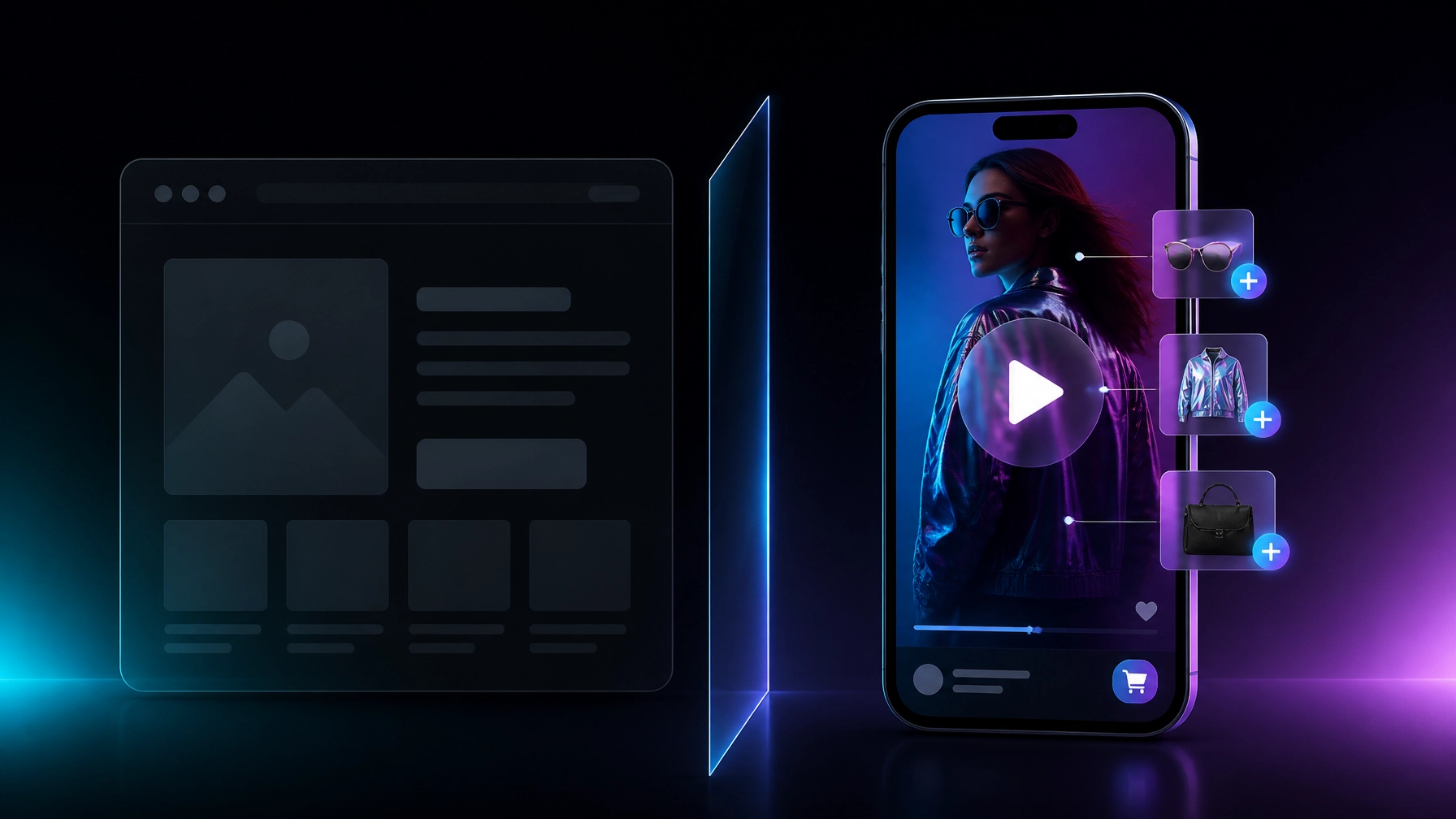
    Comparison of static product images versus dynamic shoppable video highlighting conversion and engagement

    The Rise of Shoppable Video: The High-Conversion Disruptor

    Shoppable video is no longer an experiment; it is the new standard for D2C brands that want to compete with social commerce giants. By embedding interactive hotspots directly into video content, you turn a passive viewer into an active shopper.

    Pros of Shoppable Video:

    • Bridging the Sensory Gap: Video allows customers to see the fit, flow, and texture of a garment. It reduces the "fear of the unknown" that often leads to cart abandonment in fashion.
    • Massive Conversion Lifts: Recent 2026 data shows that adding video to landing pages can boost conversion rates by up to 80%. For fashion brands specifically, site-wide conversion lifts of 17% to 33% are common when switching from static to video-first experiences.
    • Mobile-First Native: Since 80% of fashion traffic is now mobile, the vertical video format feels native to how your customers already consume content on social apps.

    Cons of Shoppable Video:

    • Performance Tax: High-quality video can slow down your site if not implemented correctly through agile Shopify apps or custom CDNs.
    • Production Costs: Creating high-quality video for every SKU in your catalog is more expensive and time-consuming than a traditional photoshoot.

    Close-up of fabric showing the difference between static and dynamic video representation

    The Decision Matrix: When to Use Which?

    You don't have to choose one or the other for your entire site. The smartest fashion brands use a layered approach based on the product type and placement.

    Product Category Best Format Why?
    Core Basics (Tees, Socks) Static Low complexity; customers already know what to expect.
    High-Fashion / Occasion Wear Shoppable Video Movement and drape are essential for the buying decision.
    Jewelry & Accessories Static + Video Micro-loops High-res stills for detail; short loops for "sparkle."
    Campaign / New Drops Shoppable Video Storytelling is required to justify the hype and premium price.
    Clearance / Sale Section Static Speed and price sensitivity are the main drivers here.

    Speed vs. Story: Solving the Mobile Performance Dilemma

    The biggest hurdle for shoppable video is page speed. At Thriftizer, we approach this with our "Amazon of Shopify Services" mindset: we look for the fastest, most agile solution possible.

    Pro Tip: Don't host your own video files. Use specialized Shopify video apps that serve content via ultra-fast CDNs and use "facade" loading. This means the video only starts loading after the initial page layout is visible to the user.

    Mobile Considerations:

    1. The Thumb Zone: Ensure the "Shop the Look" buttons in your video are within easy reach of a thumb on a mobile screen.
    2. Muted Autoplay: Always start videos on mute with clear captions or "Tap for Sound" icons.
    3. Low Latency: If a video takes more than 2 seconds to buffer on a 5G connection, your shopper is gone.

    Mobile optimization graphic showing a fast-loading shoppable video on a smartphone

    Why Thriftizer is Your Growth Co-Pilot

    Most agencies take weeks to plan a transition from static to shoppable video. We aren't most agencies. We are built for speed and impact.

    We’ve seen fashion brands struggle with "analysis paralysis." You spend months debating a feature while your competitors are already scaling. Our 4-hour onboarding is designed to cut through the noise. We get into your Shopify backend, identify the low-hanging fruit, and start optimizing your conversion funnel before your first coffee break is over.

    Never ever think of giving up on your brand's growth just because the tech feels complicated. Start small, stay creative, and focus on the metrics that matter.

    Your Shoppable Video Implementation Checklist

    Ready to make the jump? Here is your step-by-step roadmap to integrating video without killing your site speed:

    1. Identify Hero Products: Choose your top 5 best-selling apparel items that rely on "fit" or "movement."
    2. Shoot for Mobile: Record 15-30 second vertical clips. Focus on texture, walk-ups, and 360-degree views.
    3. Select a Fast Video App: Choose a tool that supports Shopify's "Online Store 2.0" and offers lazy-loading features.
    4. A/B Test the PDP: Run a split test. Show half your visitors the static page and half the shoppable video page.
    5. Monitor Core Web Vitals: Ensure your LCP (Largest Contentful Paint) stays under 2.5 seconds.
    6. Analyze Add-to-Cart Rates: If video isn't moving the needle on ATCs, refine your "Shop the Look" CTA placement.

    Stop Waiting, Start Scaling

    The gap between "looking" and "buying" is closing. If you’re a fashion or beauty brand looking to outpace the competition with disruptive speed and high-converting design, we’re here to help.

    Whether you need a full store redesign or a surgical conversion rate optimization, Thriftizer delivers at a pace traditional agencies can't touch. Check out our Shopify Expert profile to see how we've helped brands like yours turn browsers into believers.

    Next Steps: Identify your top 3 products that are "hard to explain" with just a photo. That’s where your shoppable video journey begins.

  • One-Page vs Multi-Step Checkout: Which Is Better for Your Fashion Store?

    One-Page vs Multi-Step Checkout: Which Is Better for Your Fashion Store?

    In the world of high-stakes D2C fashion, every second counts. You’ve spent thousands on influencer campaigns, perfected your product photography, and dialed in your SEO. But then, the momentum hits a brick wall: the checkout page.

    For years, the industry was obsessed with "One-Page Checkout" as the ultimate holy grail. The logic was simple: fewer clicks equals more sales. But as we move deeper into 2026, the data is telling a much more nuanced story. At Thriftizer, where we operate as the "Amazon of Shopify Services," we’ve seen that what works for a $20 basic tee doesn’t necessarily work for a $400 premium leather jacket.

    If you’re still using a "one-size-fits-all" approach to your checkout, you’re likely leaving money on the table. Let's break down the real-world performance of One-Page vs. Multi-Step checkouts for fashion brands.

    The 2026 Reality Check: What the Data Says

    Recent Shopify data reveals a surprising shift. While one-page checkouts are generally hailed for their speed, multi-step checkouts actually win in some of the most critical scenarios for fashion brands.

    • First-Time Buyers: Multi-step checkouts win 58% of the time with new customers. Why? Because a structured process builds trust.
    • Mobile Users: Contrary to popular belief, multi-step layouts often perform better on mobile (winning 62% of tests) because they prevent "scroll fatigue" and keep form fields manageable.
    • High-AOV Stores ($150+): When customers spend more, they want a "considered" experience. Multi-step wins 51% of the time here.
    • Returning Customers: This is where One-Page shines, winning 49% of tests by offering the frictionless "Buy Now" experience repeat fans crave.

    Infographic comparing One-Page and Multi-Step checkout performance across AOV and device type

    One-Page Checkout: The "Speed Demon"

    The Pros

    • Reduced Friction: Ideal for low-AOV items (<$75) and impulse buys.
    • Repeat-Friendly: When combined with Shop Pay, it’s the fastest way to get a returning customer to "Order Confirmed."
    • Higher Completion on Desktop: Data shows one-page checkouts often outperform on desktop where the layout doesn't feel cramped.

    The Cons

    • Visual Clutter: On mobile, one-page can feel like a never-ending wall of forms.
    • Intimidating for New Users: Seeing address, shipping, and payment all at once can feel overwhelming for someone who hasn't bought from you before.

    Multi-Step Checkout: The "Trust Builder"

    The Pros

    • Better Mobile UX: Breaking the process into "Information," "Shipping," and "Payment" makes the forms feel shorter and easier to fill on a thumb-driven device.
    • Trust and Clarity: Each step acts as a micro-commitment. For premium fashion brands, this confirms the customer’s choices (size, color, shipping speed) before they hand over their credit card.
    • Higher AOV Performance: For luxury or "complete look" bundles, the step-by-step approach reduces buyer’s remorse and anxiety.

    The Cons

    • Click Fatigue: If your steps aren't optimized, every "Continue" button is a potential exit point.
    • Slower Perception: Even if the actual time taken is similar, more pages feel slower.

    The Fashion Brand’s Decision Matrix

    Stop guessing and start segmenting. At Thriftizer, we don't believe in slow, month-long audits. We believe in Speed as a Feature. Here is how you should decide today:

    Scenario Recommended Format
    New Customer / First Purchase Multi-Step
    Loyal / Returning VIP One-Page
    Mobile Traffic (>70%) Multi-Step (or highly optimized One-Page)
    AOV < $75 One-Page
    AOV > $150 (Premium/Luxury) Multi-Step

    Pro Tip: The Hybrid Strategy

    The most successful Shopify brands in 2026 are using Hybrid Routing. They use a multi-step checkout for mobile users and first-time visitors to maximize trust, while serving a lightning-fast one-page checkout to returning customers on desktop.

    A high-performance mobile checkout interface highlighting speed and sleek design

    Why Most Checkouts Fail (Regardless of Format)

    It’s rarely just about the number of pages. Your checkout is likely bleeding revenue because of these "Friction Points":

    1. Forced Account Creation: Never ever force a new customer to create an account before buying. Guest checkout is mandatory.
    2. Lack of Trust Signals: Fashion is personal. If your return policy, size guarantee, and secure payment icons aren't visible at the bottom of every step, you're losing sales.
    3. Slow Load Times: If your checkout takes more than 2 seconds to load a step, you're dead in the water.

    Speed is a Feature: The Thriftizer Differentiator

    Most agencies take weeks to analyze your checkout. We don't. We operate with a "Disruptive Speed" philosophy. Our 4-Hour Onboarding means we go from "Hello" to "Optimizing Your Store" in less than a half-day.

    We don't just follow trends; we set them. Whether it’s implementing Shopify Checkout Extensibility or setting up advanced A/B tests for your apparel brand, we focus on high-impact, high-agility execution.

    Abstract representation of Thriftizer's 4-hour onboarding and disruptive speed philosophy

    Next Steps: Your 5-Step Checkout Audit

    Ready to stop the abandonment? Follow this checklist to overhaul your fashion store's checkout today:

    1. Identify Your Split: Check your analytics. Is your traffic >70% mobile? If yes, start testing a multi-step layout.
    2. Verify AOV Tiers: If your average order is over $150, ensure you have robust trust signals (reviews, return policy) clearly visible in the checkout sidebar.
    3. Enable Accelerated Wallets: Shop Pay, Apple Pay, and Google Pay should be at the top of your checkout. They bypass the "One-Page vs Multi-Step" debate entirely.
    4. Reduce Form Fields: If you don't need a phone number or a second address line to ship a dress, remove them. Every field is a hurdle.
    5. Run a Split Test: Use Shopify's native tools or a partner like Thriftizer to run a 50/50 test between One-Page and Multi-Step for 14 days.

    A numbered checklist graphic representing the 5-step optimization process

    Start small, stay creative. Your checkout shouldn't be a barrier: it should be the grand finale of your brand experience.

    Scale Your Brand with Thriftizer

    Need to move faster? We’re a team of strategists and developers driven by a shared purpose: to help brands grow with impact. From building powerful brand identities to delivering high-converting digital experiences, we are the agile partner your D2C brand needs.

    Explore Thriftizer Services | View our Shopify Expert Profile